


The government has approved a Tk 2,910-crore project to expand electricity distribution networks in Bangladesh’s three hill districts, aiming to improve power access and strengthen infrastructure in remote and hilly areas.
The project is part of 13 development schemes involving a combined Tk 15,823.57 crore approved by the Executive Committee of the National Economic Council (ECNEC) on Tuesday.
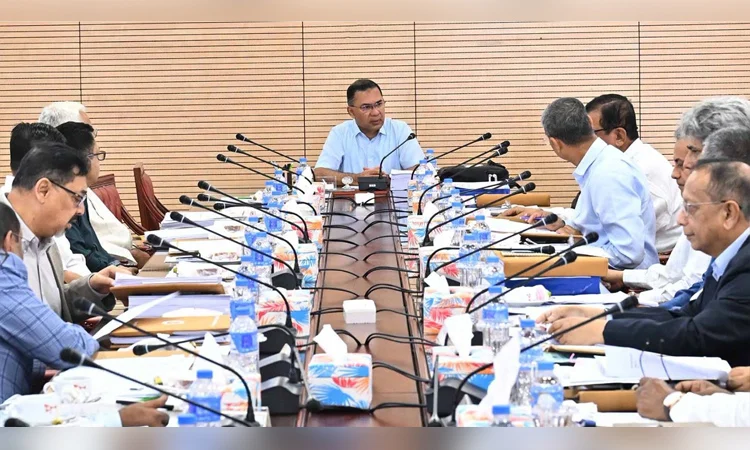
The approvals came at the fourth ECNEC meeting of the current fiscal year, chaired by ECNEC Chairman and Prime Minister Tarique Rahman at the Bangladesh Secretariat.
The electricity network expansion scheme will be implemented by the Bangladesh Power Development Board (BPDB) from July 2026 to June 2031.
Of the total cost, Tk 444.31 crore will come from government funds, Tk 2,098.40 crore from project loans and Tk 367.52 crore from the implementing agency’s own resources.
The project will expand electricity distribution infrastructure in Rangamati, Khagrachhari and Bandarban, with a focus on improving access to power and strengthening networks in remote locations.
The move comes as improved electricity connectivity remains a key requirement for expanding economic activity and public services in the country’s geographically challenging hill areas.
Major road and health investments
The largest allocation among the approved projects—Tk 4,949.76 crore—will go to widening and strengthening important upazila and union roads in Rangpur Division.
The Local Government Engineering Department (LGED) will implement the project from July 2026 to June 2030 with government funding.
The ECNEC also approved the Tk 4,039.06-crore Integrated Health System Response to Fight TB, HIV/AIDS and Malaria in Bangladesh project.
Of the total, Tk 3,168.89 crore will come from government resources and Tk 870.18 crore from project grants or loans. The project will run until June 2029.
Another major approval was the Tk 1,276.30-crore Financial Sector Support Project-II (FSSP-II), to be implemented by Bangladesh Bank from July 2026 to June 2031.
The project will receive Tk 1,261.54 crore in project loans and Tk 14.76 crore from Bangladesh Bank’s own funds.
Shahjalal airport cost revised
The ECNEC approved the third revised Hazrat Shahjalal International Airport Expansion Project (Phase 1), raising its total cost to Tk 22,213.09 crore.
The revised estimate is Tk 847.57 crore higher than the previous cost. The project is scheduled for completion by June 2027.
The committee also approved Tk 21.14 crore for acquiring land for a solar power plant at Sonagazi in Feni. The Electricity Generation Company of Bangladesh (EGCB) will implement the project from July 2026 to June 2028.
Flood control, river protection
Two major water-resource projects were also approved.
A Tk 751.77-crore scheme will focus on integrated flood and river management and drainage improvement in the Small Feni and Bamni river basins, including construction of the Musapur Regulator.
Another Tk 605.24-crore project will protect Shibpur, Dhaniya and Medua areas under Bhola Sadar and Daulatkhan upazilas from erosion by the Meghna River.
The ECNEC approved Tk 308.30 crore to expand existing physical disability training centres in Chattogram, Khulna and Rajshahi divisions and strengthen the capacity of the Neuro-Developmental Disabled Children’s Institute at Rofabad in Chattogram.
The project also includes construction of a hostel building.
A Tk 505.32-crore revised project for conducting digital land surveys in three city corporations, one municipality and two rural upazilas was also approved.
The committee approved a revised project to strengthen the technical and technological capacity of the Special Response Battalion, with its total cost reduced by Tk 8.99 crore to Tk 343.24 crore.
The third revised Rural Infrastructure Development Project covering Madaripur, Shariatpur and Rajbari was approved at a revised cost of Tk 2,515.27 crore, up Tk 3.25 crore.
The ECNEC also extended the implementation period of the Patuakhali Medical College and Hospital project, whose revised cost stands at Tk 651.01 crore.
Of the 13 approved projects, eight are new schemes, three are revised projects and two involve extensions of implementation periods without cost revisions.
15 smaller projects
The ECNEC was also informed about 15 development projects costing less than Tk 50 crore each that had previously been approved by the Planning Minister.
The projects cover education, power, agriculture, water management, transport and urban services.
They include infrastructure development at Bangladesh International School and College, Nirjhor; improvement of education quality and teaching capacity at BAF Shaheen College, Kurmitola; and infrastructure development at Alikadam Cantonment Public School and College.
Other projects include establishing government primary schools in Dhaka city and Purbachal, setting up BSTI regional offices in 10 districts, and developing the Mirpur UCEP-Labour and Employment Institute.
The list also includes the Rupsha 800MW Combined Cycle Power Plant, the Climate-Smart Agriculture and Water Management project, and flood-control and river-bank protection schemes along the Dharla and Kushiyara rivers.
Projects for improving civic services, roads and drainage in Mymensingh City Corporation, as well as safe water supply and sanitation in several municipalities, were also included.
BSS Added: Prime Minister Tarique Rahman has directed the authorities to significantly reduce consultancy costs in Development Project Proposals (DPPs) and ensure strict accountability for delays in project implementation without logical justification.
State Minister for Planning Zonayed Abdur Rahim Saki disclosed this while briefing journalists at the NEC conference room in the city after the Executive Committee of the National Economic Council (ECNEC) meeting held at the Bangladesh Secretariat with ECNEC Chairman and Prime Minister Tarique Rahman in the chair.
The Prime Minister directed that consultancy expenses included in DPPs should be scrutinised and reduced significantly across development projects, said the State Minister.
“The Prime Minister also stressed that project timelines should not be extended without valid and logical grounds. If a project deadline is extended without proper justification, the officials and executing agencies responsible for the delay will be held accountable,” Saki said.
The state minister said executing agencies would now have to provide clear explanations for seeking extensions, which would be subject to rigorous scrutiny.
The government is giving the highest priority to ensuring that ongoing and new development projects are implemented within their approved timeframes and budgets, he added.
The State Minister said the Prime Minister also emphasised the need to rethink the existing practice of conducting feasibility studies merely as an administrative formality.
“Feasibility studies have to be conducted with adequate depth and technical accuracy so that design changes, cost escalation and implementation complications can be avoided later,” he said.
Regarding procedural anomalies in the development project for Jashore, Saidpur and Shah Makhdum airports, the Prime Minister ordered a formal investigation.
Saki said budget adjustments made by the Cabinet Committee on Government Purchase (CCGP) in 2023 were not reflected in the Development Project Proposal in a timely manner, prompting the Prime Minister to order an investigation into the matter.
The Implementation Monitoring and Evaluation Division (IMED) has already submitted investigation reports on eight projects to the Prime Minister, while reports on four more projects will be submitted shortly, he said.
The reports are being forwarded to the respective ministries and divisions for taking necessary corrective measures, according to the State Minister.
Highlighting the government’s efforts to reduce regional disparities, Saki said a Tk 1,600-crore rural infrastructure project is being implemented in Rangpur Division to construct roads, culverts and bridges in rural areas.
He said the project is aimed at improving rural connectivity and addressing regional economic disparities.
The government is also working to integrate eight major automation initiatives under a high-level committee to strengthen digital governance and financial oversight, said the State Minister.
The initiatives include automation systems involving the National Board of Revenue (NBR), Comptroller and Auditor General (CAG), Integrated Budget and Accounting System (iBAS++), Bangladesh Bank and the “One Citizen, One Number, One Wallet” initiative.
He said the integration would help ensure interoperability among digital systems, reduce human intervention in the distribution of social safety-net benefits and strengthen digital monitoring of the banking sector.
The initiative is also expected to help strengthen oversight to prevent non-performing loans (NPLs) and financial irregularities, he added.