


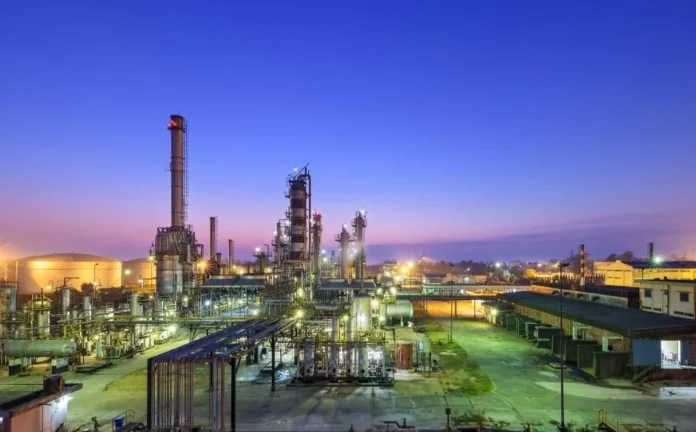
Bangladesh Petroleum Corporation (BPC) plans to build a Tk168.84 crore eco-friendly office complex in Chattogram to relocate Eastern Refinery Limited (ERL) staff and clear land for a new refinery under a major expansion project.
However, the Planning Commission has raised questions over the proposed building’s size, construction costs, implementation timeline, environmental clearance and economic viability ahead of a Project Evaluation Committee (PEC) meeting scheduled for Thursday.
The proposed office complex is intended to facilitate the long-delayed expansion of ERL, as its existing administrative buildings, canteen, mosque and engineering offices occupy land earmarked for the new refinery.
The project, titled ‘Modernisation of ERL through Construction of Eco-Friendly Office Building Complex’, will be implemented by BPC under the Energy and Mineral Resources Division at Uttar Patenga in Chattogram.
The Tk168.84 crore project will be financed entirely from BPC and ERL’s own funds, without government budgetary support or foreign financing.
It is scheduled for implementation between May 2026 and October 2028 and has been included in the list of new, unapproved projects under the Annual Development Programme for FY2026-27.
“The project will facilitate the long-delayed ERL expansion. The proposed complex will include a nine-storey administrative building covering about 17,975 square metres, along with a separate canteen and mosque,” said Khan Muhammad Golam Rabbani, deputy chief of the Planning Commission’s Industry and Energy Division.
Other facilities will include water supply and sanitation, fire protection, gas connections, lifts, central air-conditioning, building management and security systems, parking facilities and approach roads, he added.
Clearing the way for refinery expansion
ERL, which began operations on 1 May, 1968, has an annual crude oil processing capacity of 1.5 million tonnes and meets about 20% of Bangladesh’s petroleum product demand. The remaining demand is met through imports.
BPC and ERL plan to establish a new refinery with an annual processing capacity of 3 million tonnes to increase domestic refining capacity.
French engineering firm Technip has completed the front-end engineering design (FEED) for the expansion, while the development project proposal for the main project has been approved, according to project documents.
However, the proposed refinery’s process plants will be built on land currently occupied by ERL’s administrative and support facilities.
These structures must be demolished before construction can begin, making the relocation of offices and staff essential for the expansion.
According to project documents, construction of the replacement office complex will take at least two and a half years, while the main refinery project’s engineering, procurement and construction schedule allows only about 18 months before the first batches of equipment arrive.
Building the office complex alongside the refinery expansion could therefore delay site clearance and equipment installation, affecting the overall project timeline.
BPC wants to complete the relocation and clear the site before equipment for the new refinery arrives.
Questions over building size and costs
The Planning Commission has sought several clarifications from BPC ahead of Thursday’s PEC meeting.
One major concern is the proposed building’s size. Although the project provides for around 632 workstations, the proposal does not specify how many employees will use the complex.
An earlier scrutiny committee had considered an eight-storey building covering approximately 15,978 square metres.
However, the revised proposal provides for a nine-storey building covering about 17,975 square metres, without any record of a subsequent meeting approving the expansion.
The Commission has sought justification for the additional floor space.
It has also questioned BPC’s plan to combine civil, electrical, air-conditioning, lift, fire safety and other works into a single Tk 149.08 crore procurement package, warning that such an arrangement could limit competition among contractors.
The Commission has asked BPC to compare the proposed construction cost per square metre with that of similar government buildings, noting that the comparison table in the project proposal lacks supporting data.
It has also sought explanations for the proposed expenditure on electrical equipment, lifts, air-conditioning, consultancy services and architectural design.
Implementation timeline and environmental clearance
The Planning Commission has suggested shifting the implementation period to November 2026–April 2029 from the originally proposed May 2026–October 2028, considering the revised schedule more realistic.
Environmental clearance has also emerged as a concern.
The project proposal states that a separate environmental impact assessment is unnecessary because ERL Unit-2 has already received clearance.
However, an Environment Ministry representative told an earlier departmental meeting that fresh environmental clearance would be required for the proposed office complex.
The Commission has also asked whether the building design complies with the Bangladesh National Building Code 2020 and whether its nine-storey height requires clearance from civil aviation authorities and the Fire Service.
Economic viability under scrutiny
The Planning Commission has raised questions over discrepancies between the internal rates of return reported in the project proposal and feasibility study, although the two documents show almost identical benefit-cost ratios.
It also observed that the project’s economic analysis appeared to replicate the financial analysis without making separate adjustments.
Other concerns include the absence of a clear operation and maintenance plan, a lack of an exit plan and missing Finance Division clearance for using corporate funds.
The Commission also identified inconsistencies in basic project information, including differences in the total floor area mentioned in various sections of the proposal.
BPC will have to address these issues during the project evaluation process before the proposal can be considered for approval by the Executive Committee of the National Economic Council (Ecnec).