


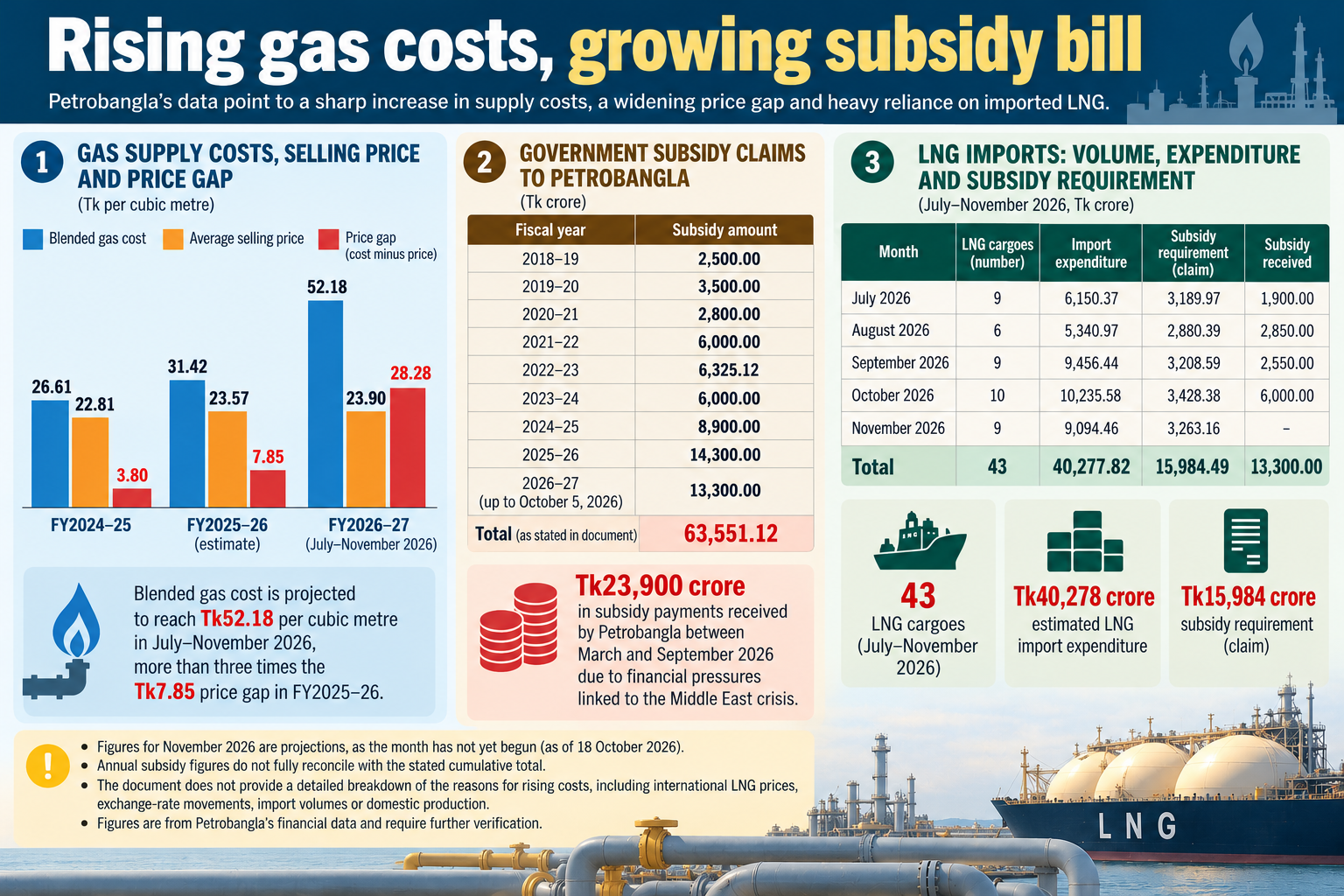
Gas sector is facing mounting financial pressure as the cost of supplying gas is projected to rise sharply while regulated selling prices remain largely unchanged, widening the gap that must be covered through government support.
According to Petrobangla’s financial data, the blended cost of gas is projected to reach Tk52.18 per cubic metre during July-November 2026, against an average selling price of Tk23.90, leaving a gap of Tk28.28 per cubic metre.
The projected shortfall is more than three times the Tk7.85 per cubic metre recorded in the 2025-26 fiscal year (FY26), highlighting the growing financial burden of supplying gas at regulated prices.
The figures also show that Petrobangla has reported cumulative subsidy claims of Tk63,551.12 crore since FY19, while LNG import expenditure is estimated at around Tk40,278 crore for July-November 2026.
During the five-month period, Petrobangla’s financial statement lists 43 LNG cargoes and subsidy claims of approximately Tk15,984 crore, underscoring the scale of financial support required to maintain gas supplies.
However, some figures in the statement require reconciliation, while the November data relate to a future period and should be treated as projections rather than completed transactions.
Gas supply costs surge
Petrobangla’s data show that the blended cost of gas stood at Tk26.61 per cubic metre in FY25, compared with an average selling price of Tk22.81.
In FY26, the blended cost rose to Tk31.42 per cubic metre, while the average selling price increased marginally to Tk23.57, leaving a gap of Tk7.85.
For July-November 2026, the blended cost is projected to climb further to Tk52.18 per cubic metre, while the average selling price is estimated at Tk23.90.
This would widen the difference between costs and selling prices to Tk28.28 per cubic metre, compared with Tk7.85 in the previous fiscal year.
The projected blended cost represents an increase of about 66% over FY26, while the average selling price would rise by only around 1.4%.
At these rates, Petrobangla would recover only about 46% of its gas supply costs through sales revenue, leaving the remaining 54% to be covered through subsidies or other financial arrangements.
The widening gap reflects the growing challenge of maintaining affordable gas prices while meeting the higher cost of procurement, particularly imported LNG.
However, the statement does not provide a detailed breakdown of how much of the projected cost increase is attributable to international LNG prices, exchange-rate movements, import volumes or changes in domestic gas production.
Subsidy claims mount
Petrobangla’s financial statement reports cumulative subsidy claims of Tk63,551.12 crore over the period beginning in FY19 and extending into FY27.
The annual figures indicate a substantial increase in subsidy requirements in recent years.
The statement lists Tk2,500 crore for FY19, Tk3,500 crore for FY20 and Tk2,800 crore for FY21.
The amounts subsequently increased to Tk6,000 crore in FY22 and Tk6,325.12 crore in FY23.
For FY24, the statement records Tk6,000 crore, followed by Tk8,900 crore in FY25 and Tk14,300 crore in FY26.
A further Tk13,300 crore is listed for FY27 up to 5 October, 2026.
However, the individual annual figures do not fully reconcile with the cumulative total stated in the document, requiring clarification of the accounting basis and any adjustments.
The statement also says Petrobangla received Tk23,900 crore in government subsidy payments between March and September 2026 amid financial pressures associated with the Middle East crisis.
These payments should be distinguished from subsidy claims, which represent amounts sought from the government and may not have been fully settled.
The data do not clearly establish how much of the cumulative subsidy requirement remains unpaid.
Nevertheless, the figures highlight the growing financial support needed to sustain gas supplies at prices below procurement costs.
LNG import bill estimated at Tk40,278cr
The financial pressure is also evident in Petrobangla’s LNG import estimates for July-November 2026.
According to the statement, the company expects LNG import expenditure of approximately Tk40,278 crore during the five-month period, involving 43 cargoes.
The document lists nine LNG cargoes for July, six for August, nine for September, 10 for October and nine for November.
Monthly LNG-related expenditure is reported at around Tk6,150 crore in July, Tk5,341 crore in August, Tk9,456 crore in September, Tk10,236 crore in October and Tk9,094 crore in November.
The statement also records subsidy claims totalling approximately Tk15,984 crore over the period, with monthly requirements ranging from about Tk2,880 crore to Tk3,428 crore.
Against these requirements, the document lists Tk13,300 crore in subsidy receipts across the reporting period, although the timing and accounting treatment of the payments require clarification.
The figures suggest that LNG procurement continues to place substantial pressure on Petrobangla’s finances, particularly as domestic gas prices remain regulated.
However, the monthly expenditure figures and reported totals do not fully reconcile, and the statement does not clearly distinguish actual expenditure from estimates for the remaining months.
As October is still under way and November has yet to begin, the later figures should be treated as projections pending confirmation.
Bangladesh relies on imported LNG to help bridge the gap between domestic gas production and demand.
This dependence exposes the country to fluctuations in international fuel prices, exchange rates, shipping costs and supply disruptions.
Higher LNG prices can increase the blended cost of gas even when import volumes remain unchanged, while additional purchases can push up total expenditure.
Without a detailed breakdown of prices and volumes, it is difficult to determine the relative contribution of these factors to the projected increase in procurement costs.
Petrobangla Chairman Md Abdul Mannan said the government was committed to ensuring an adequate supply of natural gas despite soaring LNG prices.
Pricing dilemma deepens
The widening difference between supply costs and regulated selling prices presents a growing challenge for Bangladesh’s energy policy.
Maintaining affordable gas prices helps protect households and energy-intensive industries from sudden increases in operating costs.
However, keeping prices substantially below procurement costs increases the need for government support, particularly when international fuel prices rise.
A prolonged subsidy burden could also reduce the government’s fiscal flexibility and place competing demands on resources needed for infrastructure, healthcare, education and social protection.
Passing more of the cost on to consumers could reduce the subsidy requirement but would increase expenses for households, factories and other gas-dependent businesses.
The consequences would depend on the scale and timing of any price adjustments, as well as the availability of targeted support for vulnerable consumers.
Regarding possible price adjustments in response to rising LNG tariffs, Petrobangla Chairman Md Abdul Mannan said the Petrobangla would act in accordance with the government’s decision.