


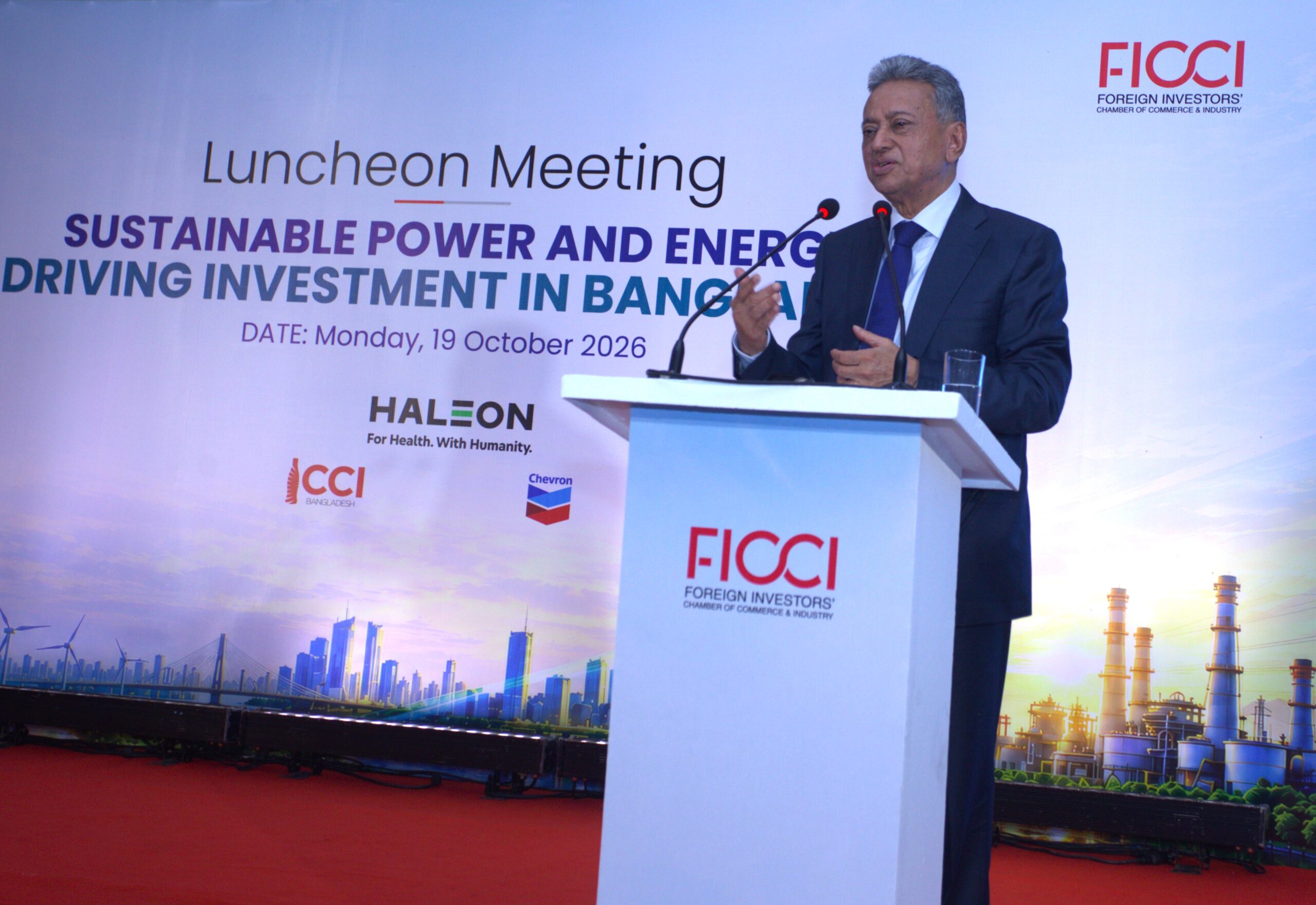
Bangladesh needs at least two years to stabilise its energy sector and the broader economy, with a stronger recovery expected in the third year and a full turnaround in the fourth and fifth years, Finance Minister Amir Khosru Mahmud Chowdhury said on Monday.
The government does not want to raise unrealistic expectations by promising an immediate solution to the country’s economic and energy problems, he said at a discussion on sustainable power and energy for investment in Bangladesh, organised by the Foreign Investors’ Chamber of Commerce and Industry (FICCI) at Hotel InterContinental in Dhaka.
“We need at least two years. Under the government’s plan, the energy sector and the entire economy will be brought to a stable position within the first two years,” the minister said, adding that economic activity would gain momentum in the third year.
His remarks come as businesses grapple with high operating costs, energy shortages and the burden of outstanding liabilities inherited from the previous administration, compounded by the fallout from the war in the Middle East.
The minister said energy and power had moved beyond being standalone sectors to become central to economic activity, particularly since the outbreak of the conflict.
He acknowledged that the cost of doing business in Bangladesh remained high and the country performed poorly in terms of ease of doing business. Excessive regulation had long constrained economic activity, and easing that burden was one of the government’s biggest challenges, he added.
50 gas wells, 10,000MW solar target
To address the energy crisis, the government has approved the drilling of 50 new gas wells through state-owned Bangladesh Petroleum Exploration and Production Company Ltd (Bapex), the minister said.
The government is also finalising production-sharing contracts to accelerate exploration for domestic gas in both onshore and offshore areas.
Bangladesh has neglected exploration of its own gas resources for around one to one-and-a-half decades, he said, making domestic exploration a key priority.
Alongside gas exploration, the government has set a target of generating at least 10,000 megawatts of solar power. It has also granted tax exemptions on solar power infrastructure to encourage investment in renewable energy.
The minister’s remarks signal a push to expand domestic energy supplies and diversify the power mix, although the two-year stabilisation timeline suggests that businesses may have to contend with the existing constraints for some time.
NBR restructuring, banking recovery
The government is also moving to ease regulatory barriers and reform tax administration, with the National Board of Revenue (NBR) being split into two separate entities—one responsible for policymaking and the other for implementation.
Despite resistance, the government has taken the decision, the minister said, describing excessive regulation as a major obstacle to business.
On the financial sector, he said the banking industry and capital market had suffered a severe setback following the alleged outflow of around $235 billion from the country.
The banking sector was now recovering, while the capital market was showing positive signs, he said. However, he warned that the country had already faced an additional outflow of $7 billion, with the potential for further pressure remaining uncertain.
The minister also said 16 leading Wall Street investors had attended a recent session with Prime Minister Tarique Rahman in New York, representing funds worth around $36 trillion.
The investors had expressed interest in putting money into Bangladesh’s banking sector, bond market and capital market, he added.
FICCI calls for sustainable energy
The discussion brought together business leaders and energy experts to examine how reliable and sustainable power supplies could help attract investment to Bangladesh.
Panel participants included Chevron Bangladesh President and Managing Director Shu Jong, energy expert and Independent University, Bangladesh Vice-Chancellor M Tamim, Centre for Policy Dialogue Executive Director Nazneen Ahmed, and FBCCI Administrator Fazlul Hoque.
HSBC Bangladesh Chief Executive Officer Mahbub ur Rahman moderated the discussion.
FICCI President Ropali Chowdhury delivered the welcome address, while Shafiqul Alam, Bangladesh and South Asia lead energy analyst at the Institute for Energy Economics and Financial Analysis, presented the keynote paper.
Delivering the keynote, Shafiqul Alam highlighted Bangladesh’s growing energy challenges, driven by declining domestic gas reserves, rising LNG imports, and volatile global fuel prices. He noted that domestic gas reserves could be depleted by 2036 without new discoveries, increasing pressure on power generation costs, industrial competitiveness, and household affordability.
He stressed that expanding domestic gas exploration, reducing gas losses, and accelerating renewable energy adoption are key to reducing import dependence. Rooftop solar, solar irrigation, industrial energy efficiency, and regional hydropower cooperation offer practical opportunities to strengthen energy security.
He also underscored the need for stable policies, green financing, and stronger public-private partnerships to attract investment and support a more reliable, affordable, and sustainable energy sector.
During the panel discussion, the speakers highlighted the need for stronger domestic gas exploration, investment-friendly policies, and a diversified energy mix to ensure energy security and affordability. Shu Xiong stressed the importance of a stable regulatory environment to attract long-term foreign investment, while Prof. Dr. Mohammad Tamim emphasised balancing domestic gas production with renewable energy.
Fazlul Hoque highlighted the impact of energy shortages and rising costs on industrial productivity and investment, calling for greater support for rooftop solar and green financing.
Dr. Nazneen Ahmed underscored the importance of attracting foreign investment while maintaining fiscal sustainability and affordable energy. The panelists collectively called for policy reforms and stronger public-private collaboration to ensure reliable energy supply, enhance industrial competitiveness, and support sustainable economic growth.