


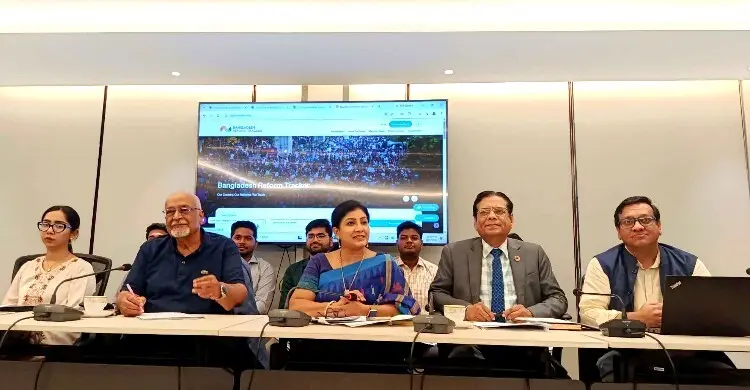
Bangladesh needs to bring its LDC graduation preparations and economic recovery under a coordinated, high-level political framework, as the country faces three major challenges simultaneously over the next three years, economist Debapriya Bhattacharya has said.
He said the government must prepare for graduation from the least developed country (LDC) category, restore macroeconomic stability and revive investment, employment and economic growth without treating them as separate agendas.
Speaking at a media dialogue organised by the Centre for Policy Dialogue (CPD) in Dhaka on Sunday, the CPD distinguished fellow said the tasks would require strong political commitment, coordination among ministries and clear accountability for implementation.
Containing inflation, stabilising the exchange rate, reducing interest rates, raising revenue collection, reforming the banking sector and improving the quality of public expenditure must go hand in hand with efforts to encourage private investment and generate employment, he said.
The three priorities were closely interconnected, and progress in one area would reinforce the others if pursued in a coordinated manner, he added.
The next three years would also be politically significant, as the country would be approaching another national election by the end of the period. This makes the implementation of the economic reform agenda a major responsibility for the political leadership, Debapriya said.
He called for elevating LDC graduation from a largely bureaucratic process to a national political priority, with the reform agenda placed before parliament to build consensus across political parties.
The issue should also be regularly discussed at cabinet meetings, while ministries should be held accountable for delivering on their assigned responsibilities, he said.
PM-led mechanism needed
Debapriya argued that LDC graduation could not be managed by the finance and commerce ministries alone, as the transition involves a wide range of sectors, including energy, technology and shipping.
He proposed establishing a central coordination mechanism under the direct supervision of the prime minister, supported by technical working groups and clearly defined responsibilities for the relevant ministries and officials.
The ERD was assigned responsibility for coordinating graduation preparations in 2018, when the main concern was retaining the trade and financial benefits Bangladesh enjoyed as an LDC after graduation.
But the challenge has since changed, he said. Graduation is now linked to a broader structural transformation of the economy, requiring reforms across multiple sectors.
The ERD, under its existing mandate and institutional capacity, would not be able to coordinate such a wide-ranging process on its own, he said, warning that keeping the responsibility confined within the finance ministry could undermine coordination and slow implementation.
Public monitoring of commitments proposed
The economist also called for publishing a time-bound action plan and setting up a public dashboard to track progress on the government’s commitments to the United Nations.
Such commitments should not remain confined to international forums; people at home should also be able to see what the government has promised and how much it has delivered, he said.
The proposed dashboard should disclose the implementation status of each commitment, the responsible ministry or agency, progress against deadlines and any outstanding tasks.
CPD has identified 23 areas for assessing Bangladesh’s progress on LDC graduation and related reforms, which would be monitored regularly, he said.
He stressed that the government would also need to identify officials responsible for collecting, updating and verifying the information to ensure transparency and accountability.
All-party caucus initiative
Debapriya said an initiative had been taken to form an all-party parliamentary caucus to bring lawmakers from different political parties into discussions on LDC graduation and the associated reform agenda.
The Speaker’s office had already issued a notice on forming the caucus with 10 lawmakers representing different parties, and it was expected to be formally launched soon, he said.
The platform would help build political consensus on the reforms needed to prepare the economy for graduation.
Extension must not become lost opportunity
Welcoming the United Nations’ decision to defer Bangladesh’s LDC graduation by three years, Debapriya said the extension offered the country an important opportunity to strengthen its preparedness.
However, he cautioned that the exceptional extension would also require exceptional performance in fulfilling the commitments made by Bangladesh.
He called for a transparent roadmap showing how the country would gradually move away from the trade and financial preferences it currently enjoys as an LDC.
The next national budget should spell out which benefits would be phased out, the timeline for doing so and which sectors would receive additional support to cope with the transition, he said.
Without coordination among the government’s various plans and programmes, it would be difficult to establish who was responsible for delays or failures in implementation, he warned.
Debapriya urged the government, parliament, private sector, development partners, experts and media to work together to ensure a successful transition.
Bangladesh’s past experience showed that it had often been better at making commitments than delivering on them, he said. The country must avoid repeating that pattern over the next three years, as successful graduation and economic recovery would depend not simply on technical or administrative preparations but on visible and sustained commitment from the political leadership.