


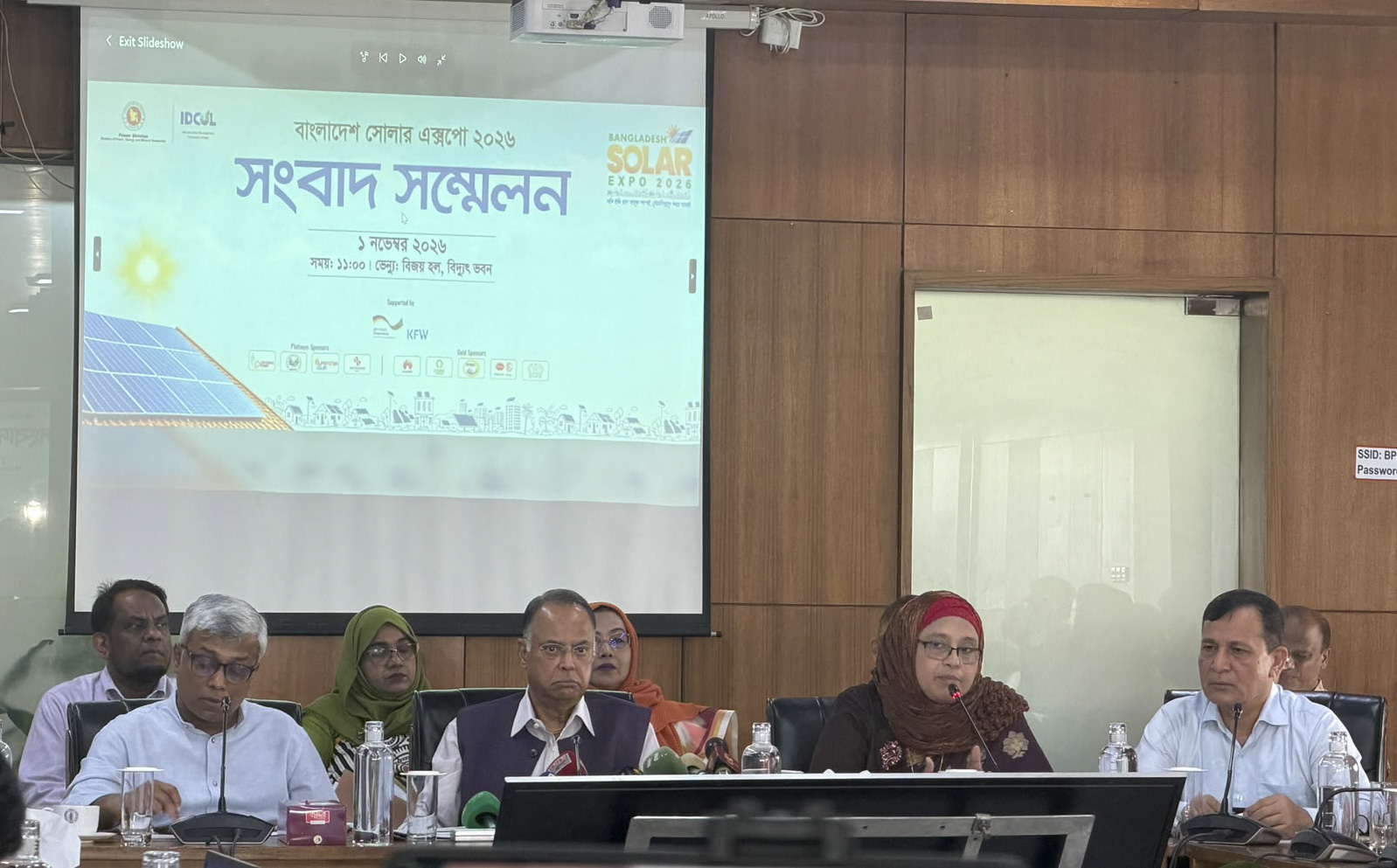
Prime Minister Tarique Rahman is using solar power instead of electricity from the national grid, Power, Energy and Mineral Resources Minister Iqbal Hassan Mahmood has said, urging the public to follow his example by installing rooftop solar panels.
“The prime minister is not taking electricity from the national grid, as he is using solar power,” the minister told reporters at a press conference at Bidyut Bhaban in Dhaka on Sunday.
“We want people to follow the prime minister’s initiative and install solar panels,” he said.
The press conference was held ahead of the country’s first-ever Bangladesh Solar Expo 2026, scheduled for 3–4 November at the Bangladesh-China Friendship Conference Centre in Agargaon, Dhaka.
The two-day event is being jointly organised by the Power Division, the Ministry of Power, Energy and Mineral Resources, and the Infrastructure Development Company Limited (IDCOL), under the theme: “Use Every Inch of Rooftop, Increase Income from Solar Power.”
Prime Minister Tarique Rahman is expected to inaugurate the expo and visit its exhibition stalls.
The minister said the event aimed to encourage greater public participation in solar energy, attract investment and accelerate Bangladesh’s transition towards renewable energy.
“We want to reduce people’s suffering during the coming summer through greater use of solar power,” he said.
Responding to a question, Iqbal said several major countries were facing difficulties in securing energy supplies in the aftermath of the war. The government was working to make electricity more affordable while maintaining a balance between supply and demand, he added.
He accused the previous administration of establishing power plants without securing adequate fuel supplies and failing to drill a single gas well. He also criticised its development approach, alleging that the rhetoric of development had been used to restrict democracy.
State Minister for Power, Energy and Mineral Resources Aninda Islam Amit said the government was working to reduce electricity shortages by 2030 and minimise public suffering during the summer months.
Power Division Secretary Mirana Mahrukh said the government was considering battery storage facilities to preserve surplus electricity generated from different sources.
“The feasibility of storing electricity generated by coal- and gas-fired power plants, including the Sonagazi project, is also being examined,” she said.
She estimated that solar power could be generated at around Tk3–4 per unit without battery storage. With four to six hours of battery backup, the cost could remain below Tk8 per unit.
The government, meanwhile, has announced a special net-metering scheme under which surplus electricity generated by individual solar users will be purchased at Tk10.50 per unit, she said.
Bangladesh Power Development Board (BPDB) chairman Engineer Md Rezaul Karim said an additional 3,000–4,000 megawatts of electricity could be added to the national grid by February next year.
Asked about a recent power disruption, he said its cause had been identified, attributing the incident to trees growing near power grid infrastructure rather than an imbalance between electricity supply and demand.
Policy push for solar investment
The government has introduced a series of policy measures to accelerate solar power deployment and attract private investment.
According to the organisers, the Special Solar Power Ordinance 2026 has been issued to speed up project implementation, remove administrative complications and encourage investment. The National Renewable Energy Development Strategy 2026–2030 has also been adopted to expand renewable energy generation and consumption and strengthen institutional coordination.
Under the net-metering initiative, the government has announced a purchase rate of Tk10.50 per unit for surplus electricity generated by rooftop solar installations.
It is also promoting the operational expenditure (OpEx) model, which allows third-party companies to install solar panels on the rooftops of public and private institutions without requiring the property owners to invest their own capital.
To reduce project costs and encourage investment in solar power and energy storage, import duties on solar and battery-related products have been reduced to 1%, while value-added tax (VAT) has been fully waived, according to the organisers.
The expo will feature specialised exhibition stalls showcasing solar panels, inverters, smart-grid technologies, advanced battery storage systems and other renewable energy equipment.
Financial institutions, project developers and service providers will also present financing options, concessional loans and technical support for solar projects.
Alongside the exhibition, four specialised seminars will examine the policy framework, investment opportunities and strategic development of Bangladesh’s solar sector under the overarching theme “Policy, People and Capital for Bangladesh’s Solar Revolution”.
The sessions will focus on pathways to a national solar revolution, expanding rooftop solar installations in the public sector, strengthening energy security and creating jobs through domestic and industrial rooftop solar, and mobilising private capital and carbon revenue to finance the transition.
Local and international experts, policymakers, financial institutions, technology suppliers, investors and industry representatives are expected to take part. A special orientation session for service providers will also be held.