


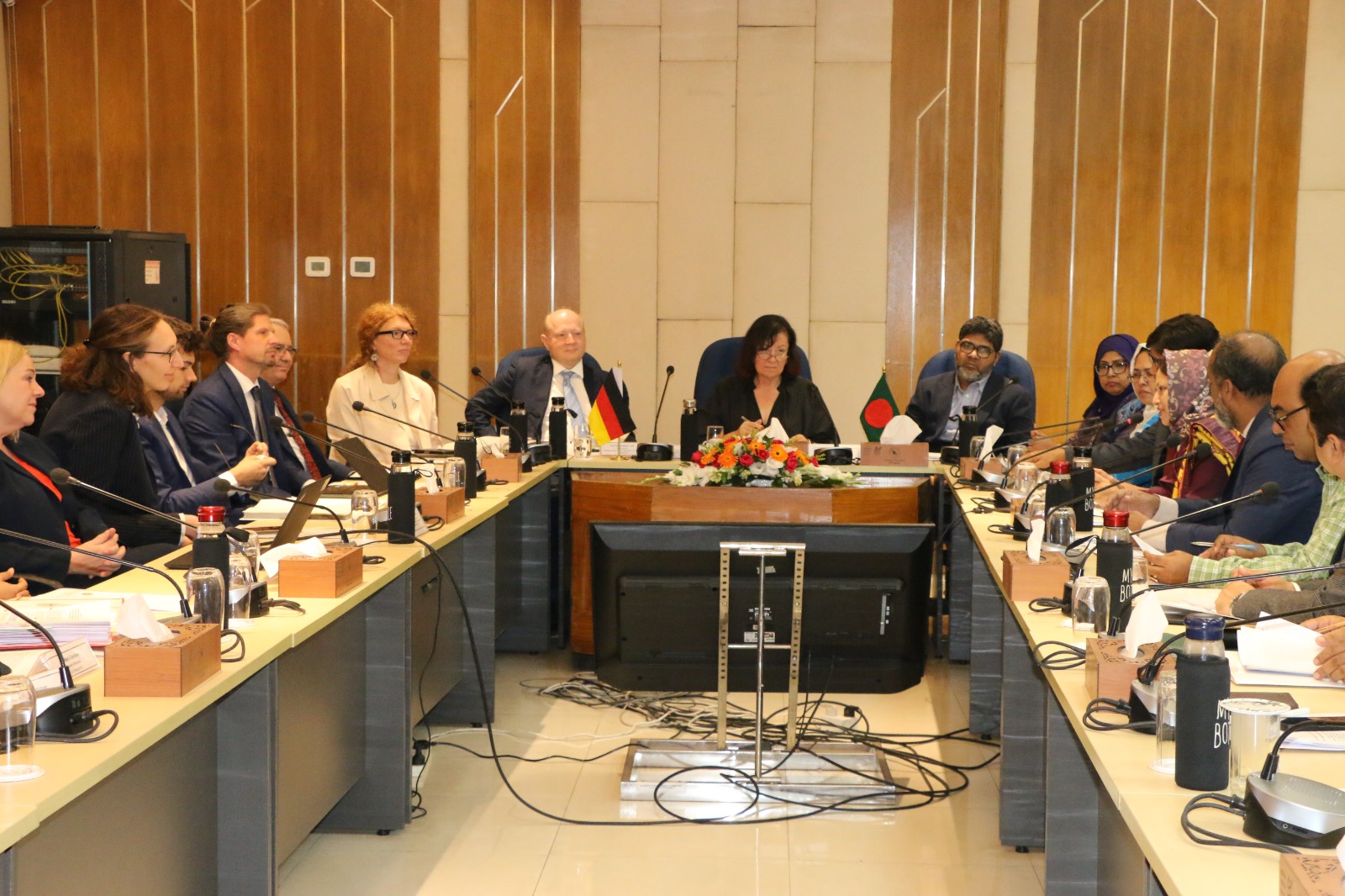
Germany has pledged up to €402 million, equivalent to around Tk5,507 crore, in development cooperation with Bangladesh, with fresh funding focusing on renewable energy, skills development, sustainable urban infrastructure and support for displaced people and host communities.
The commitment was announced following the conclusion of the 2026 bilateral development cooperation negotiations between the two countries on November 18.
Of the total, up to €246 million is new funding for bilateral technical and financial cooperation, while the overall commitment since the previous government-level negotiations in 2024 has reached €402 million, according to a statement issued on Thursday.
The latest pledge brings Germany’s total development commitments to Bangladesh since 1972 to around €3.9 billion.
The funding will support renewable energy and energy efficiency, sustainable urban development, technical and vocational education and training, socially and environmentally responsible supply chains, trade and sustainable infrastructure.
It will also cover biodiversity conservation, support for displaced people and host communities in Cox’s Bazar, and initiatives to help women resolve disputes through sustainable mechanisms.
The negotiations were led by Md Shahriar Kader Siddiky, secretary of the Economic Relations Division (ERD) under the Ministry of Finance, for Bangladesh, and Barbara Schäfer, head of the South Asia division at Germany’s Federal Ministry for Economic Cooperation and Development (BMZ).
The talks were held in a hybrid format on November 18, following an in-person round in Dhaka on October 27. BMZ Vice Minister and Parliamentary State Secretary Bärbel Kofler delivered the opening remarks online.
Shahriar Kader Siddiky appreciated Germany’s nearly 55 years of development partnership with Bangladesh and its contribution to the country’s socioeconomic progress.
He highlighted shared priorities such as poverty reduction, good governance, climate resilience, renewable energy and sustainable development.
Bangladesh also wants to deepen cooperation in renewable energy, energy efficiency, climate-resilient urban infrastructure, skills development and employment generation, he said.
He stressed the need for projects to be implemented efficiently, aligned with national priorities and supported by smoother administrative procedures.
Kofler reaffirmed Germany’s commitment to its longstanding partnership with Bangladesh, highlighting inclusive and sustainable development, good governance, human rights and climate action.
She said Germany was ready to continue supporting Bangladesh’s development priorities, including its preparations for graduation from the least developed country (LDC) category.
She also stressed the importance of using development funds effectively and overcoming administrative bottlenecks to speed up project implementation.