


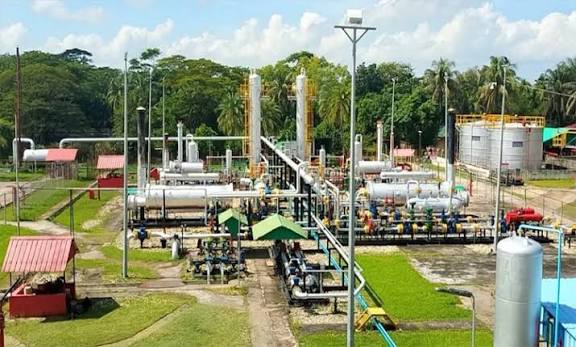
A Tk1,136 crore project to drill three exploratory gas wells has made only 2 percent physical progress in more than a year, with delays in land acquisition, procurement and drilling arrangements holding back implementation.
The project’s drilling schedule is also dependent on the completion of two other wells, raising concerns over whether the three exploratory wells can be drilled within the December 2027 deadline.
The slow progress came to light at a review meeting of the Implementation Monitoring and Evaluation Division (IMED) on October 29, which called for stronger monitoring, better coordination and accelerated implementation to complete the project on time.
Titled ‘Drilling of Three Exploratory Wells (Srikail Deep-1, Mobarakpur Deep-1 and Fenchuganj South-1)’, the project is being implemented by Bangladesh Petroleum Exploration and Production Company Limited (Bapex), under Petrobangla.
Launched on October 1, 2025, the project has an estimated cost of Tk1,136.25 crore, including Tk909 crore in government funding and Tk227.25 crore from Bapex’s own resources. It is scheduled to be completed by December 31, 2027.
According to the project director’s presentation at the meeting, expenditure stood at only Tk11.97 lakh up to September 2026, against an allocation of Tk55 crore in the current fiscal year’s Annual Development Programme (ADP).
The project aims to explore potential gas reserves through drilling at Srikail in Cumilla, Mobarakpur and Fenchuganj in Sylhet division. However, progress has been constrained by several interlinked implementation challenges.
Drilling schedule hinges on other projects
A major complication is the project’s dependence on the completion of drilling at Bapex’s Titas-31 and Bakhrabad-11 wells.
The drilling of Srikail Deep-1 and Mobarakpur Deep-1 will depend on the completion of those two wells, as the same drilling rig and contractor are scheduled to be used for the proposed operations.
This arrangement leaves the project’s drilling schedule vulnerable to delays in the ongoing work.
For drilling Srikail Deep-1 and Mobarakpur Deep-1, Bapex signed a contract with China’s CNPC Chuanqing Drilling Engineering Company Ltd (CCDC) on June 23, 2026.
For Fenchuganj South-1, an international tender was invited on June 30, 2026, and its technical evaluation was underway at the time of the review.
Bapex also signed a consultancy contract with Rich Spread Group Ltd of the British Virgin Islands on October 18, 2026, for supervising the drilling of the Srikail and Mobarakpur wells.
Land and procurement delays
Land acquisition and development have also held back preparatory work at the drilling sites.
According to the project director, land acquisition for Mobarakpur Deep-1 had been completed, along with land development and construction of the access road.
At Srikail Deep-1, the connecting road had been completed, but land development was still underway and the land acquisition process remained incomplete. The project authorities were coordinating with the Cumilla district administration to resolve the outstanding issues.
Procurement of vehicles, computers, office equipment and furniture was also still underway, further slowing project activities.
The meeting was informed that the publication of the Standard Tender Document (PW7) by the Bangladesh Public Procurement Authority (BPPA) on May 26, 2026, under the Public Procurement Rules 2025, had affected the tender process for Fenchuganj South-1.
The project has seven procurement packages — two for works, two for services and three for goods.
IMED directives to speed up work
“To address the implementation bottlenecks, IMED has directed the project authorities to strengthen regular monitoring and take effective measures to ensure timely completion while maintaining the quality of work,” Md Saiful Islam, head of IMED’s Evaluation and Monitoring Sector-03, who chaired the meeting, said.
The implementing agency was asked to follow the Planning Commission’s 2022 guidelines on the formulation, processing, approval and revision of development projects, he added.
The meeting also instructed the project authorities to regularly update project information in the electronic Project Management Information System (e-PMIS), complete internal audits regularly and upload the audit reports to the system.
Besides, regular meetings of the Project Implementation Committee (PIC) and Project Steering Committee (PSC) must be held in line with the relevant guidelines.
The meeting stressed the need for coordination among the agencies concerned to remove existing bottlenecks and accelerate implementation within the stipulated timeframe.