


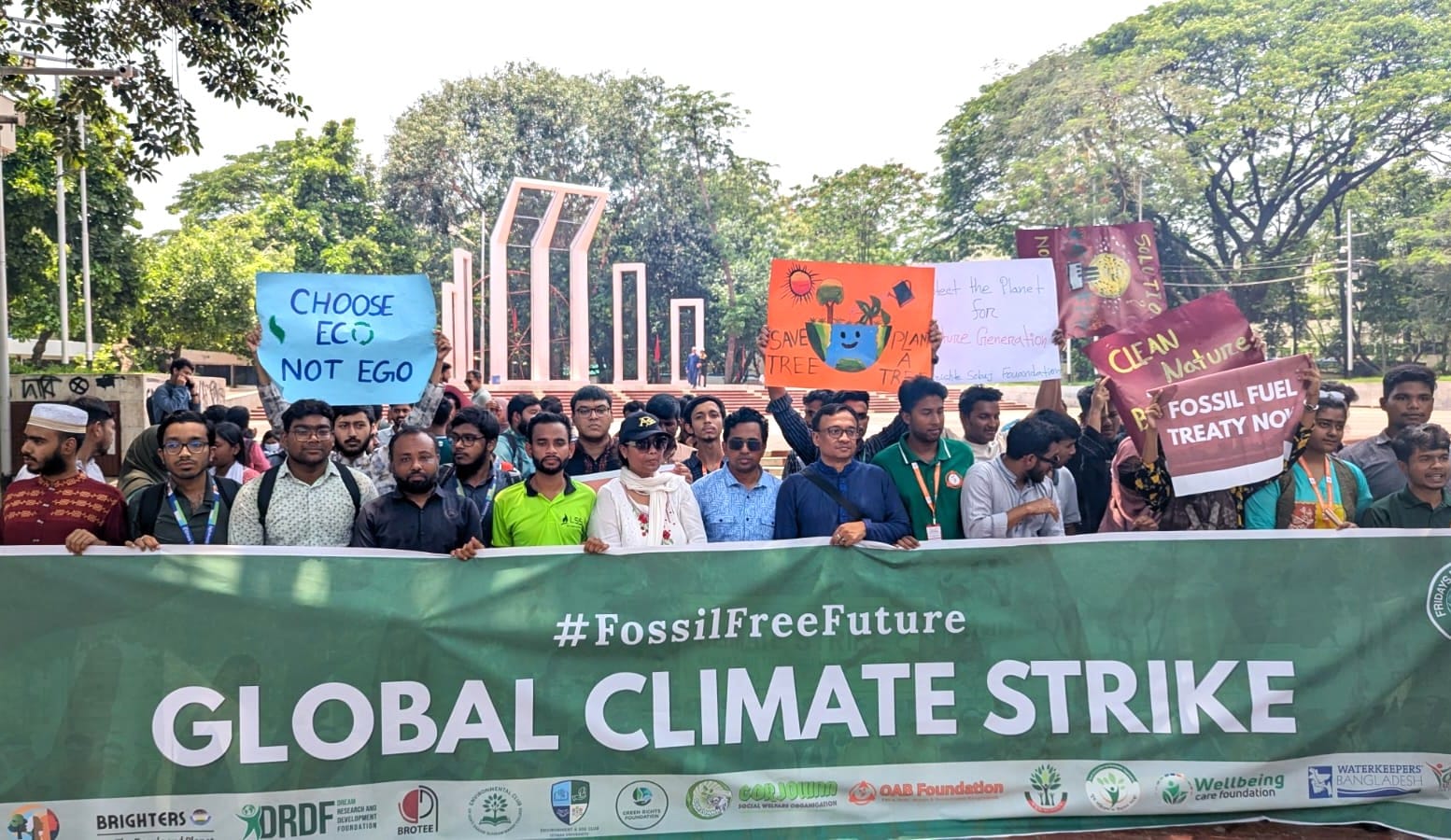
As part of the worldwide climate movement led by young people under the banner of Fridays for Future, a “Global Climate Strike” programme was held today at the National Press Club, demanding a transition towards a fossil fuel-free future.
The event brought together representatives from youth organisations, environmental platforms and civil society groups, who called for an end to fossil fuel dependence, a just transition to renewable energy, and stronger climate action.
Speaking at the programme, Sharif Jamil, member secretary of Dhori Rakshai Amra (DHORA), said the ongoing global energy crisis had once again demonstrated that Bangladesh’s future energy security depended on renewable energy rather than imported coal and gas, which are vulnerable to volatile international markets.
He urged the government to withdraw taxes on solar power equipment and to accelerate solar and wind power projects on coastal land previously acquired for coal-fired power plants. According to him, such measures could help Bangladesh achieve its target of generating 10 gigawatts of electricity from renewable sources.
Mir Mohammad Ali, a teacher at Sher-e-Bangla Agricultural University, said coal-based power projects were destroying agricultural land and polluting rivers and water bodies. He warned that declining fish production was leaving many fishing communities without livelihoods.
Saidur Rahman Siam, Bangladesh coordinator of Fridays for Future and founder and director of Brighters, said instability in global energy markets had exposed the risks of relying on imported fossil fuels.
“The country’s dependence on imported fossil fuels poses a major threat to both energy security and the economy,” he said. “The only sustainable long-term solution to this crisis is a rapid and just transition to renewable energy.”
Speakers at the event also said the climate crisis had become one of the world’s most pressing humanitarian and environmental challenges. They noted that although countries such as Bangladesh contribute very little to global carbon emissions, they remain among the most vulnerable to climate impacts.
Youth representatives said the global climate movement, driven by young people, had grown into a powerful international platform. Bangladeshi youth, they added, continued to raise their voices for climate justice, environmental protection and a sustainable future.
Organisations involved in the programme included Brighters, Waterkeepers Bangladesh and several other environmental and youth groups.
Participants demanded an end to the expansion of fossil fuel projects, increased climate financing, greater investment in renewable energy, and the implementation of environmentally sustainable development policies.