


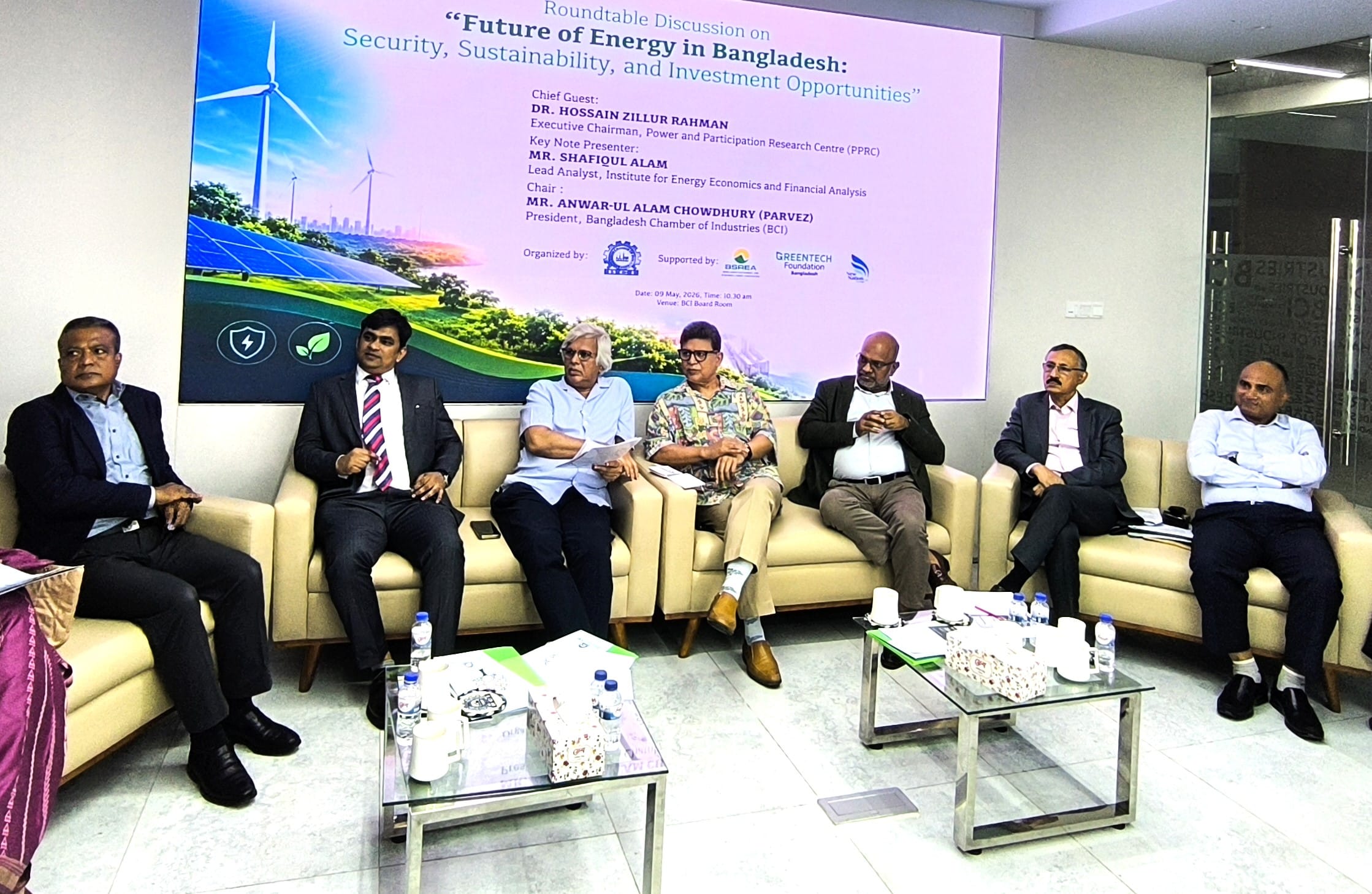
Bangladesh must explore innovative approaches to strengthen its energy security as the country faces rising pressure from declining domestic gas production and growing reliance on imported fuel, speakers at a high-level industry roundtable said on Saturday.
Addressing the discussion as chief guest, Dr Rahman praised the Bangladesh Chamber of Industries (BCI) for convening the event and stressed the need for forward-looking energy policies. He pointed to the potential of land-based floating storage and regasification units (FSRUs), wider adoption of energy-efficient technologies, and expansion of solar power generation to help stabilise the country’s energy supply.
He also called for the creation of a dedicated energy monitoring cell through a public-private partnership framework, arguing that stronger coordination between government and industry would be vital to tackling Bangladesh’s ongoing energy challenges.
The roundtable, titled “Future of Energy in Bangladesh: Security, Sustainability, and Investment Opportunities”, was held at the BCI boardroom in Dhaka and jointly organised by the BCI, the Bangladesh Sustainable and Renewable Energy Association (BSREA), and Greentech Foundation Bangladesh (GTFB).
Economist Hossain Zillur Rahman, executive chairman of the Power and Participation Research Centre (PPRC) and a former adviser to Bangladesh’s caretaker government, attended as chief guest. The session was chaired by BCI President Anwar-ul Alam Chowdhury Parvez, while the keynote paper was presented by Shafiqul Alam, lead analyst at the Institute for Energy Economics.
In his opening remarks, Mr Parvez said Bangladesh’s industrial expansion had historically depended on relatively low-cost gas, energy and labour, but warned that the country could no longer rely on cheap energy following global market disruptions after 2022.
He noted that domestic gas production was falling by around 100 million cubic feet per year, forcing the government to increasingly depend on costly liquefied natural gas (LNG) imports to meet demand.
“Energy security is essential for protecting industry and employment,” Mr Parvez said, urging policymakers and business leaders to adopt a collaborative approach to resolving persistent shortages in gas and electricity supply.
“The government is not separate from us. Just as businesses do not want industries to shut down and jobs to disappear, the government also wants to protect economic activity,” he added.
Mr Parvez also called on private sector stakeholders to provide practical policy recommendations to help secure Bangladesh’s future energy supply and support sustainable industrial growth.
Other speakers included Md Rafiqul Islam, member and additional secretary of the Bangladesh Energy and Power Research Council; Siddique Zobayer, former senior secretary to the Bangladesh government and adviser to Greentech Foundation Bangladesh; David Hasanat, president of BIPPA; Moinul Islam Swapan, president of BCMEA; Enamul Haque Khan, senior vice-president of BGMEA; and Mostafa Al Mahmood, president of BSREA.
Representatives from a range of public and private sector organisations also attended the event, which concluded with a vote of thanks from BCI Senior Vice-President Priti Chakraborty.