


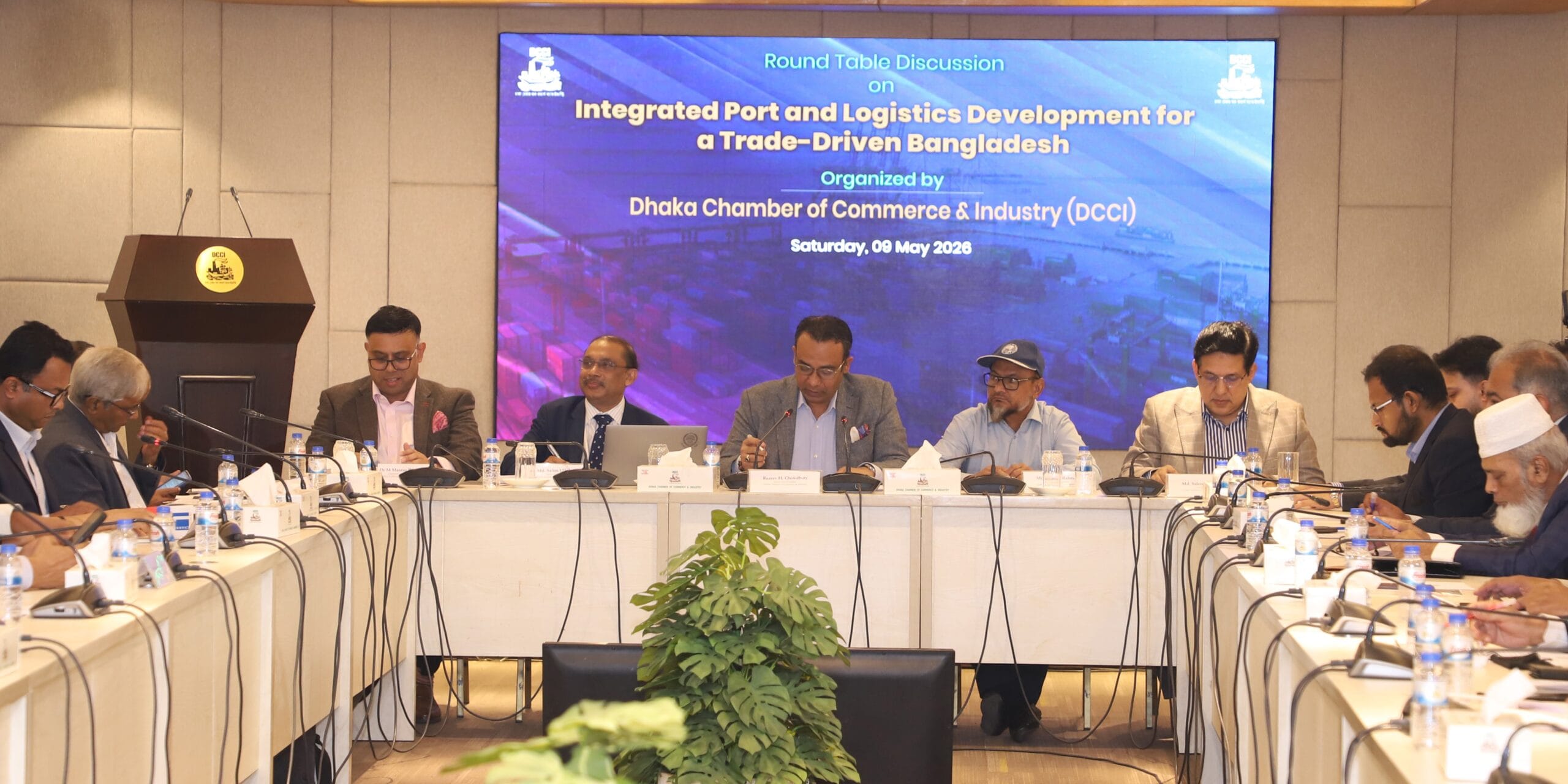
Business leaders, economists and logistics experts on Saturday called for urgent reforms to Bangladesh’s ports and logistics sector, warning that high trade costs, inefficient transport systems and weak infrastructure are eroding the country’s global competitiveness.
They said Bangladesh must develop a modern, integrated and efficient logistics ecosystem to sustain export growth and attract investment as the economy becomes increasingly trade-dependent.
The observations came at a roundtable discussion titled “Development of an Integrated Port and Logistics Sector for a Trade-Driven Bangladesh”, organised by the Dhaka Chamber of Commerce and Industry in the capital.
Delivering the welcome address, DCCI Senior Vice-President Rajib H Chowdhury said infrastructural bottlenecks and lack of institutional coordination are severely undermining the country’s export potential.
“We are steadily falling behind competing countries,” he said.
He pointed to lengthy cargo clearance times at ports, slow movement of goods by road and rail, and inadequate cold-chain logistics as major weaknesses that are making Bangladesh’s supply chain costly and inefficient.
Special guest Md Salim Ullah, director general of the Bangladesh Institute of Management, said Bangladesh remains significantly behind in developing an efficient and coordinated port and logistics management system.
He said rising business costs linked to inefficiencies in the sector are hurting overall competitiveness and stressed the need for coordinated action by all stakeholders.
The keynote paper was presented by M Masrur Reaz, chairman and chief executive officer of the Policy Exchange of Bangladesh.
He said the manufacturing sector now contributes around 25 percent to Bangladesh’s GDP, surpassing several neighbouring economies, but attracting greater local and foreign investment remains essential for further industrial expansion.
Despite remarkable export growth over the past four decades, Bangladesh’s exports remain heavily concentrated in a limited number of products and markets, he said, adding that economic diversification has become increasingly urgent.
Weak logistics infrastructure and high business costs are among the main barriers to creating a supportive business environment, he added.
According to Masrur Reaz, reducing logistics costs by 25 percent could increase exports by 20 percent, while a one percent reduction in freight costs alone could potentially raise exports by 7.4 percent.
He said Bangladesh’s slow progress in export diversification also reflects inadequate capacity development in other promising sectors.
Calling for a comprehensive overhaul of the logistics sector, he stressed the importance of building an efficient and integrated logistics ecosystem to improve the overall investment climate.
Md Habibur Rahman, additional secretary at the Chittagong Port Authority, said there is limited scope for further expansion of the Dhaka-Chattogram highway, making rail connectivity increasingly important for freight transport.
He said stronger rail links with ports could significantly reduce transport time and costs.
He also proposed involving the private sector in managing at least one of the country’s seaports, arguing that competition would improve service quality and potentially reduce tariffs.
Md Shamsul Hoque, a professor at Bangladesh University of Engineering and Technology, said many infrastructure development plans have failed to deliver expected outcomes due to lack of realism and coordination.
Without integrated planning and structural reforms in public institutions, Bangladesh risks falling further behind, he warned.
SK Masadul Alam Masud, managing director of Shahriar Steel Mills and Limited, said the absence of scanner machines at Pangaon Port has discouraged businesses from using the facility.
He also noted that inadequate inland waterway infrastructure is increasing transport costs for industries, despite expectations that river transport would lower expenses.
Nusrat Nahid Babi, senior transport specialist at the World Bank, said customs clearance procedures in Bangladesh remain insufficiently modernised.
Digital systems have yet to be fully introduced at land ports, she said, resulting in lengthy delays in cargo clearance and rising operational costs for businesses.
Meanwhile, Humayun Kabir, senior project officer at the Asian Development Bank, said the ADB is working on projects including the Dhirashram ICD container depot and a multimodal logistics hub.
He also emphasised the need to ensure digitalisation across all levels of logistics services.