


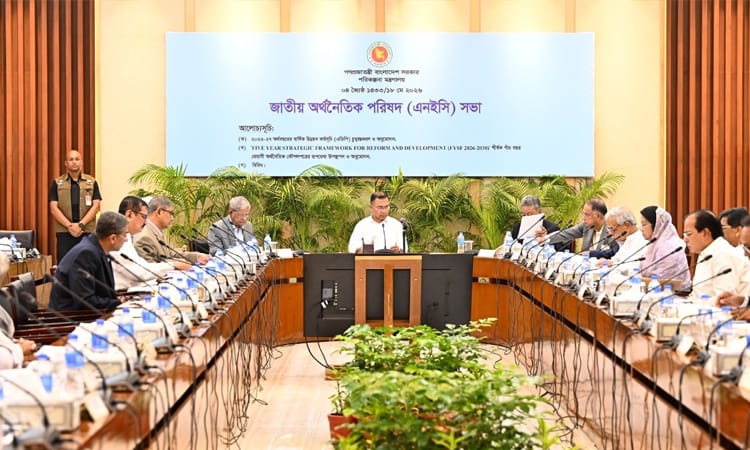
The National Economic Council (NEC) on Monday approved a Tk 3,00,000 crore Annual Development Programme (ADP) for fiscal year 2026–27, significantly scaling up public investment with a strong emphasis on reforms, faster project execution and inclusive growth.
The approval came at a meeting held at the NEC Conference Room in Sher-e-Bangla Nagar, chaired by NEC Chairperson and Prime Minister Tarique Rahman. Ministers, state ministers and senior officials attended the meeting.
The new ADP marks a shift in development planning, combining infrastructure expansion with institutional reforms, social protection, climate resilience and balanced regional development within a single framework.
Of the total outlay, Tk 1,90,000 crore will come from government financing, while Tk 1,10,000 crore will be sourced from foreign loans and grants—reflecting continued reliance on external support alongside rising domestic resource mobilisation.
The size is significantly higher than the current fiscal year’s programme, signalling increased investment capacity.
Five-year strategy framework gets policy nod
The NEC also gave policy approval to a five-year strategic financial planning framework being prepared by an advisory committee under the General Economics Division (GED).
The framework structures development priorities around five key pillars.
The first pillar focuses on state reforms, including expansion of judicial and legal services, administrative digitalisation, strengthening law enforcement capacity and modernising public investment management. It also includes plans to introduce a Multi-Year Public Investment Programme (MYPIP).
The second pillar prioritises equitable socio-economic development, with major allocations directed toward education, healthcare, agriculture, skills development and social safety net programmes.
The third pillar targets economic recovery and restructuring, with emphasis on energy security, renewable energy, transport infrastructure, industrialisation, economic zones and employment generation.
The fourth pillar aims to ensure balanced regional development, with targeted initiatives for northern districts, coastal areas, hill tracts and port-based growth. Plans include developing Chattogram and Mongla as logistics hubs and strengthening coastal protection infrastructure.
The fifth pillar focuses on social cohesion and cultural development, including youth skills, sports infrastructure, cultural promotion and community engagement.
Implementation, discipline prioritised
The ADP places strong emphasis on improving implementation and maintaining fiscal discipline. Authorities have been directed to complete projects scheduled for June 2027 within the timeline, while limiting additional spending on expired projects to enhance efficiency and accountability.
A total of 1,277 new projects have been proposed by ministries and divisions, alongside 80 projects under public-private partnership (PPP) and 148 under the Bangladesh Climate Change Trust Fund—highlighting growing focus on private investment and climate adaptation.
Among 15 sectors, the Local Government Division, Road Transport and Highways Division, Health Services Division and Secondary and Higher Education Division received the highest allocations.
The transport and communication sector secured the largest share at Tk 50,092.53 crore, or 16.70% of the total outlay, followed by education (15.86%), health (11.84%) and power and energy (10.90%). Together, these sectors account for over 60% of total allocations.
A dedicated Tk 17,000 crore has been earmarked for social development assistance programmes aimed at supporting low-income and vulnerable populations.
Foreign funding, climate alignment
A significant portion of the new projects relies on foreign financing, reflecting continued confidence from development partners in Bangladesh’s growth trajectory.
Officials said the ADP aligns with major national and global frameworks, including the Sustainable Development Goals (SDGs), National Adaptation Plan (NAP) and climate-resilient development strategies, with priority given to projects that support green growth, poverty reduction and employment generation.
If self-financed projects of autonomous bodies and corporations are included, the total development outlay would exceed Tk 3.08 lakh crore.
Overall, the FY27 ADP presents a reform-driven and execution-focused roadmap aimed at strengthening institutions, accelerating economic recovery and ensuring more balanced and sustainable development across the country.