


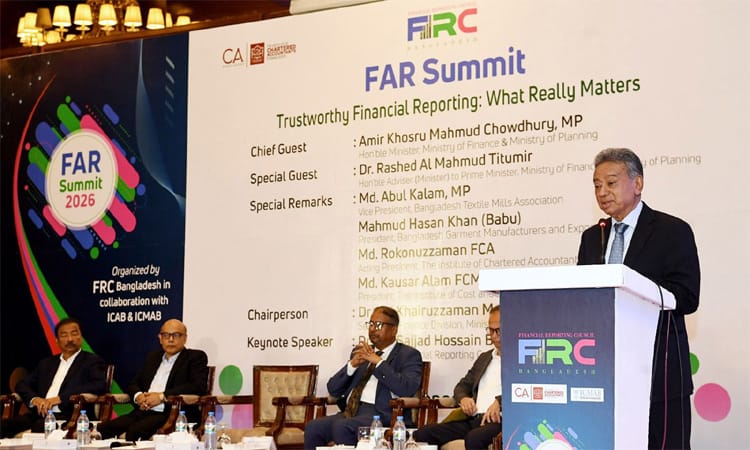
Finance Minister Amir Khosru Mahmud Chowdhury today stressed the urgent need for transparency, accountability, and institutional integrity in Bangladesh’s financial sector, warning that the country’s economic future depends on restoring confidence in financial governance and reporting systems, says BSS report.
“Many regulatory and monitoring bodies had become almost dysfunctional, causing significant disruptions in the auditing, reporting, and oversight framework,” he said.
The Minister made the remarks while speaking as the chief guest at the “Financial Accounting and Reporting (FAR) Summit 2026” titled “Trustworthy Financial Reporting: What Really Matters,” organized by the FRC in collaboration with the Institute of Chartered Accountants of Bangladesh (ICAB) and the Institute of Cost and Management Accountants of Bangladesh (ICMAB) at the Pan Pacific Sonargaon hotel in the city.
Amir Khosru Mahmud Chowdhury said that the economy currently stands at a crossroads following years of turbulence that weakened several key institutions.
,He expressed deep concern over widespread financial indiscipline in the banking and capital markets, noting that a number of companies entered the stock market through false disclosures and misleading financial representations.
According to him, such practices discouraged fundamentally strong companies from participating in the market under fair competitive conditions.
Emphasizing the importance of proper price discovery and asset valuation, he warned that the existing weaknesses have contributed to a serious capital deficit in both the banking industry and the private sector.
The minister linked the situation to rising Non-Performing Loans (NPLs), money laundering, and cases where bank owners and management allegedly colluded to siphon off funds.
He also criticized the long-standing culture of treating banks as privately owned entities despite operating with depositors’ money, stressing that conflicts of interest must be addressed decisively to restore discipline and public confidence in the sector.
Calling for stronger professional responsibility, the minister urged the ICAB and the ICMAB to ensure rigorous self-regulation among their members.
While acknowledging the oversight role of the Financial Reporting Council, he said the primary responsibility for maintaining the quality and credibility of financial reporting ultimately lies with accounting professionals themselves.
Referring to his earlier experience, the minister cited a successful example where responsibility for issuing Utilization Certificates was delegated to a private-sector association, arguing that self-regulation can be highly effective when exercised with professionalism and accountability.
Despite the challenges, he highlighted growing international interest in Bangladesh’s economy, revealing that major global fund managers, including JPMorganChase and investment funds based in London and Hong Kong, have shown strong interest in investing in Bangladesh.
However, he cautioned that attracting such investment would depend heavily on the credibility of audited financial statements and compliance with international accounting standards.
“If investors find that reporting does not meet standard accounting practices, that are the end of the story,” he warned.
The minister concluded by urging stakeholders in the financial sector to move beyond short-term interests and focus on building a sustainable and professionally managed economic system.
He reaffirmed the government’s commitment to carrying out comprehensive reforms in the banking and capital markets to establish a stronger foundation for long-term economic stability and investor confidence.
Prime Minister’s Finance Adviser Rashed Al Mahmud Titumir attended the summit as the special guest, while Finance Division Secretary Dr. Md Khairuzzaman Mozumder chaired the session.
FRC Chairman Dr. Md Sajjad Hossain Bhuiyan delivered the keynote address at the summit, which brought together senior government officials, accounting professionals, auditors, valuers, actuaries, and business leaders.
The event also featured business sessions on improving financial statement quality and strengthening external audit and assurance practices in line with international standards.