



Bangladesh’s power sector is facing mounting financial pressure as subsidy requirements continue to soar despite repeated electricity tariff hikes.
According to recent analysis by the Bangladesh chapter of the Institute for Energy Economics and Financial Analysis (IEEFA), the subsidy burden per unit of electricity has increased by more than 42% between FY22 and FY25, exposing deep structural weaknesses in the country’s energy governance.
While the government has raised bulk electricity tariffs several times over the past three years, the sector’s revenue shortfall has continued to widen, driven by high-capacity payments to private power plants, dependence on costly furnace oil-based generation, fuel supply shortages, and underutilisation of grid electricity by industries.
IEEFA argues that price hikes alone cannot resolve the crisis without comprehensive reforms aimed at reducing generation costs and improving grid reliability.
In this interview with Just Energy News Editor Md Shamim Jahangir, Bangladesh lead analyst at the Institute for Energy Economics and Financial Analysis (IEEFA) Shafiqul Alam, discusses the growing subsidy burden, the impact of expensive fuel-based power generation, and the urgent reforms needed to place Bangladesh’s power sector on a more sustainable and affordable path.
Just Energy News: What is the trend of subsidy in the power sector?
Shafiqul Alam: In recent years, the power sector’s subsidy requirement per unit of electricity consumed by different sectors has increased drastically. Between FY22 and FY25, subsidy requirement per unit of electricity rose by more than 42%.
By the end of FY22, the power sector’s overall revenue shortfall (subsidy allocated + comprehensive loss) was Tk32,891 crore against the total electricity consumption of 76,667 GWh by different sectors. This resulted in a subsidy burden of Tk4.29/kWh. The sector registered a total revenue shortfall (subsidy allocated + comprehensive loss) of Tk55,658 crore in FY25 when different sectors together consumed 90,939 GWh of electricity. As a result, the subsidy requirement touched Tk6.12/kWh in FY25.
Just Energy News: Why subsidy increases despite the rising bulk selling price of electricity?
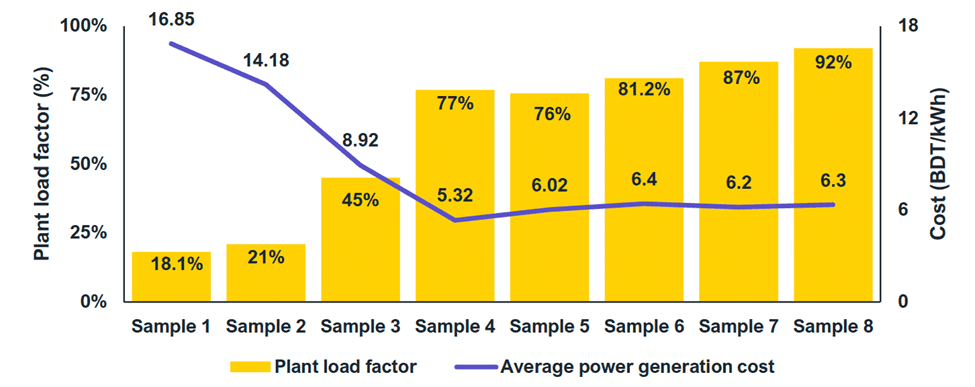
Shafiqul Alam: The government increased the bulk selling price of electricity from Tk 5.17/kWh to Tk6.2/kWh in November/December 2022. It further increased the bulk tariff to Tk7.04/kWh in February 2024. This means the government increased the bulk tariff by more than 35% between November/December 2022 and February 2024. The subsidy burden still increased. Apart from the devaluation of Bangladeshi taka against the United Staes dollar, the high-capacity payments contribute to the rising subsidy burden. IEEFA’s analysis shows that private oil-fired plants received approximately Tk9.5/kWh as capacity payments in FY25. Similarly, private coal-based plants received capacity payments of Tk5.9/kWh. Gas supply shortage reduced plant factors and increased generation cost in FY25.
Figure – Gas power plants with low PLF increase cost
Source: Fostering Bangladesh’s energy transition, IEEFA 2026
The high-capacity payments also signal the presence of a reserve margin beyond the need. Contrary to the rising installed power capacity, the demand did not increase. This is because the industry sector significantly utilises captive power generators amid an unreliable grid. The subdued economic growth in the last couple of years also resulted in a lower-than-expected demand for grid power. Further, rural people do not receive the required electricity due to distribution-related challenges and insufficient fuel supply.
Just Energy News: Will the new tariff solve the power sector’s subsidy problem?
Shafiqul Alam: In a recent move, the government raised the bulk electricity tariff to Tk8.39/kWh – a jump of more than 19% from the previous rate. However, this will not fix the power sector’s subsidy problem. Despite this significant hike in bulk tariff, the BPDB will likely experience a revenue shortfall of more than Tk4/kWh in the upcoming fiscal year.
Just Energy News: What reforms are needed to fix the subsidy burden?
Shafiqul Alam: The Bangladesh government should chalk out a plan for the power sector’s reforms, drawing lessons from the past that the price hike alone will not address the subsidy problem. Instead, a combination of tariff adjustment and cost reduction will fix it.
The power sector’s fuel mix shows that it generates a significant percentage of electricity from furnace oil. IEEFA’s comparative assessment concludes that Bangladesh generated 10.8% of its electricity from furnace oil-based plants in FY25, when India and Pakistan used oil-fired plants for only 0.02% and 0.6% of their electricity generation. Vietnam also relied on oil—based plants for only 0.06% its total power generation.
As the furnace oil-fired power is very expensive (private furnace oil-fired plants produced electricity at about Tk27.5/kWh in FY25) and drives up average generation cost, Bangladesh should reduce its use. To this end, cost-competitive renewable energy can help.
While the rising share of variable renewable energy, especially solar, could likely result in a duck curve in the future, different measures, such as demand shift and battery storage, could address this challenge.
The country should further work on ensuring reliable supply of grid power and attract industries to rely on grid. This will likely increase the use of grid power, minimising BPDB’s revenue shortfall and overall subsidy requirement.