


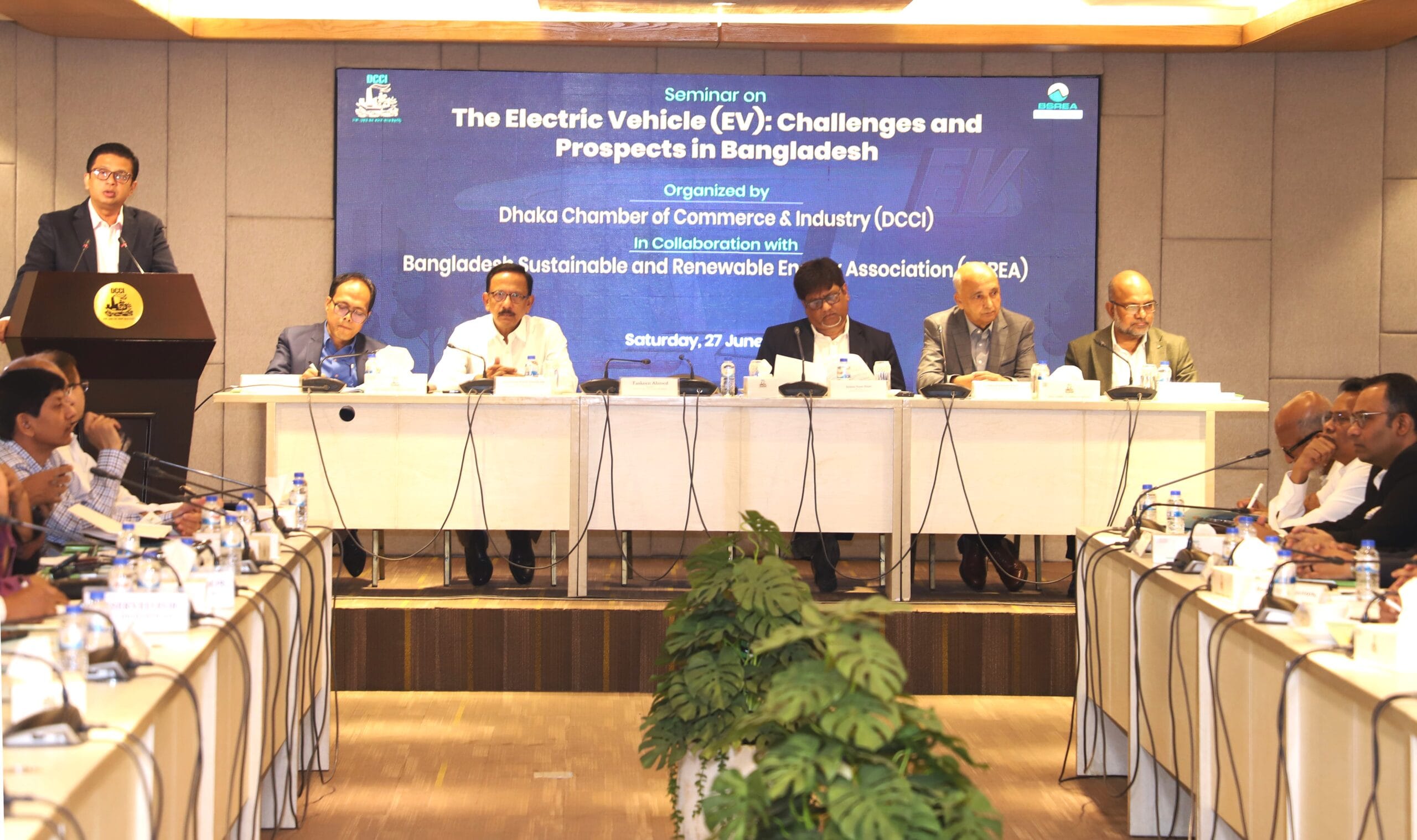
Bangladesh’s transition to electric vehicles (EVs) will remain slow unless the country can ensure uninterrupted electricity supply, rapidly expand charging infrastructure and introduce a comprehensive national policy, business leaders, government officials and industry experts said on Saturday.
They also stressed the need for better coordination among government agencies, improved financing, quality standards and accurate data on EV usage to support the country’s shift towards cleaner transport and reduce dependence on imported fossil fuels.
The observations came at a seminar on “The Electric Vehicle (EV): Challenges and Prospects in Bangladesh”, organised by the Dhaka Chamber of Commerce and Industry (DCCI) in collaboration with the Bangladesh Sustainable and Renewable Energy Association (BSREA).
Presenting the keynote paper, DCCI President Taskeen Ahmed said Bangladesh had already introduced tax and duty incentives to encourage investment in electric mobility, but the sector continues to face significant structural challenges.
He identified inadequate charging infrastructure, unreliable electricity supply, limited battery management facilities and insufficient private-sector investment as the main obstacles to EV expansion.
“Public-private partnership-based investment is essential to expand charging infrastructure alongside a coordinated and long-term policy framework,” he said, urging the government to finalise a comprehensive national EV policy.
Although nearly six million three-wheelers operate across Bangladesh, only 669 electric cars have been registered with the Bangladesh Road Transport Authority (BRTA), highlighting the slow pace of EV adoption, according to the DCCI.
Bangladesh Energy and Power Research Council (BEPRC) Chairman and Senior Secretary Mohammad Wahid Hossain said uninterrupted electricity supply would be the single most important prerequisite for the success of the EV industry.
He proposed establishing a dedicated coordination cell involving all relevant ministries and agencies to accelerate policy implementation and improve institutional coordination. He also emphasised the importance of increasing the share of renewable energy in the national power mix and creating a reliable database on EV usage for better planning.
Industries Secretary Abdun Naser Khan said the government had already prepared a draft national EV policy, which has undergone inter-ministerial and stakeholder consultations.
He said the proposed policy seeks to reduce Bangladesh’s dependence on imported petroleum products while strengthening long-term energy security.
“The final policy will incorporate stakeholders’ recommendations to make it practical and future-ready,” he said.
A recurring concern during the discussion was the lack of reliable data on the country’s growing fleet of battery-powered vehicles.
Commerce Ministry Additional Secretary Shibir Bicitro Barua said the number of electric vehicles currently operating on Bangladesh’s roads is believed to be much higher than official registration figures, making it difficult to formulate effective policies.
He said the ministry is working with the National Board of Revenue (NBR) to remove tariff and non-tariff barriers affecting the industry.
Officials also highlighted the slow development of charging facilities.
Md Aminur Rahman, director at the Sustainable and Renewable Energy Development Authority (SREDA), said the agency has approved 32 EV charging stations across the country, but only nine have so far become operational. He also stressed the need to introduce quality standards for charging stations and imported electric vehicles.
Bangladesh Power Development Board (BPDB) Chief Engineer Md Mofijul Islam said the absence of a proper registration system for battery-operated vehicles prevents the government from accurately estimating electricity demand from the transport sector.
He warned that widespread use of low-quality batteries is also contributing to significant electricity losses.
Industry leaders argued that developing a domestic EV manufacturing ecosystem could create employment and strengthen Bangladesh’s export base.
Hafizur Rahman Khan, president of the Bangladesh Automobiles Assemblers and Manufacturers Association (BAAMA), said manufacturing EV components locally would help build backward linkage industries and create new export opportunities.
BSREA President Mostafa Al Mahmud said Bangladesh spends nearly Tk 65,000 crore each year on transport fuel imports. Wider adoption of electric vehicles, he said, would significantly reduce fuel imports and help conserve foreign exchange.
Professor Md Ehsan of Bangladesh University of Engineering and Technology (BUET) said the growing use of electric three-wheelers has already reduced diesel imports by an estimated 1.5 million tonnes annually, easing pressure on government expenditure and foreign exchange reserves.
Infrastructure Development Company Limited (IDCOL) Vice-President Tanvir Ebne Bashar called for easier access to long-term financing, faster expansion of charging infrastructure and simplified import procedures to accelerate EV adoption.
Akij Motors Chief Executive Officer Sk Amin Uddin said electric vehicles can reduce fuel costs by around 30%, making them an economically viable transport option.
At the end of the seminar, DCCI and BSREA signed a memorandum of understanding to collaborate on energy policy, innovation and market development to support the country’s emerging electric mobility sector.