


Bangladesh must reduce taxes and duties on solar equipment, simplify regulations and improve access to financing if it wants to replicate Pakistan’s rapid solar power expansion, energy experts said on Tuesday.
They said Pakistan’s recent experience demonstrates how an energy crisis can be turned into an opportunity through consumer-driven solar adoption, offering important lessons for Bangladesh as it seeks to reduce dependence on imported fossil fuels.
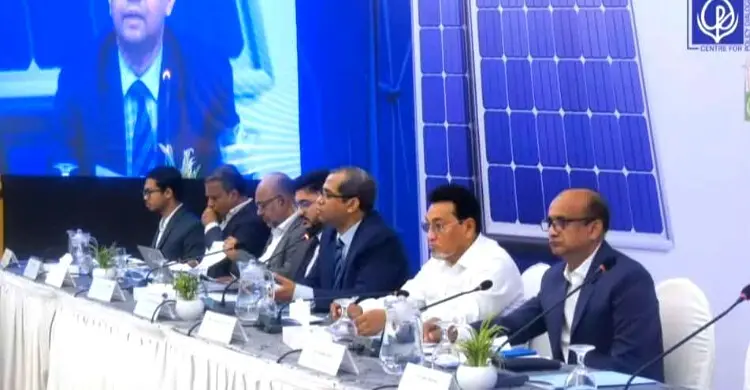
The observations came at a dialogue titled “Pakistan’s Solar Revolution: Lessons for Bangladesh from a National Budget Perspective”, organised by the Centre for Policy Dialogue (CPD) in the capital.
CPD Research Director Khandaker Golam Moazzem said Pakistan’s solar boom has attracted global attention and highlighted the potential of renewable energy in addressing energy security challenges.
“Bangladesh has taken a political decision to prioritise renewable energy alongside fossil fuels, which is a positive step,” he said, adding that the country still has a long way to go in its energy transition.
Moazzem noted that the proposed FY2026-27 budget includes tax and fiscal incentives for renewable energy, electric vehicles and battery industries. However, he said greater emphasis should have been placed on promoting solar power in agriculture.
He also stressed the importance of implementing the government’s rooftop solar programme, which aims to generate around 3,300 megawatts of electricity through solar installations on public buildings.
According to Moazzem, 41 percent of Pakistan’s electricity generation now comes from non-fossil fuel sources, including hydropower, nuclear energy and renewables.
Presenting a paper titled “Solar Rush”, Mohammad Basit Ghauri, Manager of Pakistan-based Renewable First, said Bangladesh is at the beginning of a transition from off-grid solar home systems to on-grid rooftop solar.
He identified high taxes, financing constraints and policy complexities as major barriers to faster solar adoption.
Ghauri said Pakistan imported 17.9 gigawatts of solar panels in FY2025, exceeding its total utility-scale grid capacity. The country currently has an estimated 28-38 gigawatts of installed solar capacity, with around 98 percent concentrated in distributed generation.
The number of households linked to the solar sector rose from 3.5 million in 2023 to 7.3 million in 2025, with nearly three-quarters located in rural areas.
He attributed Pakistan’s solar surge to rising electricity tariffs, concerns over grid reliability and consumers’ efforts to reduce energy costs. A 43 percent decline in global solar panel prices, driven largely by excess production in China, also accelerated adoption.
According to Ghauri, consumers financed 96.6 percent of solar investments in Pakistan. The expansion helped avoid about 35 million tonnes of carbon emissions in FY2025, created around 500,000 direct and indirect jobs and saved more than $12 billion in oil and gas import costs by February 2026.
He argued that Bangladesh’s import duties on solar products, ranging from 11 percent to 58 percent, have slowed the sector’s growth despite facing energy challenges similar to Pakistan’s.
Presenting another paper, “From Off-Grid to On-Grid: Solar Home Systems to Rooftop Solar”, CPD Research Associate Atikuzzaman Sajidsaid Bangladesh’s solar home system programme once became the world’s largest off-grid initiative, providing electricity access to more than 20 million people.
However, annual installations dropped from a peak of 853,000 in 2013 to just 3,455 in 2018. A CPD survey in 2025 found that nearly 47 percent of installed solar home systems are now non-functional.
Sajid said Bangladesh currently has 4,551 net-metering rooftop solar installations with a combined capacity of 213.3 megawatts, including 1,531 systems added in 2025 alone. More than 60 per cent of the country’s rooftop solar capacity is concentrated in Dhaka division.
He cited high taxes on solar equipment, limited access to affordable financing, cumbersome net-metering approvals and weak institutional coordination as key obstacles to expansion.
National Parliament’s Chief Whip Nurul Islam Moni, speaking as chief guest, said solar power generation had already been introduced at the National Parliament complex.
He urged businesses to take advantage of government incentives and invest in renewable energy, adding that the government is gradually converting irrigation pumps across the country to solar-powered systems.