


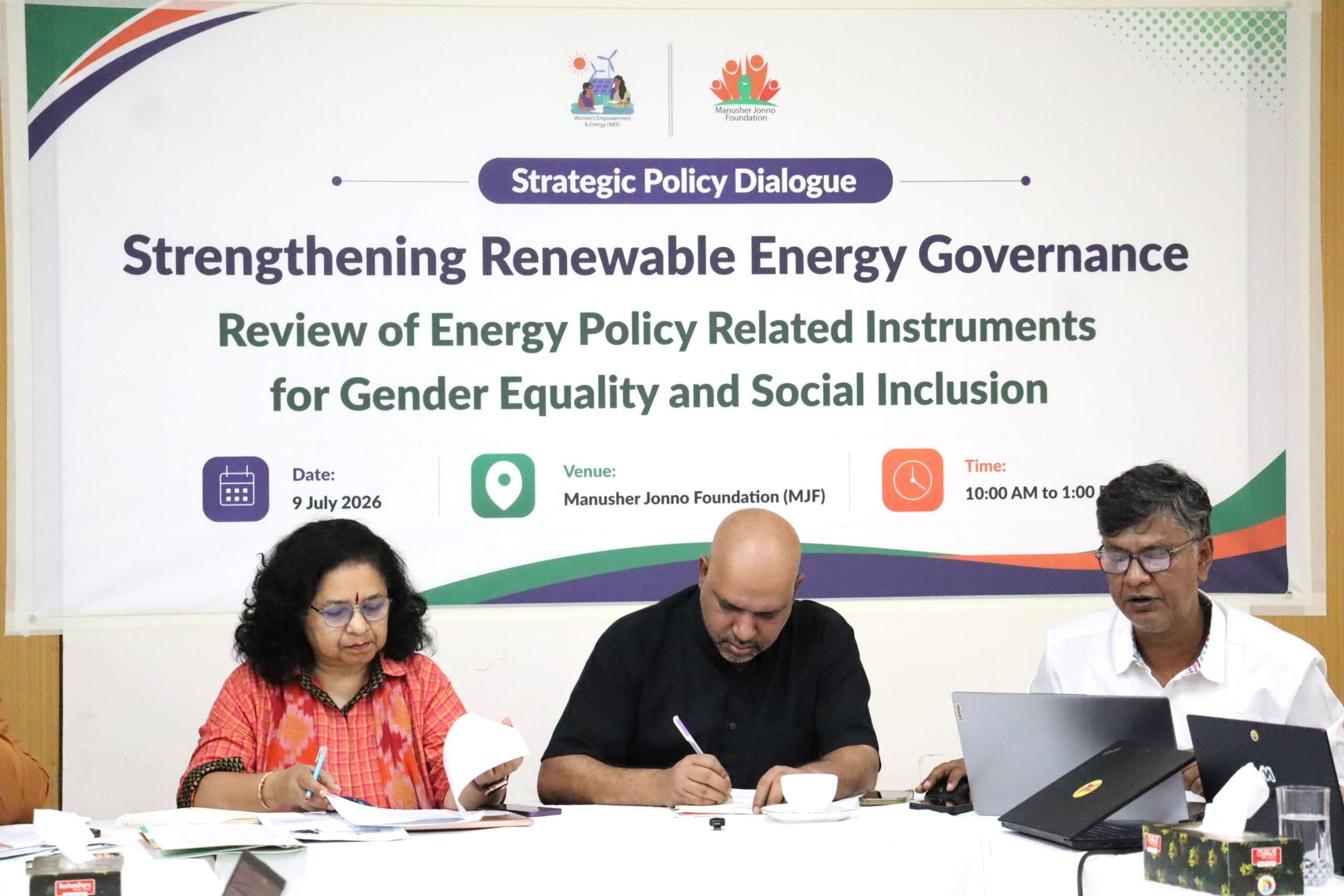
Bangladesh’s renewable energy policies should place greater emphasis on the needs and participation of women and marginalised communities if the country’s clean energy transition is to be inclusive, participants at a policy dialogue in Dhaka said on Thursday.
Speakers argued that renewable energy is not solely about electricity generation but is closely linked to livelihoods, employment, income, safety and social rights. They urged policymakers to incorporate gender equality and social inclusion more explicitly into the Draft National Renewable Energy Development Strategy (2026–2030) and the proposed Rooftop Solar Operation and Maintenance Guidelines.
The dialogue, titled “Strengthening Renewable Energy Governance: Review of Energy Policy Related Instruments for Gender Equality and Social Inclusion,” was organised by Manusher Jonno Foundation (MJF) under its Women’s Empowerment and Energy (WEE) project.
The event reviewed the two draft policy documents from a gender equality and social inclusion perspective, with participants examining how the concerns of women and disadvantaged groups could be better integrated into the proposed frameworks.
Banasree Mitra Neogi, Director of Rights and Governance Programmes at MJF, said the draft renewable energy strategy and rooftop solar guidelines do not adequately recognise the role of women entrepreneurs and marginalised communities.
“These documents have been reviewed through the lens of gender equality and social inclusion. Civil society must continue to play the role of a pressure group,” she said.
Neogi added that while policy documents provide strategic direction, stronger legal provisions are needed to make compliance mandatory. She also called for the draft documents to be made publicly available to allow broader public consultation before they are finalised.
Presenting the keynote paper, Wasiur Rahman Tonmoy, Lead for Youth and Social Cohesion at MJF, said his review found that key stakeholders had not been sufficiently consulted during the drafting process.
He noted that references to women and marginalised communities remain limited in both documents and called for targeted incentives and easier access to finance for these groups.
Tonmoy said Bangladesh’s renewable energy strategy, operational guidelines and related policy instruments should be strengthened through wider consultation involving government agencies, civil society organisations, the private sector, development partners and technical experts to ensure a more inclusive energy transition.