


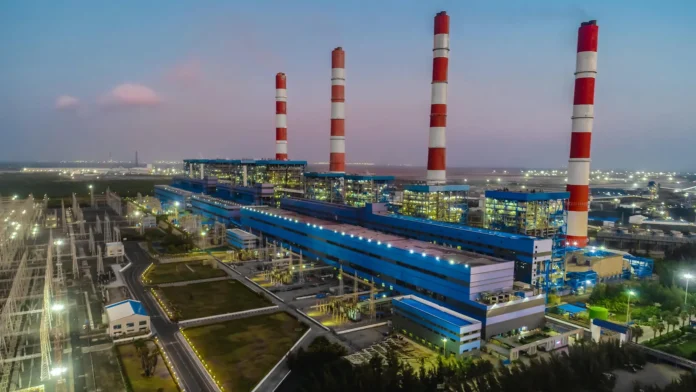
A widening dispute between Adani Power and Bangladesh’s state-owned Power Development Board (BPDB) has intensified, with the Indian power giant rejecting a series of deductions from its electricity invoices and claiming that hundreds of millions of dollars remain outstanding.
In a letter dated 21 August, 2026, addressed to the chairman of BPDB, Adani Power Limited (APL) said its outstanding dues under the long-term power purchase agreement (PPA) stood at $711.72 million as of 31 July, 2026.
According to the company, BPDB’s own acknowledged outstanding amount was $384.81 million, including the late-payment surcharge calculated up to the same date.
The figures underline the scale of a payment dispute that could have significant implications for Bangladesh’s electricity finances and its long-term relationship with one of its largest private-sector power suppliers.
The dispute centres on electricity supplied from Adani’s 1,600MW ultra-supercritical coal-fired power project at Godda in Jharkhand, developed specifically to supply Bangladesh. Under the 2017 PPA, the project is contracted to provide 1,496MW of net capacity to BPDB.
Adani challenges deductions from April to July
The latest correspondence follows BPDB notices concerning disputed invoice deductions for April, May, June and July 2026.
Adani said the deductions relate, among other issues, to the calculation of coal prices, the plant’s dependable capacity and the application of a power-factor adjustment in the variable operation and maintenance (VOMP) calculation.
The company has formally rejected the deductions and said it reserves all its contractual and legal rights.
“APL rejects the deductions proposed” in BPDB’s invoice-dispute notices, the letter states, while reserving the company’s rights concerning the validity and consequences of those notices.
Adani also argues that BPDB’s notices cannot retrospectively cure what it describes as previous non-compliance with the PPA.
The company specifically invokes Section 13.2(i) of the agreement, saying it retains the right to recover amounts withheld by BPDB, along with the applicable late-payment surcharge.
The coal-price battle
One of the central disagreements concerns the coal price used to calculate the energy charge.
Adani says Schedule 6 of the PPA expressly specifies the HBA Index and a formula for proportionately adjusting the coal price for a stipulated gross calorific value of 4,600 kcal/kg.
The company argues that the contractual formula was specifically designed to account for differences in calorific value.
Adani’s position is that BPDB cannot unilaterally replace the agreed index with another benchmark simply because it believes HBA II represents a closer calorific-value range.
The company says the HBA Index remains available and continues to be published.
It also points to Section 13.1(c) of the PPA, arguing that an alternative index can only be introduced through the contractual mechanism—including mutual agreement or determination by the designated expert — rather than through unilateral action.
“BPDB’s unilateral application of HBA II and the consequential deductions from Energy Charges are contrary to the PPA,” Adani Power Limited Senior Vice President Avinash Anurag says in another correspondence on August 26, 2026.
The issue is significant because the coal component is a major element of the price Bangladesh pays for electricity generated at Godda. “We are negotiating coal pricing with Adani Jharkhand Power Limited to settle the dispute,” the BPDB chairman told Just Energy News.
He admitted that Adani had sought payment of the full outstanding dues, including the disputed coal tariff.
The original agreement is a 25-year PPA signed in November 2017 between BPDB and Adani Power’s wholly owned subsidiary, then known as AdaniPower (Jharkhand) Ltd.
Dispute over dependable capacity
A second major disagreement concerns dependable capacity — the amount of generating capacity that BPDB considers the plant capable of reliably delivering.
Adani rejects BPDB’s assertion that it used an incorrect dependable-capacity figure.
The company says the generating units have demonstrated output exceeding the contracted net-capacity requirement and argues that BPDB’s revised dependable-capacity calculation has resulted in deductions from capacity charges.
Adani instead attributes those deductions to what it describes as an erroneous application of the power-factor adjustment, rather than an inability of the plant to meet its contracted performance.
The company maintains that any reduction in dependable capacity arising from external grid conditions should not be attributed to a deficiency in the design, construction or operation of its facility.
Power-factor dispute
The third major issue is the treatment of power factor.
Adani argues that power factor at the electricity delivery point is affected by conditions on Bangladesh’s grid, including grid voltage, reactive-power absorption capability and wider system conditions.
The company says these factors are external to the plant and outside its reasonable control.
It points to Section 9.3(f)(i) of the PPA, which, according to Adani, requires BPDB to provide the facility’s daily requirements for both net energy output and reactive energy.
Adani’s argument is that achieving the required power factor at the delivery point depends partly on the Bangladesh grid’s reactive-power absorption capability.
Therefore, the company says, where monthly power factor is affected by external grid conditions and reactive-energy requirements determined on the Bangladesh side, it should not be penalised through the PPA’s VOMP calculation.
Adani has therefore rejected BPDB’s proposed power-factor deductions.
A dispute with wider implications
The disagreement comes as Bangladesh continues to examine the economics of major power contracts signed during the previous interim government.
A national review committee said earlier this year that the Adani agreement had become a significant financial burden for Bangladesh and that the government was preparing a potential claim in Singapore arbitration.
The government has also said the 2017 Adani agreement is under review.
At the same time, Adani’s Godda project remains an important component of Bangladesh’s electricity supply. BPDB’s published statistics list 1,496MW of imported power from “Jarkhondo (India), Adani Power” among Bangladesh’s power-import sources.
Adani signals further legal action if necessary
The tone of the August letter suggests that the dispute is moving beyond routine invoice reconciliation.
Adani has made clear that it does not accept BPDB’s calculations and intends to preserve its rights under the PPA, the Implementation Agreement and applicable law.
The company also expressly reserves its claim for recovery of amounts withheld by BPDB and for late-payment surcharge.
For Bangladesh, the stakes are substantial. BPDB’s acknowledged liability of US$384.81 million, even before considering Adani’s substantially larger claim of US$711.72 million, represents a sizeable financial exposure for the state electricity authority.
For Adani, the issue goes beyond the immediate invoices: acceptance of BPDB’s methodology could affect the contractual calculation of energy charges, capacity payments and other components of the PPA over time.
The August correspondence therefore represents more than a disagreement over individual electricity bills. It sets out a fundamental clash between the parties over how a long-term international power contract should be interpreted and applied.
With Bangladesh reviewing the economics of the Adani agreement and Adani insisting that the agreed contractual mechanisms must be followed, the dispute could ultimately become a test of the enforceability of the commercial terms negotiated in 2017.
During the interim government, a high-powered review committee findings said Bangladesh has been paying an additional 4–5 US cents per kilowatt-hour for electricity supplied by India’s Adani Power, costing the country an estimated $400 million–$500 million a year under what a government-appointed review committee has described as an “unfair” power purchase agreement (PPA).
According to the committee, the excess payments could amount to nearly $10bn over the 25-year term of the contract for the 1,496-megawatt coal-fired plant built by Adani in Godda, in India’s Jharkhand state.