


American companies operating in Bangladesh have pledged to help mobilise a further US$5 billion in investment over the next five years, as business leaders called for greater policy certainty and faster implementation of economic reforms.
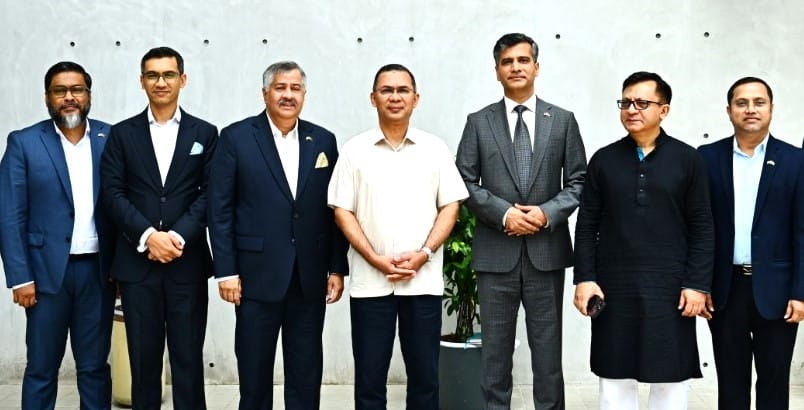
The commitment was made by the American Chamber of Commerce in Bangladesh (AmCham) during a meeting with Prime Minister Tarique Rahman at the Secretariat on Tuesday.
AmCham said its member companies have already invested more than US$5 billion in Bangladesh over the years and argued that there remains significant scope for further US investment in the South Asian economy.
The chamber, led by its president Syed Mohammad Kamal, Vice President of Mastercard, said it was prepared to work with existing members and prospective American investors to facilitate the additional investment.
It called for stronger government-business cooperation to create the conditions needed to attract long-term foreign capital, including greater predictability in taxation, customs, regulation and economic policy.
AmCham also welcomed recent government efforts to improve Bangladesh’s investment climate, particularly measures included in the FY2026-27 reform package. These include time-bound approvals and licensing, implementation of a Single Window system, digital tax and VAT administration, simplified customs procedures and measures aimed at easing the repatriation of capital and profits.
The chamber nevertheless stressed that long-term policy predictability would be crucial if Bangladesh is to compete successfully for international investment.
Digital regulation was another major issue discussed at the meeting. AmCham welcomed the enactment of the Personal Data Protection Act (PDPA) and National Data Governance Act (NDGA), while calling for effective implementation, clearer regulation, stronger cybersecurity and greater readiness for the growing use of artificial intelligence.
The organisation also described the US-Bangladesh Reciprocal Trade Agreement framework as a strategic opportunity to deepen economic ties between the two countries and strengthen Bangladesh’s role in global supply chains.
But AmCham said the relationship should move beyond traditional market access and develop into a wider economic partnership covering technology, artificial intelligence, digital innovation, cloud computing, cybersecurity, healthcare, life sciences, renewable energy, advanced manufacturing and financial-sector modernisation.
The chamber urged the government to focus on implementing reforms rather than simply announcing them, warning that Bangladesh’s ability to attract investment would depend on sustained improvements in competitiveness.
Among its proposals were the creation of a Digital Economy Advisory Forum or Task Force and a Public-Private Competitiveness Council, bringing together government officials, businesses, foreign investors and AmCham representatives.
Such bodies, it said, could help identify regulatory bottlenecks, monitor implementation of reforms and strengthen investor confidence.
AmCham also highlighted the wider contribution of US-linked businesses to Bangladesh’s economy. It said the organisation, which has worked to strengthen Bangladesh-US commercial ties since 1996, represents companies that collectively contribute more than 20 per cent of the country’s tax revenues.
The meeting comes as Bangladesh seeks to strengthen its position as an investment destination and expand its integration into global value chains. For foreign investors, the success of the government’s reform programme is likely to depend increasingly on whether improvements in regulation, infrastructure, energy supply and public administration are delivered consistently.
The AmCham delegation said it was ready to work with the government to support that process and help turn the proposed US$5 billion investment pipeline into actual projects over the coming five years.