


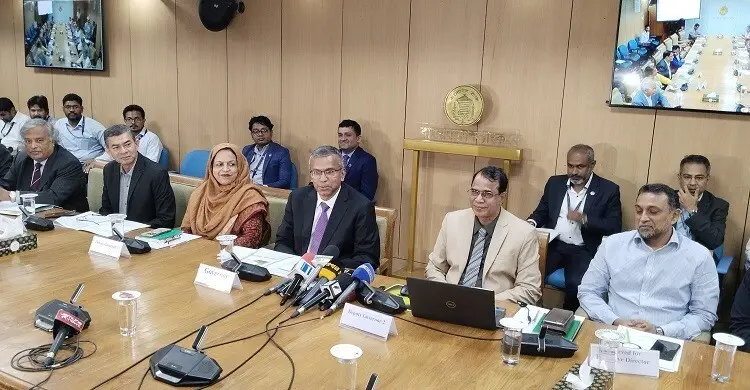
Bangladesh Bank on Tuesday kept its benchmark policy interest rate unchanged at 10%, maintaining its tight monetary policy to contain inflation, while unveiling a Tk 600 billion (Tk 60,000 crore) stimulus package to support industry, agriculture and cottage, micro, small and medium enterprises (CMSMEs).
The central bank said the package is designed to stimulate production, encourage private investment and create around 2.5 million direct and indirect jobs, while maintaining its focus on bringing inflation under control.
Governor Mostakur Rahman announced the monetary policy for the first half of the 2026-27 fiscal year (July-December) at Bangladesh Bank headquarters in Dhaka.
The policy repo rate was kept unchanged at 10%, while the Standing Lending Facility (SLF) rate remained at 11.5% and the Standing Deposit Facility (SDF) rate at 7.5%.
The governor said inflation control remains the central bank’s primary objective, but Bangladesh Bank will also provide targeted credit support to revive economic activity.
“We are giving equal importance to containing inflation while promoting production, employment and investment,” he said.
Of the Tk 600 billion stimulus package, Tk 410 billion will be financed from excess liquidity in the banking sector, while the remaining Tk 190 billion will come from Bangladesh Bank’s own resources.
According to the monetary policy statement, inflation has eased from a peak of 11.7% in July 2024 to 9.4% in May 2026, but remains well above the desired level, prompting the central bank to retain its contractionary policy stance.
Bangladesh Bank said inflation is being driven not only by monetary factors but also by supply-side constraints, structural market weaknesses and global cost pressures.
The central bank also warned that geopolitical tensions in the Middle East, possible disruptions to fuel and fertiliser supplies, and continued global economic uncertainty remain significant risks to Bangladesh’s economic outlook.
As part of financial sector reforms, Bangladesh Bank announced measures to strengthen banking sector resilience, including stricter loan audits, implementation of the IFRS-9 Expected Credit Loss (ECL) framework, enhanced risk-based supervision, and enforcement of the newly enacted Bank Resolution Act 2026 and Deposit Protection Act 2026.
It also plans to introduce a Distressed Asset Management Act and amend the Money Loan Court Act to speed up the resolution of non-performing loans.
To expand digital payments, the central bank said it will introduce the interoperable Bangla QR platform, enabling seamless transactions between banks and mobile financial service providers.
Bangladesh Bank expressed confidence that the FY2026-27 budget’s tax and tariff reforms, together with the new stimulus package, would gradually support higher investment and economic growth despite persistent challenges.
DCCI disappointed over unchanged policy rate
The Dhaka Chamber of Commerce and Industry (DCCI) expressed disappointment that the central bank left the policy rate unchanged, saying the decision offers little relief to businesses grappling with high financing costs and subdued investment.
In a statement, DCCI President Taskin Ahmed noted that private sector credit growth has slowed to around 5%, while inflation has remained elevated despite nearly four years of contractionary monetary policy. He said the latest monetary policy appears out of sync with the government’s growth-oriented fiscal measures announced in the new national budget, which include tax and duty incentives to encourage investment and industrialisation.
The chamber, however, welcomed the Tk 600 billion stimulus package, describing it as a timely initiative for productive sectors. It urged Bangladesh Bank to ensure the fund is disbursed quickly and transparently, with simplified procedures so that CMSMEs, export-oriented industries and genuinely affected businesses can access financing without unnecessary delays.
DCCI also called for stronger coordination between monetary and fiscal policies, warning that without adequate and affordable financing, the investment incentives announced in the national budget may not deliver their intended economic benefits.