


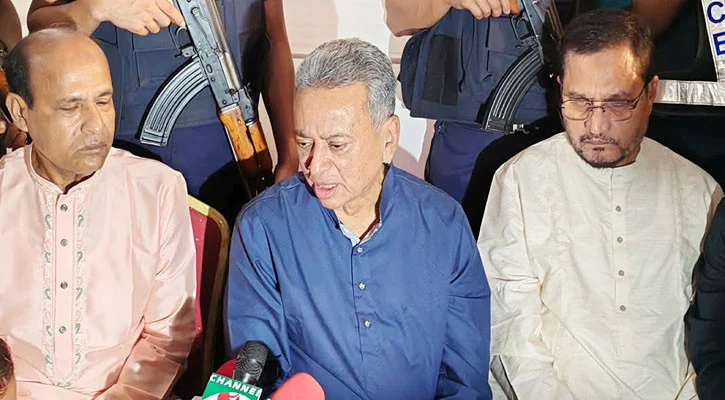
Finance and Planning Minister Amir Khosru Mahmud Chowdhury on Monday said Bangladesh is steadily positioning itself as a major global investment destination, citing the government’s reform drive, strong political commitment and accelerated decision-making.
Briefing reporters after the National Economic Council (NEC) meeting, the minister said the proposed Tk 3,00,000 crore Annual Development Programme (ADP) for FY2026-27 has been crafted as a strategic response to pull the economy out of fragility through large-scale investment and job creation.
“If aspirations are not high, development cannot move forward,” he said, defending the size of the ADP amid questions over its ambition. “Without investment there will be no growth, no employment and no development.”
He expressed confidence in implementing the expanded development programme, noting that an elected government ensures stronger administrative efficiency and faster execution.
“We have already demonstrated within three months that we can take decisions quickly and implement them,” he said.
Investment push to revive economy
Explaining the rationale behind a large ADP despite economic challenges, Khosru likened the situation to a tube-well.
“When the water level drops, you need to pour water in before it starts flowing again. Similarly, without injecting investment, there is no way to recover from a fragile economy,” he said.
He added that Bangladesh’s reform-oriented economic strategy is drawing increasing attention from global investors and financial institutions.
“International investors and fund managers are closely following Bangladesh. They are coming because they see commitment, dynamism and quick decision-making,” he said, adding that the country is becoming “acceptable to the world” as a competitive investment destination.
Tk 3 lakh crore ADP outlined
The minister said the ADP outlay for the next fiscal year has been set at Tk 3,00,000 crore, including Tk 1,90,000 crore from domestic resources and Tk 1,10,000 crore from foreign loans and grants.
He described the ADP as a “people-centric development roadmap” aimed at rebuilding the economy, strengthening institutions and ensuring inclusive growth.
“This is not just about infrastructure. It reflects a new development philosophy focusing on reforms, sustainability, regional balance and a discrimination-free society,” he said.
The ADP is aligned with a five-year strategic framework built on recovery, transition and reconstruction of the economy.
Focus on reforms, governance and efficiency
Khosru said the government is prioritising institutional reforms, including judicial and administrative improvements, digitalisation and better governance.
To ensure effective project implementation, he announced a shift towards a transparent and competency-based system for appointing Project Directors (PDs), addressing long-standing allegations of politicisation and inefficiency.
“Only qualified individuals meeting clear criteria will be appointed. Projects failed in the past due to both corruption and lack of competence,” he said.
He also said ministries will introduce digital dashboards to monitor project progress in real time, enabling swift intervention in case of delays.
Review, cancellation of weak projects
The minister said the government inherited around 1,300 ongoing projects, many of which are now under review.
“Some projects were driven by inefficiency, wastage or even motivated corruption. Those that do not serve national interest will be cancelled,” he said.
He made it clear that newly approved projects would not be allowed time extensions, stressing strict adherence to deadlines.
The Implementation Monitoring and Evaluation Division (IMED) will investigate irregularities and recommend actions where necessary, he added.
Revenue reforms and tax net expansion
On revenue mobilisation, Khosru acknowledged that Bangladesh’s tax-to-GDP ratio remains among the lowest globally and stressed the need for urgent reforms.
“We cannot continue like this if we want to become a stronger economy,” he said.
The government is undertaking reforms in the National Board of Revenue (NBR) and expanding the tax base to reduce pressure on existing taxpayers.
“For years, the same group has borne the burden. We are now widening the network and bringing new areas under taxation,” he said.
He noted that expanding the tax net would ultimately benefit citizens through improved public services and social protection.
Growth, jobs and climate resilience
The minister said future development planning would prioritise employment generation, human resource development, healthcare, technical education and climate resilience.
“Every project must ensure value for money and generate employment. We do not want jobless growth,” he said.
He added that the government expects gradual economic recovery rather than a sudden surge in growth, with investment and employment expected to rise in tandem over time.
“This budget has been designed with a clear strategy—from a fragile economy to recovery, transition and long-term prosperity,” he said.