


Government plans to replace 1.5 million diesel-powered irrigation pumps with solar alternatives, while experts urge stronger research, regulation and public-private partnerships
Bangladesh is aiming to develop a carbon market worth $1 billion by 2034, with a major shift towards renewable energy, including plans to replace 1.5 million diesel-powered irrigation pumps with solar alternatives within the next 18 months.
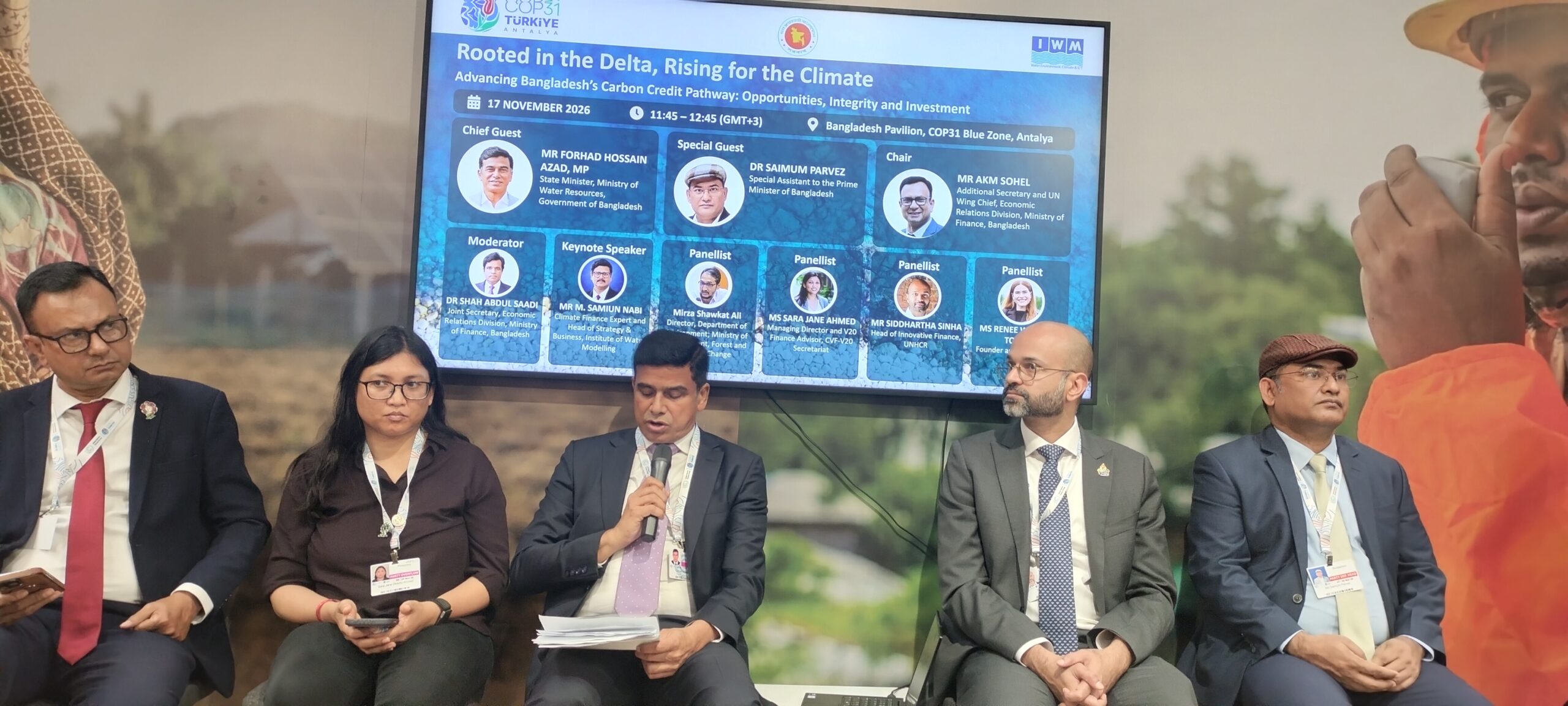
The ambitious target was outlined by policymakers at a discussion on the sidelines of the COP31 climate conference at the Bangladesh Pavilion on Tuesday.
Experts, carbon market consultants and development practitioners welcomed the initiative, but stressed that stronger institutional capacity, research and public-private collaboration would be essential if the country is to realise its ambitions and secure maximum financial benefits from carbon trading.
Speaking at a dialogue entitled Rooted in the Delta, Rising the Climate, Dr Saimum Parves, special assistant to the Prime Minister, said Bangladesh had significant potential to generate revenue from carbon credits.
He said the Infrastructure Development Company Limited (IDCOL) could generate around $16m in carbon credit revenue, adding that a group of experts was working to identify further opportunities.
“Bangladesh has huge potential to use the carbon market properly. We are working with experts to explore how we can increase our carbon credit earnings,” he said.
Dr Parves identified the Sundarbans, the world’s largest mangrove forest, as one of the country’s biggest potential sources of carbon credits.
The government plans to plant 250 million trees in the Sundarbans over the next five years, including 20 million mangrove trees along coastal belts within the next six months, he said.
The government is also expanding renewable energy initiatives, particularly rooftop solar, wind power and cleaner transport, as part of its strategy to reduce dependence on fossil fuels.
Dr Parves said the Prime Minister had introduced a rooftop solar initiative ahead of COP31, describing the expansion of renewable energy using domestic resources as government policy.
Railway development was another priority, he said, as shifting transport away from fossil-fuel-dependent road vehicles could help reduce emissions.
Agriculture, however, is expected to be a major part of the country’s carbon reduction strategy.
The government is promoting climate-resilient irrigation systems and cleaner cooking technologies, alongside plans to convert more than 1.5 million small and large diesel-powered irrigation pumps to solar power.
The Prime Minister has instructed the relevant authorities to complete the transformation of irrigation pumps within 18 months, Dr Parves said.
Bangladesh has also developed a national carbon credit framework, which is expected to be submitted to the Cabinet next month. A national carbon registry is also in the pipeline.
The government has formed a committee to ensure a coordinated approach to the country’s carbon market initiatives.
Refugee camps offer carbon credit opportunities
The potential for carbon finance extends beyond the energy and forestry sectors.
Siddhartha Sinha, senior innovation financing officer in the Division of External Relations at the UN refugee agency UNHCR, said the organisation was working directly with Bangladesh on introducing improved cooking stoves in Rohingya refugee camps in Cox’s Bazar.
The initiative could generate around $1m in carbon credit revenue, he said.
The introduction of cleaner cooking technologies would also help reduce pressure on surrounding forests, which have suffered significant degradation following the arrival of large numbers of refugees.
Improved cooking stoves could therefore deliver a double benefit by reducing emissions while helping to address deforestation in the refugee-hosting areas.
Bangladesh urged to learn from Ghana and Sri Lanka
Sara Jane Ahmed, managing director and V20 finance adviser to the Climate Vulnerable Forum and V20, cited Ghana’s experience in developing a carbon finance market worth around $1bn.
She also pointed to opportunities in Sri Lanka, where the tea sector could provide scope for carbon trading.
Bangladesh, she suggested, could explore similar opportunities in its agricultural and plantation sectors.
Solar power was another area where the country could generate carbon credits, she added.
Experts warn against weak project design
Despite the opportunities, experts warned that Bangladesh would need to strengthen its technical and institutional capacity to benefit fully from international carbon markets.
Farah Kabir, country director of ActionAid Bangladesh, told Just Energy News that capacity-building must be a priority if the country is to secure the best possible returns from carbon trading.
She said investment in research and development in the renewable energy sector was essential to achieving meaningful results.
“Without research and development in renewable energy, it will be impossible to achieve the best outcomes from carbon trading,” she said.
Ms Kabir also cautioned that carbon market projects must be carefully designed to ensure that Bangladesh receives a fair share of the benefits.