


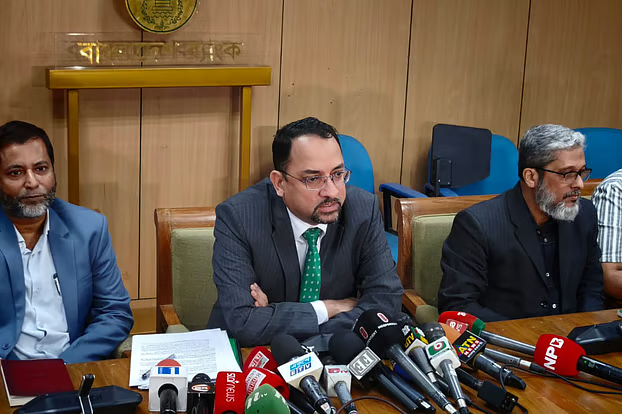
Bangladesh may rank among the countries most affected by money laundering through the banking sector, with the scale of fund siphoning from its banks having few parallels globally, a central bank taskforce adviser said on Monday.
Farhanul Gani Chowdhury, an adviser to the taskforce formed by Bangladesh Bank to recover laundered assets, warned that bringing the money back would require lengthy legal battles abroad, potentially taking five to 10 years.
Speaking at a press conference at Bangladesh Bank headquarters in Motijheel, he said even civil proceedings to recover assets could take three to five years. Authorities must first trace where the money went, identify who holds it and establish in foreign courts that the assets were acquired illegally.
The taskforce is pursuing civil proceedings with the affected banks at the forefront, seeking to recover money lost through large-scale loan fraud and diversion of funds overseas.
Of six cases selected in the first phase, work on three has advanced substantially, Farhanul said. Another around 40 cases have been shortlisted for the second phase.
The taskforce was formed in October 2024 and initially focused on criminal proceedings. It later brought banks into the process to pursue civil claims and recover assets.
In the first phase of the civil recovery drive, priority was given to cases involving large defaulted loans. International firms have reportedly found that the loan, collateral and personal-guarantee documents supplied by banks in at least two cases are of sufficient quality to support legal action abroad.
For the second phase, cases are being screened against several criteria, including whether the defaulted loan amounts to at least Tk200 crore, whether banks have information indicating that the money was transferred overseas, and whether the owners concerned have also moved abroad.
After confidentiality agreements are signed between the banks and foreign firms, the relevant loan documents will be shared for review. The firms will assess whether there are sufficient grounds for legal action and whether litigation funding can be secured.
Tracing and freezing assets abroad and pursuing court cases could cost several million dollars, Farhanul said. The taskforce is therefore exploring third-party litigation funding, under which banks would not have to pay upfront. Funders would receive a share of the recovered assets if the cases succeed.
Asked about progress on recovering assets linked to the Sikder Group, he said the boards of the banks concerned had given in-principle approval to an arrangement. Legal documents are now being prepared.
Foreign asset-freezing orders yet to take effect
Bangladeshi courts have ordered the freezing of around Tk19,000 crore worth of assets held abroad, but the orders have not yet been enforced in the countries concerned, Farhanul said.
The clarification followed a statement by the finance minister in parliament that assets worth nearly Tk77,000 crore had been frozen. Of that amount, around Tk58,000 crore relates to assets frozen within Bangladesh, while the remaining amount involves assets overseas.
He said some foreign assets had been temporarily frozen following Bangladesh’s mutual legal assistance requests, or MLARs. However, he did not disclose their value.
The countries concerned have sought additional information from Bangladesh to keep the freezing orders in force.
As an example, Farhanul cited assets worth around £250 million held by former land minister Saifuzzaman Chowdhury in the United Kingdom. British authorities have disclosed the freezing of those assets, and legal proceedings are under way.
Asked whether funds temporarily frozen abroad had been moved to another country because of delays in sending information from Bangladesh, Bangladesh Bank spokesperson Arif Hossain Khan said Bangladesh had completed the required process within the stipulated time.
However, the money was transferred to another country after 30 days, he said, adding that efforts to trace the funds were continuing. He did not disclose the amount or the countries involved.
Farhanul said requirements for legal assistance vary from country to country, making it necessary to tailor each request accordingly. The taskforce is also looking for ways to reduce delays in sending requests through diplomatic channels.
He said the taskforce was not disclosing detailed progress regularly because money laundering investigations are highly sensitive. Revealing information prematurely could alert those involved, allowing them to move assets or adopt new tactics and undermine recovery efforts.