


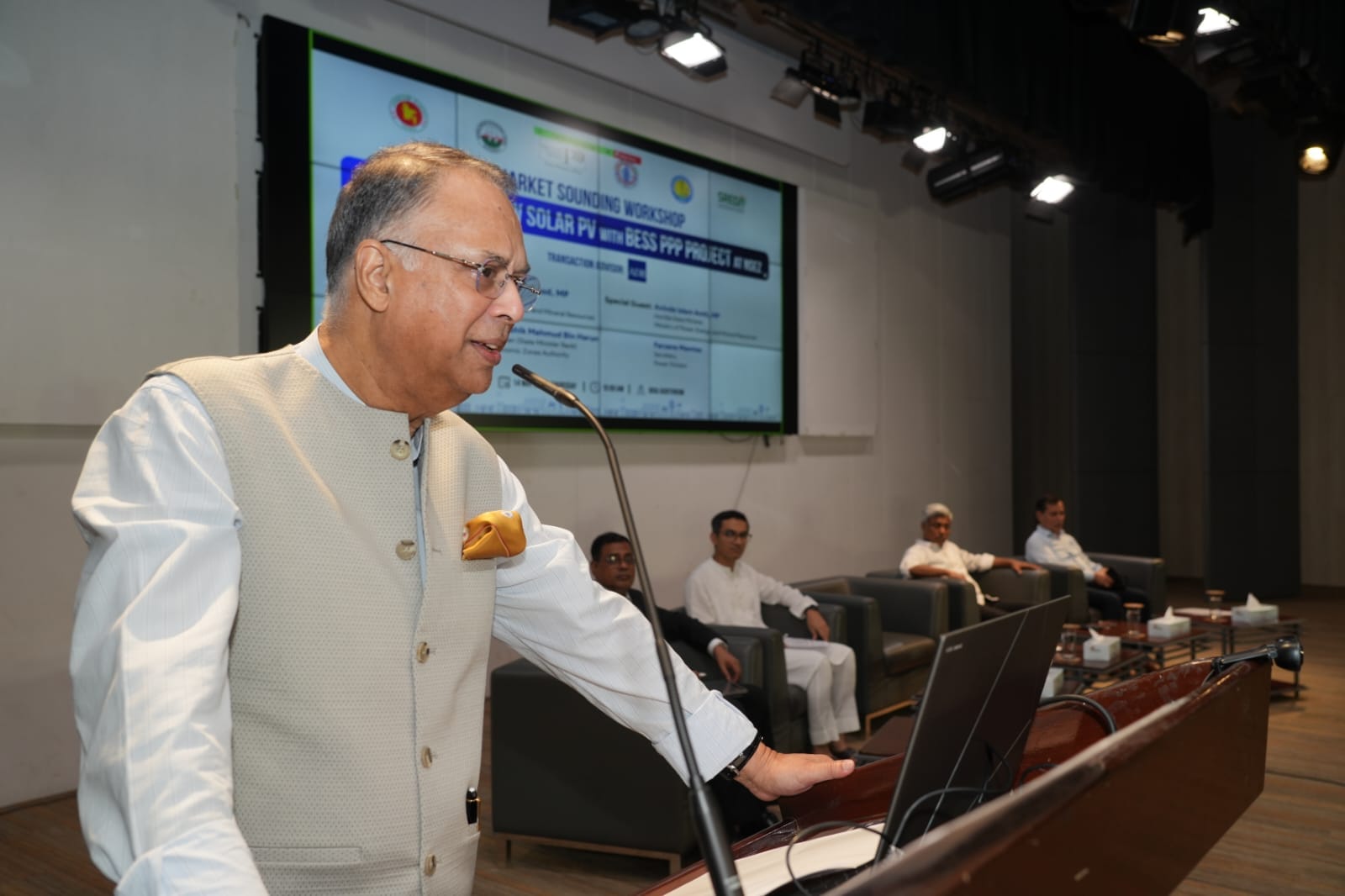
Bangladesh is set to introduce an investment-friendly renewable energy policy by June 2026 as the government seeks to accelerate private sector participation in the country’s growing clean energy market, Energy Minister Iqbal Hassan Mahmood said on Thursday.
Speaking at a market sounding workshop on the proposed Sonagazi 130MW Solar PV with Battery Energy Storage System (BESS) public-private partnership project, organised by Bangladesh Economic Zones Authority, the minister said a high-level committee formed by Prime Minister was working to identify incentives and policy support required to attract investment into the renewable energy sector.
“The government will act as a facilitator and create conditions for profitable business in this sector through an investor-friendly policy framework,” Mahmood said.
Drawing parallels with the rapid expansion of Bangladesh’s garment industry under policies introduced during the tenure of former President Ziaur Rahman, the minister said the government hoped to replicate a similar success story in the solar energy sector.
Mahmood said the government was considering withdrawing taxes on solar components including frames, photovoltaic cells and batteries to reduce project costs and expand energy storage capacity.
He added that authorities were also evaluating tax incentives and reduced import duties to encourage investment.
Referring to Pakistan’s solar expansion as an example, the minister said Bangladesh could either import solar equipment directly or allow private firms to import such equipment duty-free to support industry growth.
He further proposed a five-year tax holiday for renewable energy investors, arguing that attracting investment should take precedence over immediate tax revenue.
“Investment must come first before revenue. After five years, the government will naturally receive taxes,” he said.
The minister also highlighted the untapped rooftop solar potential in Dhaka, suggesting that private investors could lease rooftops in residential areas such as Dhanmondi and Mohammadpur under a net metering system capable of generating up to 1,000MW of electricity.
According to Mahmood, such a move would ease pressure on the national grid and allow more electricity to be diverted to industrial users.
State Minister for Power, Energy and Mineral Resources Aninda Islam Amit said the private sector would play a crucial role in Bangladesh’s renewable energy transition.
“Bangladesh must move towards a more balanced power generation mix,” he said, warning that excessive dependence on imported fuels exposed the country to global price volatility, foreign exchange pressures and fiscal risks.
He noted that large-scale solar projects developed through competitive procurement could help reduce Bangladesh’s exposure to imported energy.
The proposed Sonagazi solar project, located within the National Special Economic Zone, is being developed through collaboration among several state agencies, including Bangladesh Power Development Board as the power purchaser, Power Grid Company of Bangladesh for grid connectivity, the Power Division, Sustainable and Renewable Energy Development Authority and the Public-Private Partnership Authority.
Amit said the inclusion of battery energy storage would strengthen grid stability and improve utilisation of renewable energy as Bangladesh increases its reliance on solar and other intermittent power sources.
He also stressed the importance of clear policies, predictable regulations and coordination among government agencies to ensure the success of renewable energy investments in the country.