


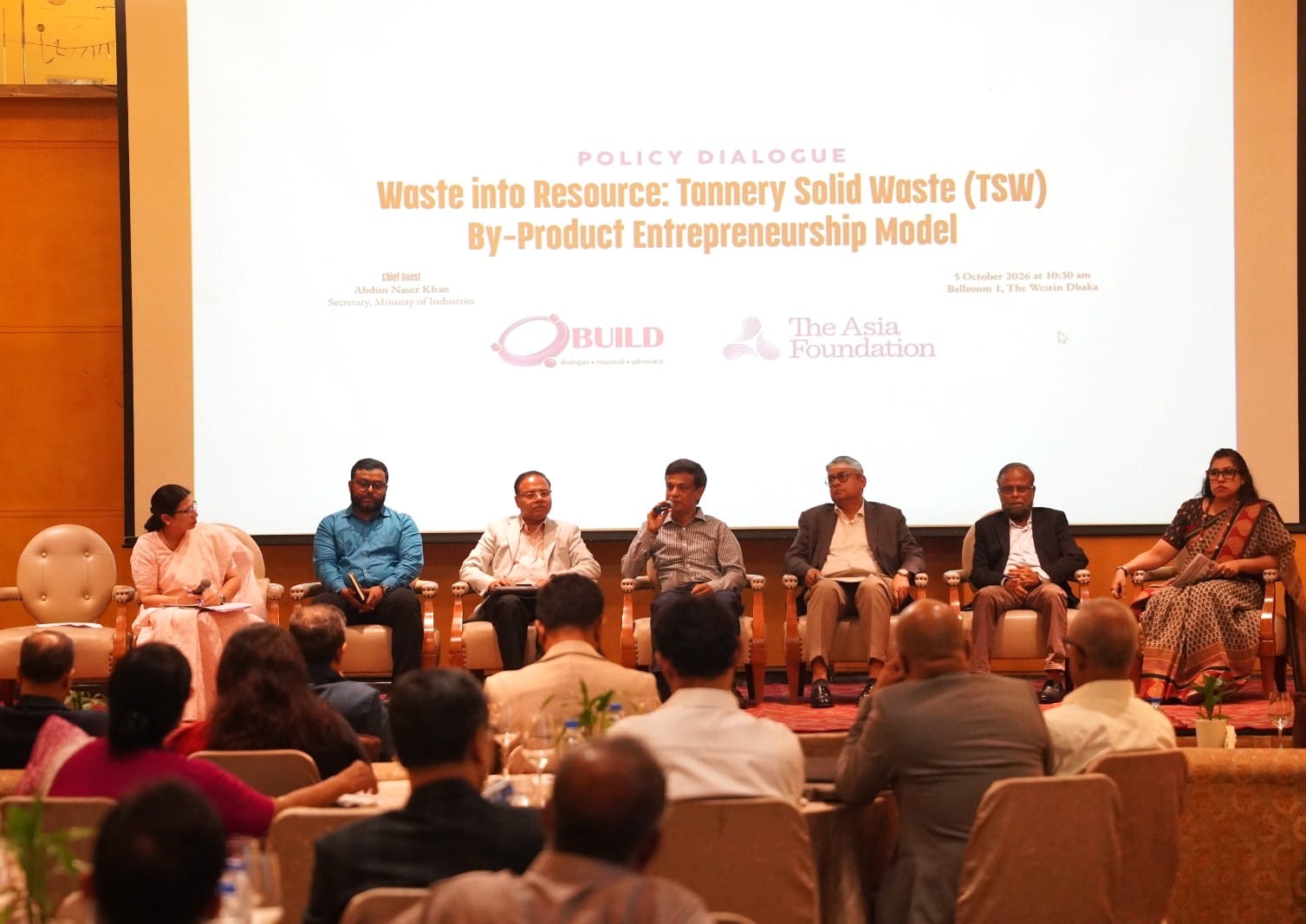
Bangladesh should treat tannery solid waste as a source of industrial raw materials rather than simply an environmental liability, speakers at a policy dialogue in Dhaka have said, arguing that better waste management could create new businesses, attract investment and reduce imports.
The discussion focused on developing commercially viable and environmentally compliant business models for converting tannery waste into products such as gelatin, collagen, protein meal and tallow.
Smriti Karmakar, additional secretary at the Ministry of Industries, said tannery solid waste should not be viewed solely as a source of pollution or a threat to rivers.
With appropriate technology, she said, it could become a valuable economic resource supporting new investment and green entrepreneurship.
Speaking as chief guest at the policy dialogue, jointly organised by Business Initiative Leading Development (BUILD) and The Asia Foundation at The Westin Dhaka, Ms Karmakar said Bangladesh needed to strengthen environmental management, resource efficiency, product diversification, compliance and value addition in the leather sector.
She said the ministry was ready to work with BUILD and other stakeholders to review recommendations from the study and identify practical policy measures.
Abul Kashem Khan, chairperson of BUILD, said effective management of tannery solid waste could support export diversification, attract foreign direct investment and generate additional revenue.
He said some foreign investors were already prepared to invest in by-product industries but were facing serious shortages of suitable raw materials.
He called for sustained cooperation between government ministries, regulators, development partners and the private sector to close the gap between policy decisions and implementation.
84,000 tonnes of waste a year
Presenting the keynote paper, Ferdaus Ara Begum, chief executive of BUILD, said the Savar Tannery Industrial Estate generated about 84,000 tonnes of solid waste a year.
Around 60–70% of the waste consists of chrome-free beamhouse trimmings and fleshings, which have significant potential for conversion into gelatin, collagen, protein meal and tallow, she said.
However, fragmented policies, unclear waste classifications and the absence of source-level segregation mean much of this material remains underused or is improperly disposed of.
Ms Begum said Bangladesh needed to recognise recovered tannery waste as a secondary industrial raw material, rather than automatically treating it as hazardous refuse.
The study identified a range of potential business models, from large commercial biorefineries to small and medium-sized tallow extraction units.
According to the study, such ventures could unlock millions of dollars in domestic economic value and potentially replace about $100 million a year in imports of gelatin, glue, shoe soles and poultry-feed additives.
Leather seen as an alternative growth engine
Alamgir Hossain, country representative of the United Nations Industrial Development Organisation (UNIDO), said Bangladesh would need to diversify beyond its traditional sectors as it pursued its ambition of becoming a trillion-dollar economy.
He described the leather industry as a potential alternative engine of growth and said Bangladesh needed to prepare for the challenges associated with its graduation from the UN’s least-developed country category, regardless of the outcome of its request for a three-year extension.
UNIDO was keen to support Bangladesh’s leather industry and work with BUILD, he said, although the sector is currently outside the organisation’s core programming.
Kazi Nazrul Islam, director of promotion and development at Bangladesh Small and Cottage Industries Corporation (BSCIC), said waste management required coordination among households, businesses, industries and government agencies.
He noted that waste segregation at source was common in many Western countries, while Bangladesh continued to face shortcomings in policy, public awareness, institutional capacity and implementation.
The government could not tackle the problem alone, he said, calling for greater participation from businesses, industries, citizens and other institutions.
Mr Islam proposed a master action plan and a dedicated coordination committee, potentially chaired by the secretary of the Ministry of Industries, to identify obstacles and develop practical solutions.
Call for dedicated policy
Sharifa Khan, former alternate director at the World Bank and former senior secretary of the Economic Relations Division, moderated the panel discussion and stressed the need for coordinated action to establish tannery solid waste management as a compliant industry.
Dr Mohammed Abu Eusuf, professor of development studies at the University of Dhaka and executive director of RAPID, called for a “3C” approach — comprehensive action, coordination and compliance.
He also pointed to existing financing constraints and said Bangladesh urgently needed a dedicated policy framework for tannery solid waste.
Ainee Islam, programme director at The Asia Foundation, said parts of the leather-sector ecosystem remained linked to Hazaribagh even after the industry’s relocation to Savar.
She said the foundation was interested in working with the government and other stakeholders to help implement recommendations emerging from the dialogue.