


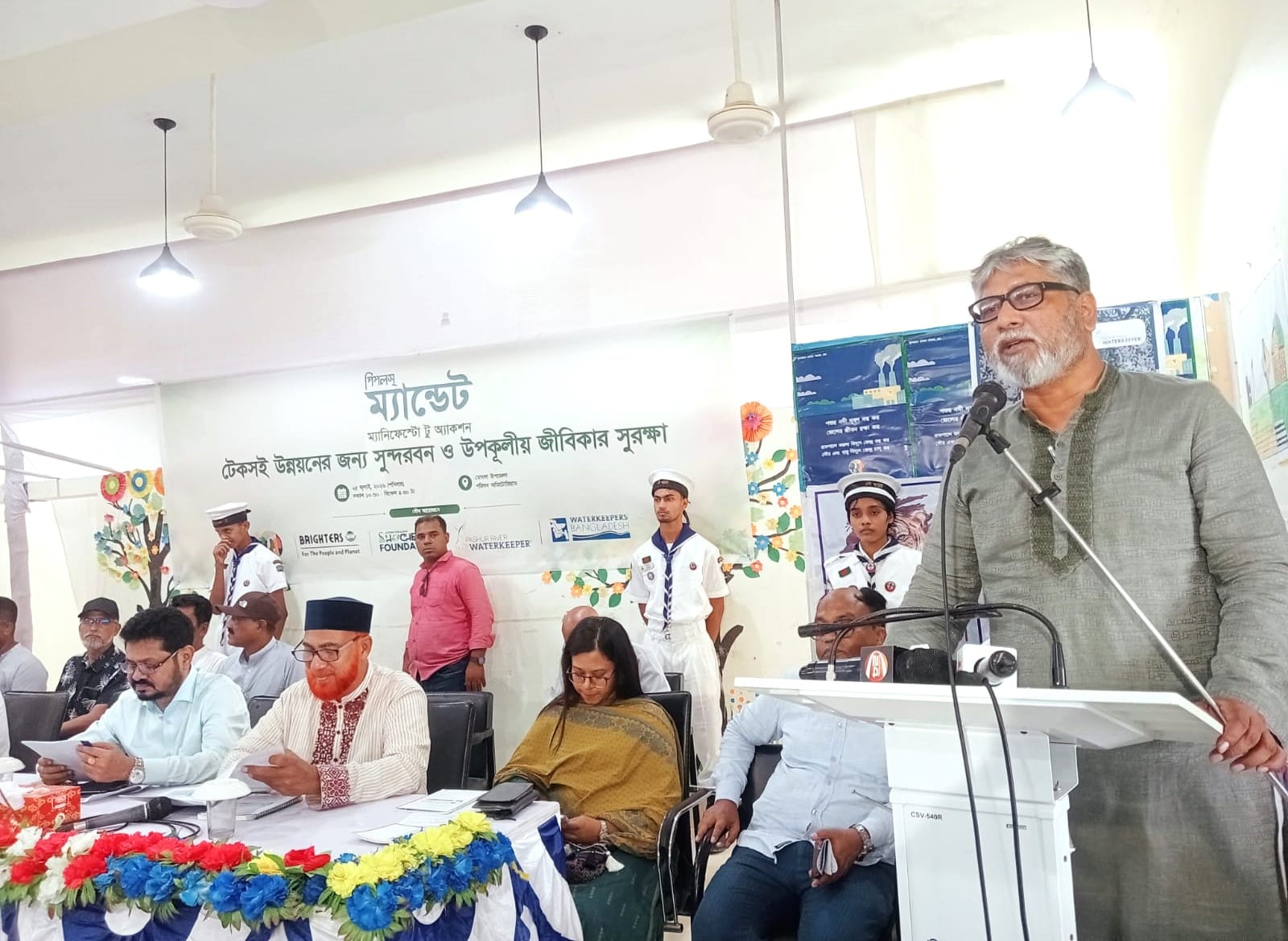
Protecting the Sundarbans and securing sustainable livelihoods for coastal communities will require coordinated action by the government, political parties, local authorities, civil society organisations and local residents, speakers said at a day-long public dialogue in Bangladesh’s south-west on Saturday.
The event, titled “Protecting the Sundarbans and Coastal Livelihoods for Sustainable Development,” was organised at the Mongla Upazila Auditorium in Bagerhat as part of the People’s Mandate: Manifesto to Action series. It was jointly hosted by environmental organisations Dhara (We for Protecting the Earth), Brighters, Pashur River Waterkeeper, Sachetan Foundation and Waterkeepers Bangladesh.
The first session was chaired by Sharif Jamil, Member Secretary of Dhara and Coordinator of Waterkeepers Bangladesh. The chief guest was Dr Sheikh Faridul Islam, State Minister for Environment, Forest and Climate Change.
Addressing the gathering, Dr Islam described the Sundarbans as one of the foundations of Bangladesh’s environmental security, biodiversity and coastal economy. He said the government was pursuing a “zero tolerance” policy against environmental crimes and would continue taking strict legal action against activities that threaten the forest.
He announced plans to expand alternative employment opportunities for forest-dependent communities through language education and vocational training. He also said that, for the first time, 6,662 tonnes of Vulnerable Group Feeding (VGF) rice had been allocated to support 8,271 fishers who rely directly on the Sundarbans during seasonal fishing restrictions.
According to the minister, the government is also strengthening conservation measures by restricting forest access during breeding seasons, releasing rescued wildlife back into their natural habitat and installing environmentally friendly fencing around forest-edge communities to reduce human-wildlife conflict.
Highlighting Bangladesh’s climate policy, Dr Islam said the government was shifting away from constructing new coal-fired power plants and placing greater emphasis on renewable energy.
During the second session, Nazrul Islam Manju, Administrator of Khulna City Corporation, warned that climate change is accelerating displacement in Bangladesh’s coastal regions. He called for sustainable alternative livelihoods for forest-dependent communities to reduce pressure on the Sundarbans while enabling people to remain in their own localities.
He also proposed establishing specialised forest courts to expedite environmental crime cases, forming local Sundarbans protection committees involving elected representatives and community members, and ensuring strict legal action against those responsible for forest destruction. He further stressed the importance of managing tourism, forest resource extraction and protected areas within the ecological carrying capacity of the Sundarbans.
Special guest Amir Ejaz Khan MP, representing Khulna-1, described the Sundarbans as a natural shield protecting coastal communities from cyclones and other climate-related disasters. He said government operations known as “Restore Peace in Sundarban” and “Mangrove Shield” had produced positive results in tackling forest piracy and organised environmental crime.
He emphasised that nature-based solutions, renewable energy, afforestation and active participation by local communities should form the foundation of future conservation and sustainable development strategies.
Another special guest, Md Abdul Alim MP of Bagerhat-4, described the Sundarbans as the world’s largest mangrove forest and a vital ecological buffer for Bangladesh’s coast. He called for stronger protection during fish breeding seasons, effective use of government support for fishers, increased public awareness and expanded reforestation programmes.
Barrister Sheikh Mohammad Zakir Hossain, Administrator of the Bagerhat District Council, said he had actively participated in the movement opposing the Rampal coal-fired power plant because of concerns over the Sundarbans. Calling the forest “the lungs of Bangladesh”, he urged stronger law enforcement against environmental crimes and greater investment in alternative livelihoods for forest-dependent communities.
In his closing remarks, Sharif Jamil noted that recent election manifestos from Bangladesh’s political parties have placed greater emphasis on environmental protection and climate action than ever before. He argued, however, that these commitments must now be translated into concrete policies through meaningful participation by affected communities, local representatives and environmental experts.
“The purpose of the People’s Mandate: Manifesto to Action initiative is not to criticise the government,” he said. “Rather, it seeks to support implementation of electoral commitments through evidence-based recommendations and constructive engagement.”
Jamil identified illegal hunting, poisoning of waterways for fishing, unauthorised resource extraction, deforestation, climate change, rising salinity, pollution and unplanned development as the most significant threats facing the Sundarbans. He called for stronger law enforcement, improved monitoring, alternative livelihood programmes, skills development, community participation, science-based planning and responsible forest governance.
He also urged policymakers to prioritise renewable energy and nature-based solutions, establish an independent coastal authority for the Sundarbans and adjacent coastal regions, and ensure thorough investigations and exemplary punishment for those responsible for environmental destruction.
The programme opened with a presentation by Faisal Ahmed, editor of River Bangla, outlining environmental and climate commitments contained in the election manifestos of Bangladesh’s major political parties.
Other speakers included Monira Sharmin, Convener of Jatiya Narishakti and Joint Convener of the National Citizen Party (NCP); Sharmin Akter Sumi, Upazila Nirbahi Officer of Mongla; Md Refatul Islam, Assistant Superintendent of Police, Mongla Circle; Md Rezaul Karim Chowdhury, Divisional Forest Officer (DFO), Bagerhat; and Md Abdul Mannan Hawlader, President of the Bangladesh Nationalist Party (BNP), Mongla Upazila branch. Representatives of political parties, environmental organisations, researchers, journalists, civil society groups and local stakeholders also attended.
Participants concluded by calling for the swift implementation of environmental and climate commitments contained in political parties’ election manifestos, greater public participation in policymaking and stronger partnerships between government institutions and civil society to safeguard the Sundarbans and promote sustainable development across Bangladesh’s vulnerable coastal region.