


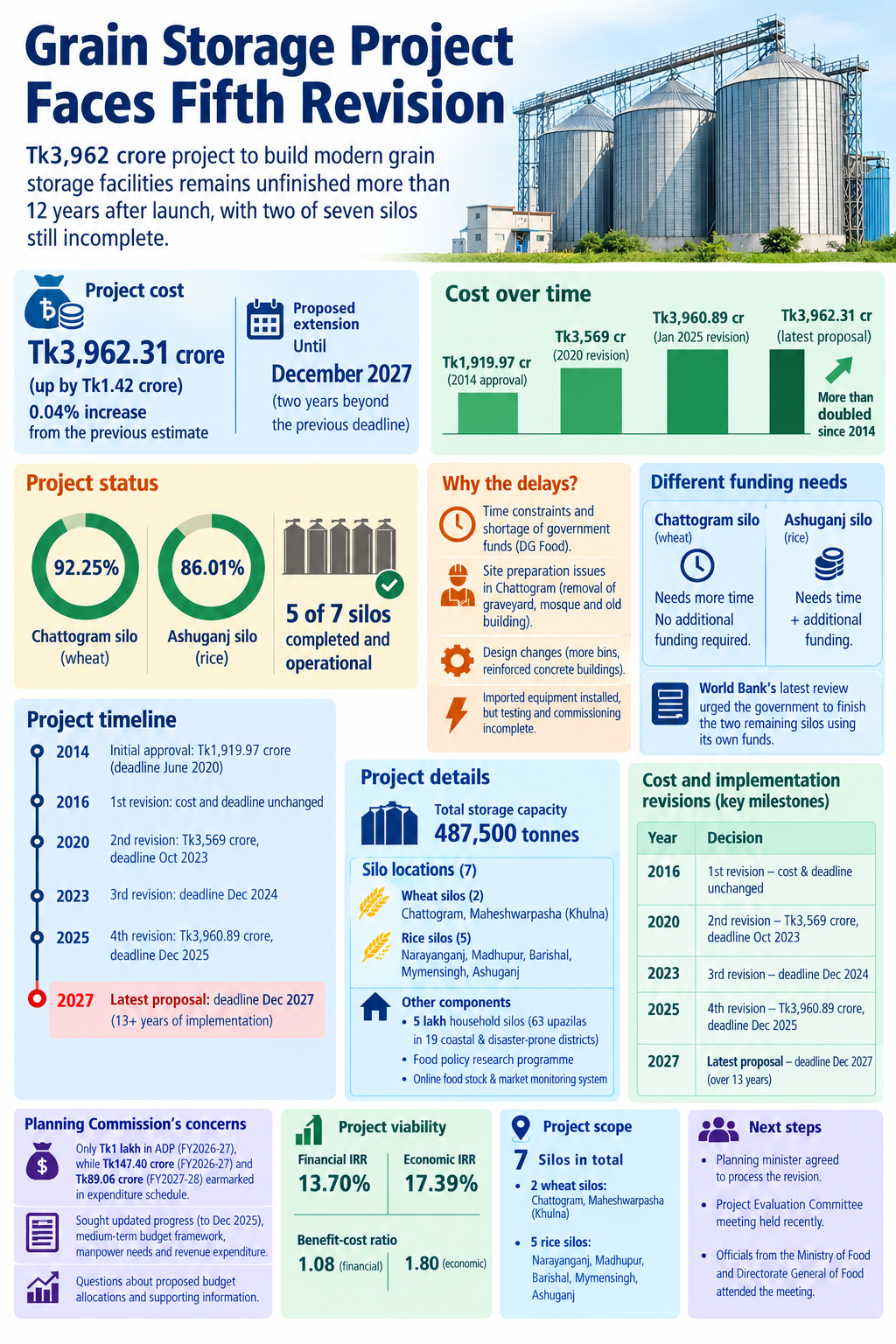
A Tk3,962 crore project to build modern grain storage facilities is heading for a fifth revision, with two of its seven steel silos still unfinished more than 12 years after the project was launched.
The Ministry of Food has proposed extending the project until December 2027, two years beyond the previous deadline, to complete a wheat silo in Chattogram and a rice silo in Ashuganj, according to Planning Commission documents.
The proposed revision would raise the project cost by Tk1.42 crore to Tk3,962.31 crore, a marginal increase of 0.04% over the previous estimate.
However, the overall cost has more than doubled from the original Tk1,919.97 crore approved in 2014, while the completion deadline has been pushed back repeatedly from June 2020.
According to a Planning Commission review, physical progress has reached 92.25% at the Chattogram silo and 86.01% at the Ashuganj facility. The other five silos have been completed and are operational.
The repeated delays have prolonged a project designed to strengthen Bangladesh’s grain storage capacity and improve food security, despite most of its major infrastructure already being in place.
The Directorate General of Food told the Planning Commission that time constraints and a shortage of government funds had prevented the remaining work from being completed by December 2025.
The two unfinished facilities face different funding requirements. While the Chattogram silo needs additional time without any increase in its allocation, the Ashuganj facility requires both an extension and additional funding.
At Chattogram, construction was delayed partly by site preparation work involving the removal of a graveyard, a mosque and an old office building.
The design was also revised to increase the number of storage bins from nine to 10, while three buildings are being constructed with reinforced concrete instead of steel to improve durability.
Imported electromechanical equipment has already been installed, but testing and commissioning remain incomplete.
According to project documents, the World Bank’s latest completion review mission urged the government to finish the two remaining silos using its own funds.
The proposed extension would also require adjustments to expenditure on outsourced manpower, office rent, software licences, consultants and supervision services.
Cost doubles amid repeated revisions
The project’s cost and implementation schedule have undergone several revisions since its approval in 2014.
The first revision in 2016 left both the cost and completion deadline unchanged.
The second revision, approved by the Executive Committee of the National Economic Council (Ecnec) in October 2020, raised the cost to around Tk3,569 crore and extended the deadline to October 2023.
A third revision in December 2023 pushed the completion deadline to December 2024.
The fourth revision, approved in January 2025, increased the cost to Tk3,960.89 crore and extended the implementation period until December 2025.
Under the latest proposal, the deadline would move to December 2027, extending the project’s implementation period to more than 13 years.
The project involves constructing seven silos with a combined storage capacity of 487,500 tonnes.
The two wheat silos are located in Chattogram and Maheshwarpasha in Khulna, while the five rice silos are in Narayanganj, Madhupur, Barishal, Mymensingh and Ashuganj.
It also includes distributing five lakh household silos across 63 upazilas in 19 coastal and disaster-prone districts, implementing a food policy research programme and developing an online food stock and market monitoring system.
Planning Commission questions funding arrangements
The Planning Commission has raised questions about the proposed budget allocations and supporting information for the latest revision.
Its review found that the project has an allocation of only Tk1 lakh in the Annual Development Programme (ADP) for FY2026-27, although the proposed expenditure schedule earmarks Tk147.40 crore for the same fiscal year and Tk89.06 crore for FY2027-28.
The commission has also sought updated implementation progress through December 2025, along with additional information on the medium-term budget framework, manpower requirements and revenue expenditure.
According to the proposal, the project has an estimated financial internal rate of return of 13.70% and an economic internal rate of return of 17.39%, with benefit-cost ratios of 1.08 and 1.80, respectively.
The planning minister has agreed to process the proposed revision, while a Project Evaluation Committee meeting was recently held to examine the proposal.
Officials from the Ministry of Food and the Directorate General of Food attended the meeting.