


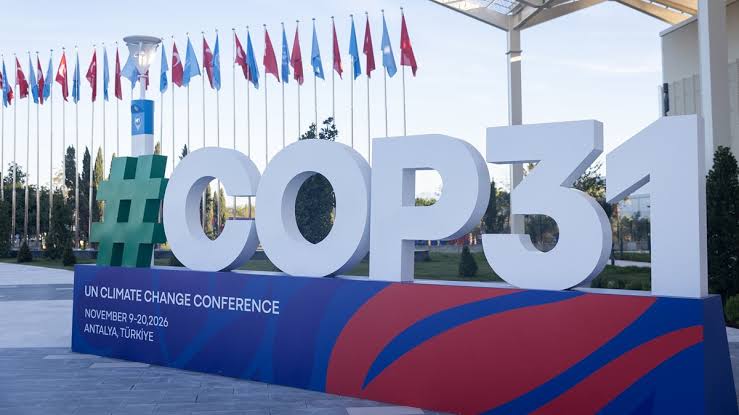
Antalya, November 9: The UN Climate Change Conference COP31 opened in Antalya, Türkiye, on Monday with a strong call from its presidency to translate international climate commitments into practical action, as mounting geopolitical tensions, economic uncertainty and extreme weather intensify pressure on governments worldwide.
COP31 President Murat Kurum declared that the summit must become an “Implementation COP”, focused on delivering tangible results rather than making further promises.
Addressing delegates at the opening ceremony, Kurum warned that climate change could no longer be treated as an isolated challenge, arguing that geopolitical conflicts, economic instability, food insecurity and technological inequalities were increasingly interconnected.
“Each crisis makes the others worse,” he said, highlighting how droughts, floods, water shortages and extreme heat were disrupting agricultural production, supply chains, economies and public health.
“A drought in one part of the world is felt at the dinner table in another,” Kurum added.
He reaffirmed the Paris Agreement’s ambition to limit global temperature increases to 1.5°C above pre-industrial levels, describing the target as the guiding benchmark for international climate action.
“The 1.5°C goal remains our guide, and at COP31 we will be frank about what the science tells us,” he said.
Kurum pledged that Türkiye would seek to bridge political and economic divisions to advance international climate cooperation.
“Türkiye has long served as a bridge – we are ready to take on that responsibility again,” he said.
Climate finance and electrification take centre stage
The COP31 presidency has placed electrification, renewable energy, energy efficiency and climate finance at the centre of its implementation agenda.
Kurum highlighted Türkiye’s proposed ’35-by-35′ Global Electrification Pledge, which aims to increase electricity’s share of final energy consumption to 35% by 2035.
He said renewable energy, stronger electricity grids, energy storage, clean transport and green industrial development would be essential to accelerating the global energy transition.
The presidency wants climate commitments to produce visible improvements in everyday life, including more energy-efficient buildings, cleaner public transport, affordable electricity and employment opportunities.
Climate finance will be another major test of the summit’s ambition.
Kurum referred to the agreement reached in Baku to provide at least $300 billion annually in climate finance for developing countries by 2035, alongside a broader ambition to scale up financing from all sources to at least $1.3 trillion a year.
“Now our promises must be backed by capital. That capital must fund investment. And that investment must deliver results,” he said.
Bowen highlights climate and energy security link
COP31 President of Negotiations Chris Bowen said the conference offered an opportunity to demonstrate what international cooperation could achieve for both climate action and global energy security.
“COP31 is an opportunity to show what cooperation can deliver at this crucial time for both our climate and global energy security,” Bowen said.
He identified climate finance, investment, electrification and ocean protection as key priorities for the negotiations.
“COP31 must help close the gap between commitment and delivery, and focus on real-world outcomes – investment, infrastructure, jobs, energy security and resilient communities,” he said.
“Working together, we can turn climate commitments into stronger, more resilient and prosperous economies.”
UN climate chief warns of mounting economic costs
UN Climate Change Executive Secretary Simon Stiell warned that fossil fuel price volatility and extreme weather were imposing growing economic costs on households and businesses.
“This year’s fossil fuel cost chaos has delivered a global shockwave, hitting households hard and spreading inflation like a cancer,” Stiell said.
He pointed to the economic benefits of renewable energy, saying global renewables had saved $265 billion in the first half of 2026 alone.
“Adaptation delivers proven returns on investment. It’s in every country’s interest to limit global heating, and protect every community and economy,” he added.
Stiell urged governments to move beyond climate targets and accelerate implementation through both formal negotiations and practical initiatives.
“Global heating is already costing the Earth, and the vulnerable everywhere are paying the highest price. COP31 must supercharge solutions, across both the negotiations and the Action Agenda,” he said.
Food, agriculture and health dominate opening-day agenda
Food security, agriculture and public health formed the thematic focus of COP31’s opening day, reflecting growing concerns about the impact of climate change on vulnerable communities.
The current ‘Super’ El Niño phenomenon could push nearly 50 million additional people into acute hunger, according to the conference materials.
The opening-day programme focused on strengthening food systems, improving agricultural resilience and ensuring that climate finance and technical support reach communities most exposed to climate-related risks.
A major initiative launched by the COP31 presidency, Türkiye’s Ministry of Health, the World Health Organization (WHO) and the Alliance for Transformative Action on Climate and Health (ATACH) is the Antalya Initiative for Resilient Health Systems (AIR).
The initiative aims to help countries strengthen healthcare systems so they can better anticipate, adapt to and respond to climate-related threats.
Agricultural finance and the role of women farmers also featured prominently.
A High-Level Women Farmers’ Dialogue, organised by the COP31 presidency, the International Fund for Agricultural Development (IFAD) and Türkiye’s Ministry of Agriculture and Forestry, is examining barriers preventing women farmers from accessing climate finance.
The event also features the launch of The Unfunded Half, a joint report by IFAD and Türkiye’s Ministry of Agriculture and Forestry.
Young farmers and agricultural innovation are another priority. A separate High-Level Young Farmers’ Dialogue, organised with the Food and Agriculture Organization of the United Nations (FAO), will focus on the role of younger generations in transforming agriculture, water management and food systems.
The programme also includes the Antalya Call to Action for Youth on Agri-food Systems.
Meanwhile, the new Children and Youth Pavilion will provide a dedicated platform for young people to present their climate solutions and engage with policymakers, investors and development partners.
Two-week summit faces implementation challenge
The opening programme also introduced the broader agenda for the two-week summit, with activities taking place across the Blue Zone and Green Zone.
The Blue Zone will host official UN climate negotiations and high-level government meetings, while the Green Zone will bring together businesses, academics, civil society organisations, government agencies and young people to showcase climate solutions.
A further initiative, the Turquoise Nexus Initiative, is scheduled to be launched on Tuesday under Türkiye’s Ministry of Agriculture and Forestry, in coordination with the COP31 presidency.
The programme, linked to FAO’s Food and Agriculture for Sustainable Transformation (FAST) Partnership, seeks to integrate food-system transformation, sustainable water management and climate adaptation into national policies and investment programmes.
As COP31 begins, the central challenge facing negotiators is whether governments can translate years of climate pledges into measurable progress on the ground.