


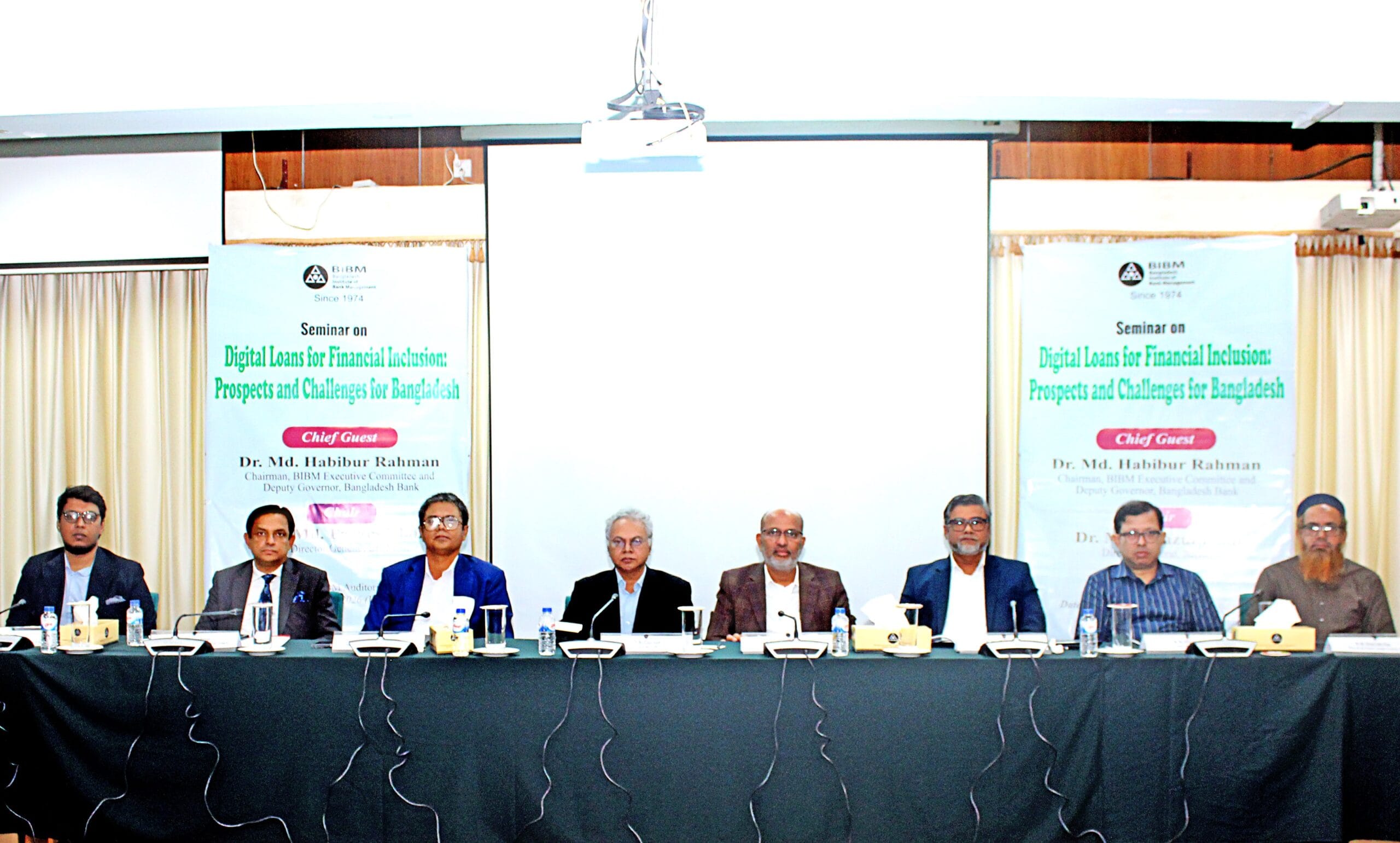
Digital lending could help expand financial inclusion in Bangladesh by making formal credit more accessible and affordable to people underserved by traditional banks, speakers at a financial-sector seminar in Dhaka have said.
The comments came at a seminar titled “Digital Loans for Financial Inclusion: Prospects and Challenges for Bangladesh”, organised by the Bangladesh Institute of Bank Management (BIBM) at its auditorium in Mirpur on Wednesday.
A research team from BIBM presented a study examining the opportunities, challenges and future direction of digital lending in the country. The research drew on international experience, questionnaire-based evidence from banks and interviews with key financial-sector stakeholders.
The study found that digital lending could make small loans commercially viable by cutting transaction costs, reducing geographical barriers and using digital and alternative data to assess borrowers who lack conventional credit histories.
Bangladesh has already established much of the infrastructure needed to support digital finance, including mobile financial services, agent banking, electronic know-your-customer systems and digital payment platforms.
However, the country’s digital lending market remains concentrated largely in nano-loans and models operated by banks or through partnerships between banks and mobile financial services providers.
The study estimated that the operating costs of digital lending can be less than 1–2% of those associated with traditional lending, highlighting its potential to improve efficiency.
Digital loans account for a significant proportion of retail loan disbursements and loan accounts, although they still represent a relatively small share of total outstanding loan portfolios, the research found.
The reported default or classification rate for digital loans was around 3–4%, while rural borrowers accounted for roughly 30–40% of observed digital borrowers. Repeat borrowers made up approximately 45–60% of the borrower base, while female participation varied considerably between institutions, ranging from about 3% to 25%.
The researchers said digital lending could be particularly beneficial to underserved households, microentrepreneurs, farmers, women and micro, small and medium-sized enterprises.
They warned, however, that financial inclusion should not be judged simply by the number or value of loans issued. Affordability, sustainability, responsible borrowing and the quality of credit should also be taken into account.
Dr Md Habibur Rahman, chairman of the BIBM Executive Committee and deputy governor of Bangladesh Bank, attended the seminar as chief guest. He said digital lending could help bring formal financial services to people who remain outside the conventional banking system.
The expansion of digital credit could reduce barriers faced by small borrowers and others who struggle to secure traditional bank loans, he said, while stressing the need for responsible and sustainable growth to prevent new risks for borrowers and financial institutions.
The seminar was chaired by Dr Md Ezazul Islam, director general of BIBM. He said digital lending could become an important pillar of financial inclusion if the wider ecosystem develops responsibly.