


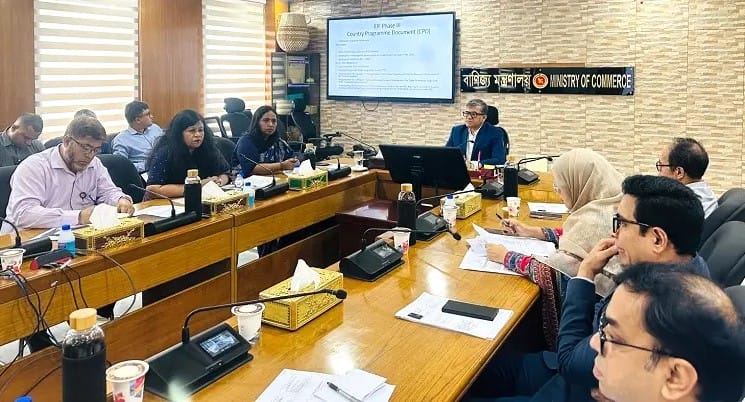
Bangladesh is set to roll out a new five-year action plan to strengthen trade capacity, improve the investment climate and enhance global competitiveness ahead of its graduation from the least developed country (LDC) status.
The initiative will be implemented through a Country Programme Document (CPD) prepared under the third phase of the Enhanced Integrated Framework (EIF) of the World Trade Organization, officials said at a validation workshop on Sunday.
Speaking at the event, Commerce Secretary Ataur Rahman Khan said the economy is passing through a critical juncture, as the country prepares for LDC graduation while facing non-tariff barriers, compliance challenges and constraints in the investment environment.
He said the new CPD incorporates key recommendations from previous EIF phases and outlines 12 priority interventions aligned with Bangladesh’s reform agenda and trade capacity needs.
“Policy formulation alone is not enough—the real challenge lies in effective implementation,” he said, stressing the need for clear execution strategies to ensure reforms reach all levels of government institutions.
The plan places emphasis on trade facilitation, liberalisation, regulatory reforms and stronger coordination among ministries to improve the overall business environment, he added.
Additional Secretary (WTO) Khadija Nazneen said the EIF programme supports LDCs in building trade capacity, with funding from development partners including the United Kingdom, the European Union and Sweden.
She noted that Bangladesh has already completed two phases of the EIF programme—spanning 2009–2015 and 2016–2024—and is now preparing to launch the third phase. The new five-year programme is expected to begin later this year, subject to funding approval.
Former additional secretary and EIF consultant Md Hafizur Rahman said the CPD has been developed by aligning existing national policies and strategies, including the Diagnostic Trade Integration Study (DTIS), export and industrial policies, trade policy and commitments under the Trade Facilitation Agreement.
Initially, around 52 potential projects were identified, but these were streamlined into 12 priority programmes based on feasibility and expected donor support, he said.
The selected programmes focus on export diversification, trade facilitation, investment climate reforms, institutional capacity building, training and research, along with the use of artificial intelligence in trade-related processes.
Officials and stakeholders at the workshop expressed hope that the third phase of the EIF programme would help Bangladesh sustain its competitiveness in global trade and attract new investment in the post-LDC era.