


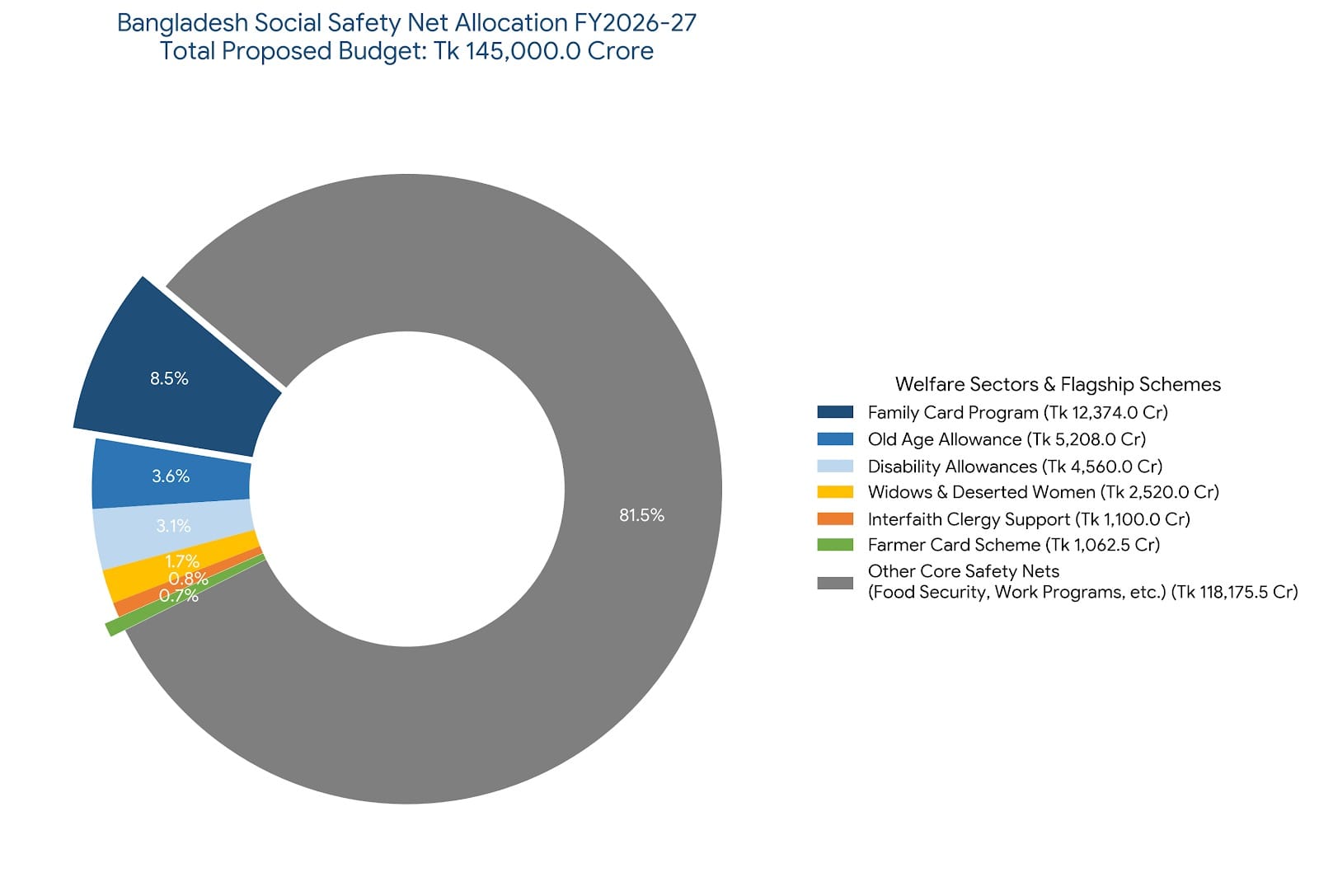
The government has proposed a record Tk1.45 trillion allocation for social safety net programmes in the FY2026-27 budget, significantly expanding welfare spending while introducing reforms aimed at improving targeting, transparency and direct cash support for vulnerable groups.
Presenting the proposed Tk9.38 trillion national budget in parliament on Thursday, Finance Minister Amir Khosru Mahmud Chowdhury said the expanded social protection framework is aligned with the government’s goal of “economic democratisation” and is designed to shield low-income households from persistent inflationary pressures.
The proposed allocation marks an increase of nearly Tk280 billion from the original FY2025-26 allocation of Tk1,167.31 billion and accounts for 15.39% of the national budget and 2.11% of GDP.
Focus on direct assistance
The government plans to strengthen the social protection system by increasing direct cash transfers and improving beneficiary identification through digital platforms.
Officials said the revised framework excludes several expenditures that were previously included in social safety net calculations, such as government pensions and broad-based subsidies, to provide a clearer picture of spending targeted at poor and vulnerable populations.
Allowances Increased
Under the proposal, the monthly Old Age Allowance will rise from Tk650 to Tk700, while the number of beneficiaries will increase from 6.1 million to 6.2 million.
The monthly allowance for widows and destitute women will also increase from Tk650 to Tk700, covering around 3 million beneficiaries.
For persons with disabilities, the monthly allowance will be raised from Tk900 to Tk1,000, while the number of beneficiaries will increase from 3.45 million to 3.8 million.
The government also plans to double emergency healthcare assistance for patients suffering from critical illnesses, including cancer, stroke and kidney disease, from Tk50,000 to Tk100,000. Up to 65,000 people are expected to benefit from the programme.
Expansion of Family Card Programme
A key feature of the proposed budget is the expansion of the Family Card Programme, for which Tk123.74 billion has been allocated.
Under the scheme, 4.1 million female-headed poor households will receive Tk2,500 per month directly through digital payment channels. Beneficiaries of the programme will not be eligible to receive support from other major safety net schemes.
The government aims to expand the programme to 16.1 million families over the next five years.
Support for Farmers and Religious Workers
The budget allocates Tk10.62 billion for a new Farmer Card programme that will provide annual cash support of Tk2,500 to 4.25 million small and landless farmers.
The government has also proposed Tk11 billion for an honorarium programme covering 255,666 religious workers from Islam, Hinduism, Buddhism and Christianity. Registered imams, priests and abbots will receive monthly allowances, along with support for assistants and attendants.
Urban Employment and Climate Response
To support workers affected by economic or climate-related shocks, a temporary assistance programme will provide Tk5,000 per month for up to three months to 15,000 displaced or unemployed labourers.
The budget also includes funding for public works programmes, including canal excavation and tree plantation initiatives, which are expected to generate around 350,000 jobs in rural areas.
Strengthening Digital Oversight
The government plans to enhance monitoring and accountability through mandatory National Identity Card (NID) verification, digital birth registration for child beneficiaries and the use of a Dynamic Social Registry (DSR) to identify eligible recipients.
All cash assistance will be disbursed directly through Government-to-Person (G2P) payment systems using mobile financial service platforms.
The finance minister said the reforms are intended to reduce leakages, eliminate intermediaries and ensure that social protection benefits reach intended recipients more efficiently.
The government also plans to introduce regular reviews of allowance rates linked to inflation and gradually connect cash assistance programmes with skills development and livelihood support initiatives to help beneficiaries transition toward economic self-reliance.