


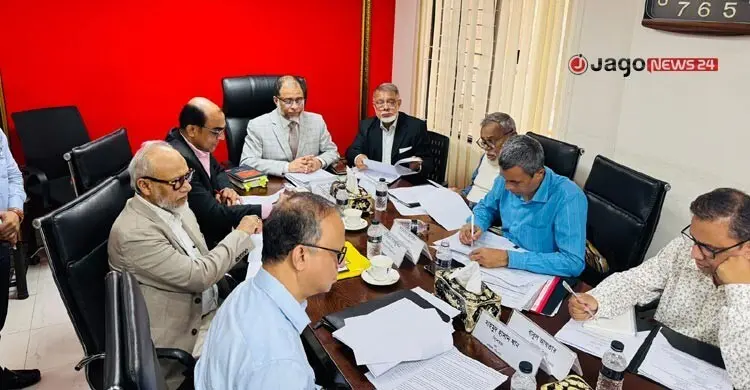
The minimum wage negotiations for garment workers remained deadlocked on Tuesday, with factory owners offering Tk15,700 a month against the workers’ demand for Tk22,000, leaving a Tk6,300 gap between the two sides.
Despite several rounds of negotiations and revisions to their proposals, the two sides failed to reach a compromise at the fourth meeting of the Minimum Wage Board in Dhaka.
The owners’ latest offer is Tk100 lower than the Tk15,800 they proposed during Tuesday’s marathon meeting, while the workers’ side has maintained its revised demand of Tk22,000, down from its initial demand of Tk32,000.
Briefing reporters after Tuesday’s meeting, board chairman Syed Azad Subhani said discussions were continuing to formulate recommendations for fixing minimum wages for all categories of workers and employees in the garment sector.
The meeting, held at the board’s Segunbagicha office, focused on the written wage proposals submitted by the owners’ and workers’ representatives and the formulation of recommendations for a new minimum wage structure.
The workers’ representatives have described the owners’ offer as unreasonable, while the substantial difference between the two proposals has made a settlement difficult.
A separate calculation of Tk16,996 also came up during Tuesday’s discussions, but it was neither a final proposal nor a decision, a board representative said.
The representative said neither side’s proposal was final and the board was trying to reach a consensus by taking the views of all stakeholders into account.
In an effort to narrow the differences, the board has been holding both joint and separate consultations with the owners’ and workers’ representatives. Industry experts have also been invited to share data and analysis to facilitate the discussions.
The board is following the relevant laws and regulations and will not accept any proposal unilaterally, the representative said.
He also cautioned against treating various wage figures circulating in the media as official decisions, saying the board would not be responsible for information attributed to unofficial sources.
The previous day’s meeting continued until around 9:15pm without any formal announcement.
The board faces the challenge of reconciling workers’ growing living costs with the garment industry’s ability to absorb higher labour expenses. A mutually acceptable wage settlement is considered crucial to easing labour discontent in the country’s largest export-earning sector.