


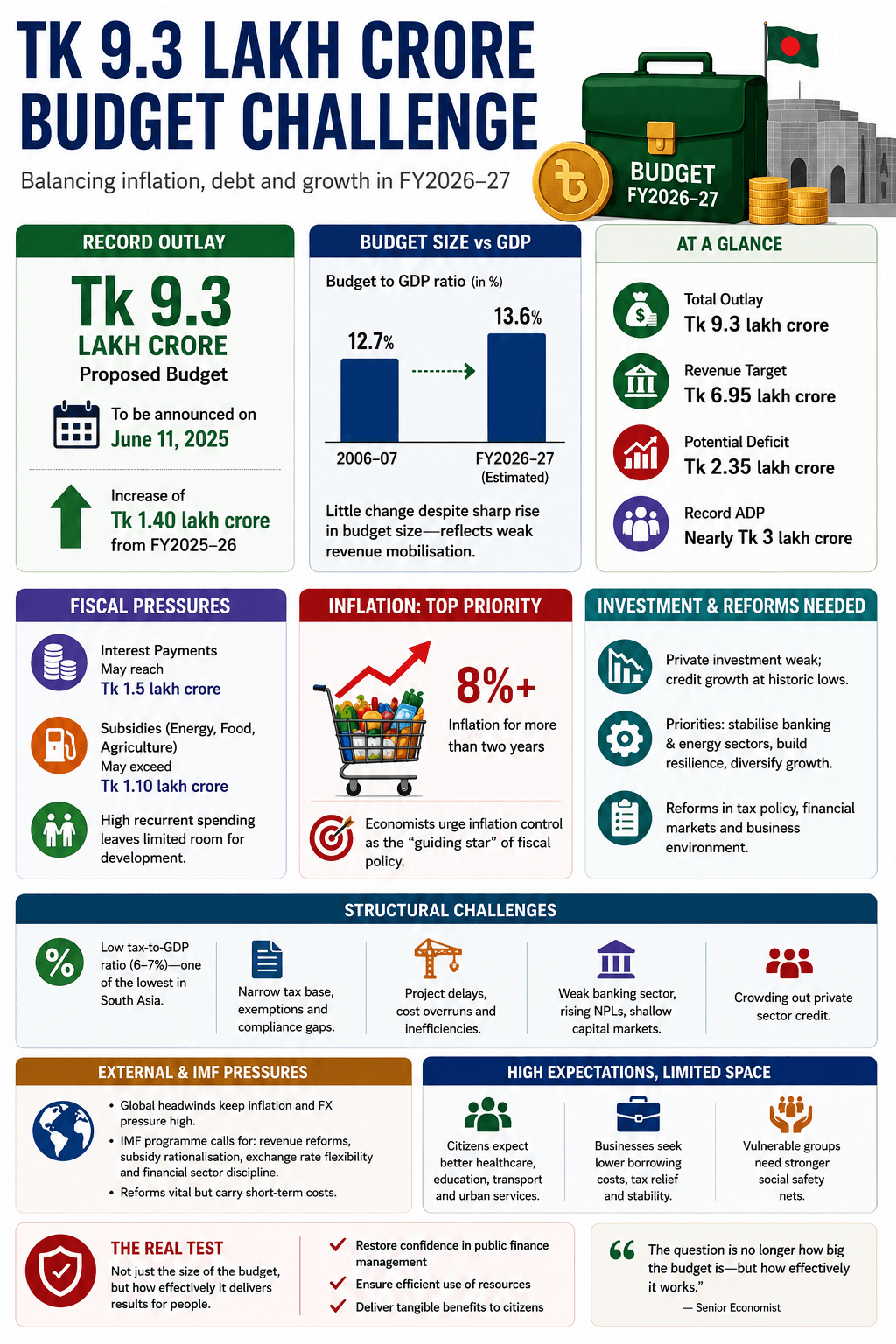
The government Bangladesh is set to unveil its largest-ever national budget of Tk9.3 lakh crore for FY2026-27, as policymakers grapple with tight fiscal space, persistent inflation and rising debt, turning the upcoming announcement into a delicate policy balancing act.
The proposed outlay, expected to be announced on 11 June, is nearly Tk1.40 lakh crore higher than the budget for the current fiscal year, reflecting rising expenditure commitments and political pledges made by the newly elected BNP government.
Yet, despite the sharp increase in budget size over nearly two decades, the budget-to-GDP ratio has changed only marginally, from about 12.7% in 2006-07 to an estimated 13.6%, highlighting persistent weaknesses in revenue mobilisation.
While the larger outlay reflects growing expenditure needs and political commitments, economists say the real challenge lies in managing limited resources amid mounting economic pressures.
Revenue strain, rising debt
Officials say the government is targeting revenue collection of around Tk6.95 lakh crore, leaving a potential deficit of about Tk2.35 lakh crore. The gap is expected to be financed largely through domestic and foreign borrowing, adding to an already rising debt burden.
Interest payments alone could approach Tk1.5 lakh crore in the next fiscal year due to higher borrowing costs and elevated global interest rates. In addition, subsidies for energy, food and agriculture may exceed Tk1.10 lakh crore, further tightening fiscal space.
Economists warn that an increasing share of the budget is being absorbed by recurrent expenditure, leaving limited room for development spending despite a record Annual Development Programme (ADP) of nearly Tk3 lakh crore.
Inflation takes centre stage
Containing inflation, which has remained above 8 percent for more than two years, is emerging as the central priority of the upcoming budget.
Economists and business leaders have urged the government to make inflation control the “guiding star” of fiscal policy, as rising prices continue to erode household incomes.
“Macroeconomic stability hinges on bringing down inflation,” said Debapriya Bhattacharya, distinguished fellow at the Centre for Policy Dialogue, describing the budget as a “tough test of balance” amid competing pressures.
Call for a ‘people-centric’ budget
Economic analysts have stressed the need for a “comfort-oriented” budget aimed at easing pressure on ordinary citizens through lower tax burdens, reduced harassment in tax administration and relief from high interest rates.
Responding to such concerns at a pre-budget roundtable, the finance minister said the government would prioritise citizens’ welfare over headline growth.
“Growth has little meaning if it does not improve people’s lives,” he said, adding that the government plans to move towards a more participatory and inclusive economic model.
He also signalled reforms in tax policy, financial markets and business regulations, including measures to revitalise the capital market and reduce the cost of doing business.
Investment slowdown, reform urgency
Analysts say weak private investment remains a major concern, with credit growth to the private sector falling to historic lows and investor confidence remaining subdued.
Policy Exchange Bangladesh Chairman M Masrur Reaz described the current investment climate as having “bottomed out”, warning that employment, exports and productivity would stagnate without restoring momentum.
He identified three key priorities for the budget: stabilising the banking and energy sectors, strengthening resilience against policy and external shocks, and diversifying growth drivers.
Structural challenges persist
Bangladesh’s fiscal challenges are compounded by a tax-to-GDP ratio hovering around 6-7%, among the lowest in South Asia.
Experts say expanding the tax base, reducing exemptions and improving compliance will be crucial for financing development sustainably.
At the same time, governance concerns, including delays in project implementation, cost overruns and inefficiencies in public spending, continue to undermine budget effectiveness.
Weaknesses in the banking sector, rising non-performing loans and shallow capital markets have further constrained financing options, increasing reliance on banks and crowding out private-sector credit.
Pressure from global and IMF fronts
External factors, including the lingering effects of the pandemic, the Russia-Ukraine war and tensions in the Middle East, have kept inflationary and foreign exchange pressures elevated.
The government is also operating under an ongoing IMF programme that calls for revenue reforms, subsidy rationalisation, exchange rate flexibility and greater financial sector discipline.
While these reforms may strengthen long-term stability, economists caution that they could carry short-term social and political costs.
Expectations versus constraints
Beyond macroeconomic pressures, rising public expectations are also shaping the budget narrative.
With expanded access to electricity, infrastructure and digital services over the past two decades, citizens are now demanding better healthcare, education, transport and urban services, placing additional structural pressure on public spending.
At the same time, businesses are seeking lower borrowing costs, tax relief and policy stability to revive investment, while vulnerable groups are looking for expanded social safety net coverage.
A test of credibility
For the finance minister, analysts say, the challenge extends beyond announcing a large budget.
The real test lies in restoring confidence in public finance management, ensuring efficient use of resources and delivering tangible benefits to citizens.
As one senior economist put it, “The question is no longer how big the budget is, but how effectively it works.”
With limited fiscal space, rising obligations and high public expectations, the FY2026-27 budget is shaping up to be one of the most consequential, and constrained, in recent years.