


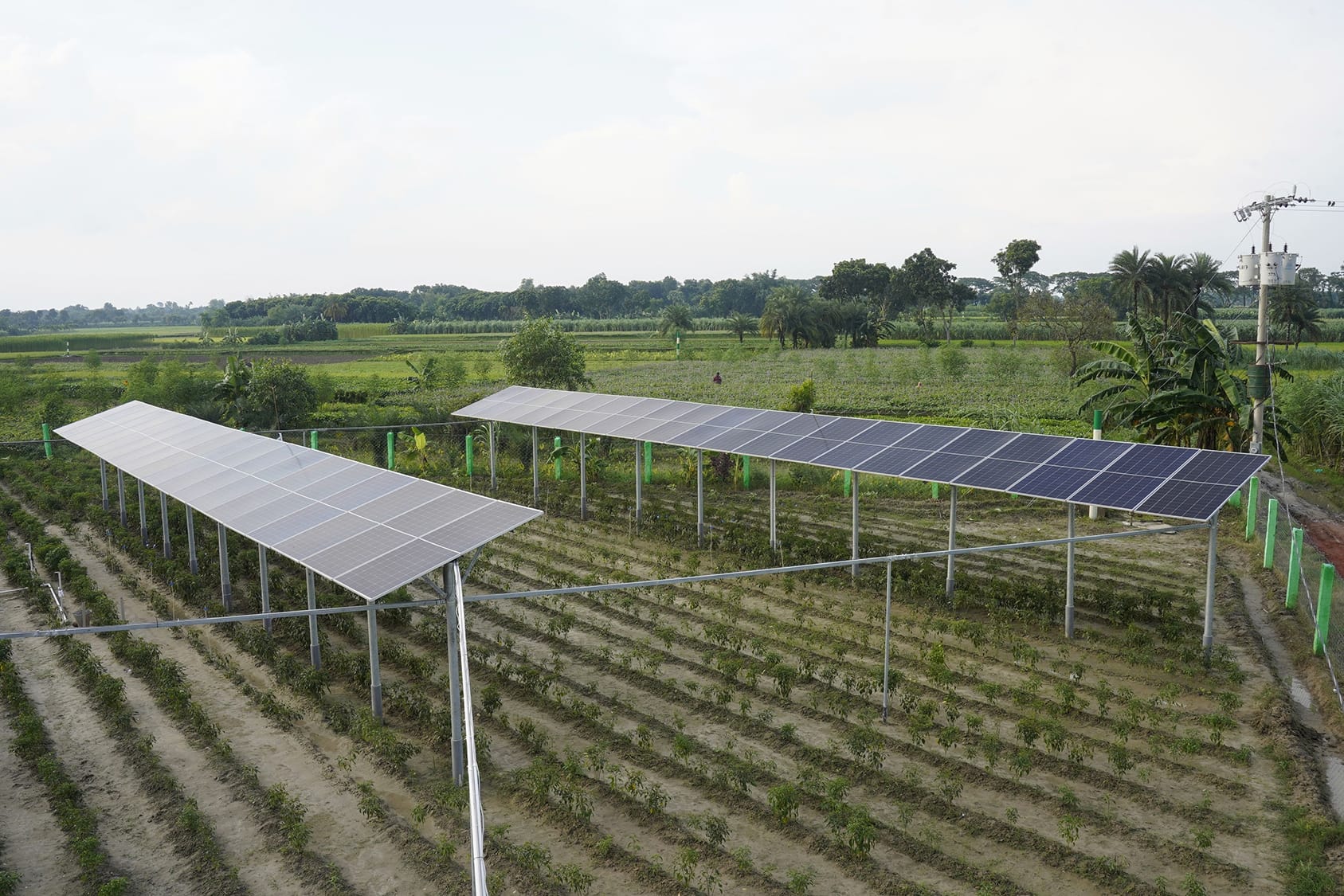
The government has launched its first scientifically structured, grid-connected agrivoltaics pilot project, combining solar power generation with crop cultivation in an effort to expand renewable energy without putting further pressure on agricultural land.
The 49.6kWp project was inaugurated in Chuadanga Sadar on Wednesday by the Power Division. The pilot is designed to test how solar panels and farming can operate on the same land, with the results expected to help shape future policy and investment in Bangladesh’s renewable energy sector.
The initiative is being implemented under the Green Energy Transition – Policy Advisory Partnership (GET-PAP), a project co-funded by the European Union and Germany’s Federal Ministry for Economic Cooperation and Development (BMZ), and implemented by GIZ Bangladesh in partnership with the Power Division.
Green chillies are currently being cultivated beneath and around the solar installation, with seasonal vegetables and rice among the crops being considered for future planting.
The project is being developed with technical support from the Fraunhofer Institute for Solar Energy Systems (Fraunhofer ISE), which has expertise in agrivoltaic system modelling, technical design and installation. The German research institute is also helping build local expertise so that similar projects can be developed elsewhere in Bangladesh.
Agrivoltaics — also known as agri-PV — is designed to allow agricultural production and solar electricity generation to take place on the same site. For a densely populated country where competition for land is a major constraint on renewable energy expansion, the approach could offer a way of increasing solar generation while retaining land for food production.
Ahead of the inauguration, farmers, teachers, researchers, engineers, contractors and system operators took part in practical training at the site. The sessions covered farming techniques for crops grown in partial shade, solar system maintenance and digital data collection.
Officials and policymakers also visited the demonstration plot as part of efforts to develop a potential national roadmap and guidelines for agrivoltaic projects.
Muhammad Khalequzzaman, Joint Secretary of the Efficiency and Conservation Division at the Ministry of Power, Energy and Mineral Resources, said the dual use of land could help Bangladesh pursue clean-energy targets without undermining food security.
“By using the land for multiple purposes, Bangladesh will be able to play a role in achieving its sustainable energy goals without compromising on agricultural productivity and food security,” he said.
Ulrich Kleppmann, Head of Development Cooperation at the German Embassy in Dhaka, and Tanzina Dilshad, Programme Manager for Green Inclusive Development at the European Union Delegation to Bangladesh, also addressed the inauguration.
The pilot brings together international development agencies, public finance and Bangladeshi organisations. Infrastructure Development Company Limited (IDCOL) has financed 80% of the installation cost through a capital grant supported by Germany’s KfW Development Bank.
Bangladeshi civil society organisation Wave Foundation is sponsoring the project, providing equity and hosting the installation at its solar irrigation pumping site. GIZ and Fraunhofer ISE are providing technical support.
The project comes as Bangladesh seeks to increase the share of clean energy in its electricity mix. The government is targeting 20% of electricity generation from clean energy sources by 2030.
Data from the Chuadanga site — including crop yields, solar generation and operational performance — is expected to be used to inform national policy. Supporters of the scheme say establishing common technical and agricultural standards will be essential if agrivoltaics is to move beyond pilot projects and attract wider private investment.
The GET-PAP programme forms part of the wider Team Europe Initiative in Bangladesh, which brings together more than €3.7bn from the European Union, its member states and financial partners to support the country’s transition towards a greener and more resilient economy.
In November 2025, the programme also supported the establishment of a National Working Group on Agrivoltaics and Floating Solar, reflecting growing interest in renewable-energy technologies designed to make better use of Bangladesh’s limited land resources.