


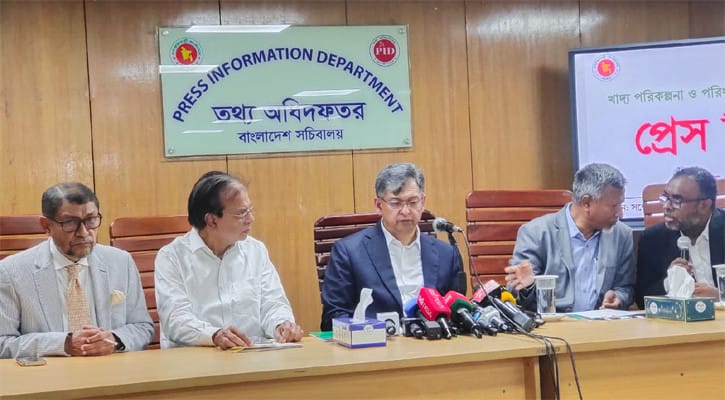
The government will start procuring 1.85 million tonnes of boro paddy, rice and wheat from May 3 as part of its efforts to strengthen food security and maintain stable market supplies, officials said on Wednesday.
The decision was finalised at a meeting of the Food Planning and Monitoring Committee (FPMC), chaired by Home Affairs Adviser Salahuddin Ahmed, and later announced at a press briefing at the Secretariat.
Under the programme, the government will purchase boro paddy at Tk 36 per kg, parboiled rice at Tk 49 per kg, and non-parboiled (atap) rice at Tk 48 per kg.
Wheat will also be procured at Tk 36 per kg. The procurement drive will continue until August 31, with rice collection scheduled to start from May 15.
Officials said the procurement target includes 500,000 tonnes of paddy, 1.2 million tonnes of parboiled rice, 100,000 tonnes of atap rice, and 50,000 tonnes of wheat. The prices remain unchanged from last year.
Speaking at the briefing, Salahuddin Ahmed said the initiative aims to ensure fair prices for farmers while strengthening public food reserves.
He added that the country currently holds a comfortable stock of around 1.7 to 1.8 million tonnes of rice in government warehouses.
The adviser noted that Bangladesh’s annual food grain requirement stands at about 8 million tonnes, while domestic production averages between 7.0 and 7.2 million tonnes.
To bridge the gap, the government imports roughly 800,000 tonnes of food grains each year through government-to-government agreements and open tenders.
He said the minimum safe food stock level has been set at 1.3 million tonnes, which must be maintained at all times. However, the government now plans to raise total reserves to 2.4–2.5 million tonnes in the coming years by strengthening procurement and, if necessary, increasing imports.
Officials also acknowledged that wheat procurement has historically faced challenges due to lower domestic production and limited farmer interest.
Nevertheless, the government has retained a target of 50,000 tonnes for this season.
Authorities said procurement targets and strategies may be adjusted based on market conditions and production trends to ensure uninterrupted food supply and long-term food security.