


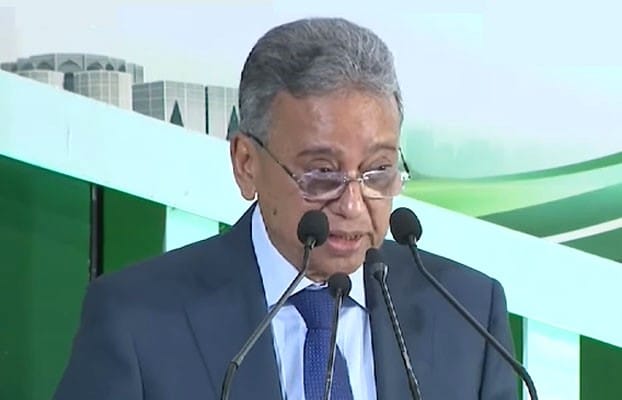
The restructuring of the National Board of Revenue (NBR) into separate revenue policy and revenue management divisions marks a fundamental shift in the government’s revenue philosophy, rather than merely an administrative reorganisation, Finance Minister Amir Khosru Mahmud Chowdhury said on Tuesday.
“The transformation initiated by separating revenue policy from management may create some uncertainty among officials. But the success of this reform depends on your competence and professionalism,” he told NBR officials.
The minister was speaking at a revenue conference organised by the NBR at the China Friendship Conference Centre in Dhaka. Prime Minister Tarique Rahman attended the event as the chief guest.
Khosru said the restructuring would create clearer career paths for officials, empower them and provide greater opportunities to serve the country with professionalism and dignity.
Policy and management separated
Under the new structure, the Revenue Policy Division will serve as the government’s principal think tank on taxation, he said.
It will formulate a balanced, competitive and development-friendly tax framework, drawing not only on officials specialising in income tax, VAT, customs, economics, research, statistics, audit, accounting and law, but also on economists, private-sector representatives, researchers and experts from business and trade organisations.
The government will also establish a formal consultation mechanism to hold regular pre-budget and pre-policy discussions with businesses and other stakeholders, the minister said.
The Revenue Management Division, meanwhile, will serve as the government’s “action arm”, focusing on revenue collection, simplifying tax compliance, enforcing tax laws and preventing evasion.
Tax officials will be expected to provide services to taxpayers at the field level without fear or favour, Khosru said.
Low tax-GDP ratio
The finance minister identified Bangladesh’s persistently low tax-to-GDP ratio as one of the country’s biggest structural weaknesses.
The ratio fell from 6.8 percent to 6.7 percent in FY2024-25, he said, describing it as one of the lowest rates globally.
In comparison, the average tax-to-GDP ratio in the Asia-Pacific region was 19.5 percent in 2023, while Bangladesh’s ratio was 7.2 percent, according to figures cited by the minister.
This indicates that the government’s revenue-raising capacity has failed to keep pace with the expansion of the economy, he said.
The government has set a record revenue collection target of Tk 6.04 lakh crore for FY2026-27, 46 percent higher than the previous year’s target.
Khosru said the government would pursue three broad strategies to achieve the target: modernisation, expansion of the tax net and partnership with stakeholders.
Push for contactless tax administration
The minister called for end-to-end automation of the revenue administration to reduce direct interaction between taxpayers and tax officials.
“No taxpayer should have to visit a tax official unless absolutely necessary,” he said, stressing the government’s goal of establishing a fully contact-free and faceless revenue administration.
The NBR has already introduced e-Tax Management, e-VAT, ASYCUDA, the National Single Window, Customs Bond Management and risk-based audit selection, which have reduced opportunities for arbitrary action by officials, he said.
The government now wants to go further by establishing a cashless transaction system and a reliable financial reporting mechanism through full-scale automation.
Call to reduce tax exemptions
Khosru also urged businesses to improve operational efficiency and gradually move away from reliance on tax exemptions.
The government wants to expand the tax base by identifying new taxpayers while ensuring a harassment-free environment for regular taxpayers, he said.
Bangladesh must also shift from a debt-dependent economy to an investment-driven one and finance development increasingly through domestic resources, the minister said.