


The government has little immediate scope to ease the country’s acute gas shortage and will have to manage load shedding and wait for repairs to an out-of-service floating LNG terminal, Power, Energy and Mineral Resources Minister Iqbal Hasan Mahmud Tuku said on Thursday.
“There is actually nothing I can do at this moment,” the minister said, explaining that the government could neither increase domestic gas production overnight nor bring imported LNG into the national grid until the floating storage and regasification unit (FSRU) is repaired.
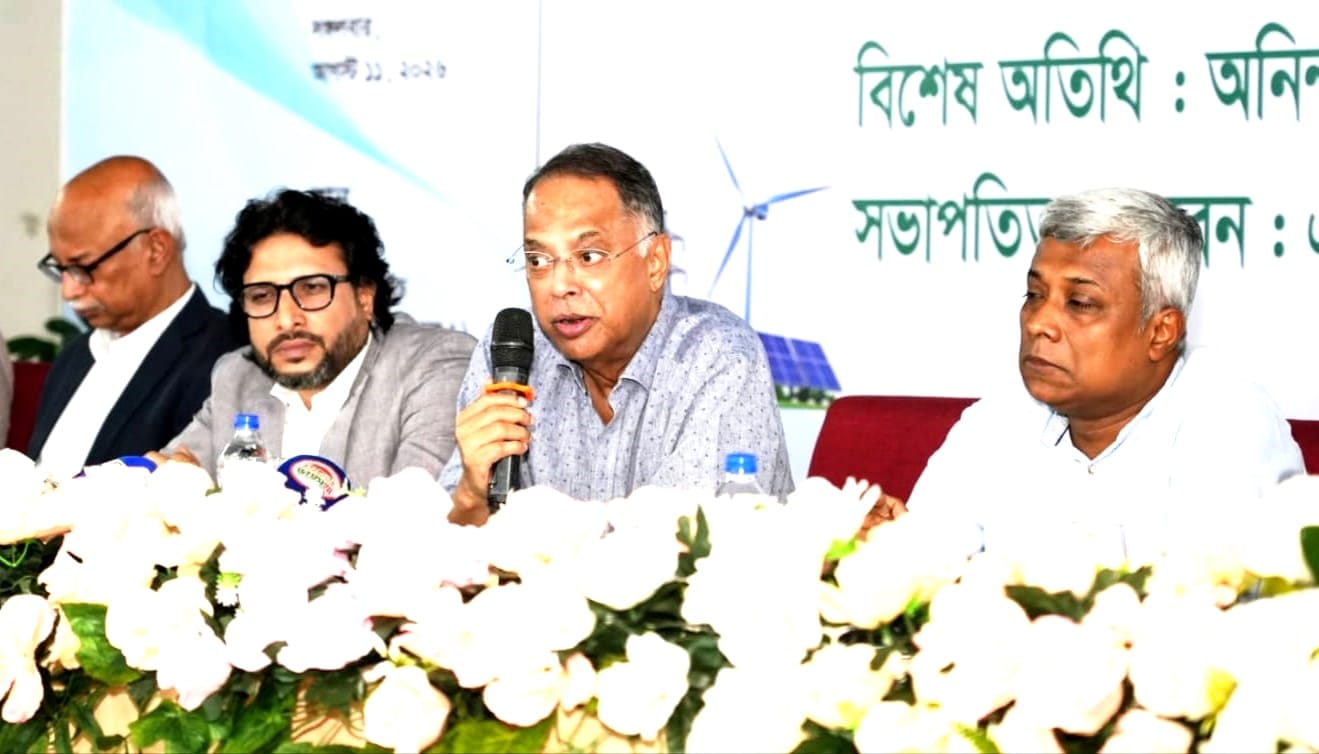
He was speaking virtually as the chief guest at a dialogue titled “Navigating Bangladesh Energy Crisis: Immediate Priorities and the Path to a Sustainable Energy Future”, organised by the Centre for Policy Dialogue (CPD) at BRAC Centre in Dhaka.
The minister said the current crisis began after a fire at an LNG terminal. Until engineers complete the repairs, the government’s main options are to wait and manage the available gas and electricity supplies to minimise load shedding.
“Now, I have nothing to do but count the days while the engineers work on the FSRU,” he said. “Apart from that, I can only manage the situation so that load shedding is reduced and gas can be supplied to industries.”
Engineers from the United Kingdom and Singapore are working on the FSRU, Mahmud said. But the crisis may briefly intensify even after the repairs are completed, as two new boilers will have to be commissioned simultaneously. The entire system may need to remain shut for about 72 hours for technical coordination, he said.
The government is planning to expand LNG infrastructure to meet rising demand, with 2029 as the target. An order has already been placed for a new FSRU, while three more are planned for Payra, Mongla and Hiron Point.
As an immediate measure for industry, the government has allowed a company to operate 30 container trucks to transport gas from Bhola to factories. It is also negotiating with a Malaysian company on supplying gas directly in containers.
Industry production down 35-40pc
The gas and power crisis has already caused a sharp decline in industrial production, business leaders said at the dialogue.
Bangladesh Chamber of Industries president Anwar-ul Alam Chowdhury Parvez said factory production had fallen by 35 to 40 percent because of shortages of gas and electricity.
He warned that the crisis could lead to the loss of foreign orders, particularly in the garment sector, as international buyers become concerned about Bangladesh’s ability to maintain production schedules.
Businesses were paying high energy bills but not receiving reliable supplies, leaving many at risk of defaulting on bank loans, he said. He called for industries to receive the highest priority in gas distribution and demanded an emergency “rescue package” to protect businesses and jobs.
CPD trustee Syed Nasim Manzur also urged the government to give clear priority to industry, saying unreliable gas and power supplies were threatening production and export competitiveness. He called for specific load-shedding schedules, lower system losses and tax incentives for solar-storage systems.
CPD seeks structural reforms
Presenting the keynote paper, CPD Senior Research Associate Fakhruddin Al Kabir said the energy crisis had become severe because of excessive import dependence and structural weaknesses.
He said 84 percent of the country’s electricity comes from fossil fuels, while renewable energy accounts for only 4.5 percent.
The CPD recommended urgent exploration for domestic gas, faster expansion of solar and other renewable energy sources, and the creation of a strategic fuel reserve. It also called for policies to protect low-income consumers from fluctuations in global fuel prices.
CPD Executive Director Fahmida Khatun said temporary measures would not provide a sustainable solution. She called for a coordinated 10-year energy policy, stronger institutions and market-based energy pricing with targeted subsidies.
Energy expert Prof Ijaz Hossain said years of inadequate reforms, weak pricing policies and system losses had allowed the crisis to accumulate.
He said increasing supply alone would not be enough and urged the government to focus on demand management, realistic pricing and curbing electricity and gas theft.
Pressure on power system
Mahmud also blamed the growing number of battery-run rickshaws for adding to electricity demand.
Calling them “the Tesla of the poor”, he said many were charged through illegal connections after midnight. This was shifting peak electricity demand towards midnight, with overall demand reaching around 18,000MW, he said.
Government officials often face attacks when attempting to disconnect illegal connections, the minister added.
He also rejected rumours that the government was giving a particular company a monopoly over oil trading. A new policy was being prepared to allow private companies to import oil under certain conditions, he said.
To encourage solar power, import duties on solar batteries and inverters have been reduced to 5 percent, while a five-year tax holiday has been provided for the sector.
Bangladesh Independent Power Producers Association president David Hasnat said many gas-fired power plants were being forced to remain shut because of the shortage. With domestic gas production declining, he called for land-based LNG terminals as a more reliable long-term option.
Bangladesh Sustainable and Renewable Energy Association president Mostafa Al Mahmud urged faster development of renewables, simpler port-clearance procedures and tax incentives for energy storage. He also proposed converting 1.3 million diesel-powered irrigation pumps to solar power.
The minister said he understood the difficulties businesses face when factories remain shut while workers’ wages and bank instalments continue to fall due.
He said the government was making all-out efforts to address the crisis and that the prime minister would present a comprehensive power and energy plan up to 2029 in the next session of parliament.