


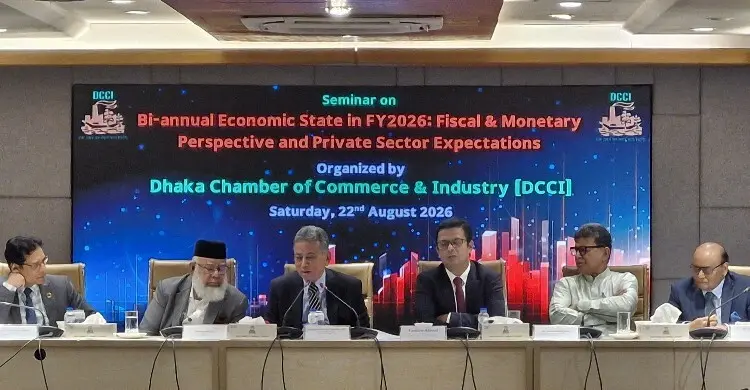
The government has had to spend an additional $5 billion to pay for high energy prices, Finance and Planning Minister Amir Khosru Mahmud Chowdhury said on Saturday.
He said ensuring energy security was critical to economic development and the government was working to build reserves equivalent to three months’ requirements in every energy sector.
“We had to spend an additional $5 billion because of the high prices of energy,” he said while speaking as the chief guest at a seminar organised by the Dhaka Chamber of Commerce and Industry (DCCI) at its auditorium in Motijheel.
The seminar, titled “Biannual Economic Situation for FY2026: Context of Fiscal and Monetary Policies and Expectations of the Private Sector”, brought together business leaders, economists and policy researchers.
Khosru said when the government took office, some energy sectors had reserves for only 15 to 17 days. The reserve position had since been improved to about one month, and efforts were under way to raise it to three months.
“Energy security is the primary component for the development of the economy,” he said, adding that the crisis could not be resolved within a month.
The government was trying to address the situation it had inherited through short-, medium- and long-term measures, he said.
FSRU, onshore gas in focus
The minister said the government was working on several fronts to ease the electricity and gas shortages.
Discussions were under way on floating storage and regasification units (FSRUs) to address the gas shortage, while work had also begun on developing onshore gas sources and pipelines, he said.
“We are trying to ensure three months’ reserves in every energy sector,” Khosru said.
He said investment was indispensable for reviving the economy and that domestic investment would have to increase to restore confidence among foreign investors.
“Without investment in the country, we will not be able to create confidence among foreign investors,” he said.
Private sector to drive growth
Khosru said Bangladesh’s economic growth in the past had largely been driven by the private sector and that the government wanted to continue with a private sector-led growth model.
“The private sector will drive economic growth, while the government’s responsibility is to create the necessary environment, support and facilities,” he said.
He stressed the need for deregulation and said merely announcing policies would not be enough unless their implementation was ensured.
The government was working to identify areas for deregulation and planning to launch a website where businesses could report obstacles they face, he said.
Business organisations, too, should take responsibility for raising problems faced by their members, he added.
Govt moves to cut business costs
The minister said the government was holding discussions with customs, port authorities and private-sector representatives to reduce the cost of doing business.
Around eight to 10 decisions had been taken at a single meeting, he said, without elaborating on the specific measures.
The government was also setting deadlines for customs and port authorities to complete various procedures, including the time required to release imported cargo after arrival, Khosru said.
Loan relief from Sept 1
On businesses struggling with loan defaults, the finance minister said industries had been hit by various factors, including energy shortages.
Against this backdrop, Bangladesh Bank had provided opportunities for loan rescheduling and one-time settlement, he said.
Businesses that want to continue operations would be able to seek rescheduling, including additional time and grace periods, while those seeking to exit could do so through one-time settlement, he said.
The package will come into effect on September 1, Khosru said, urging eligible businesses to inform the government if they face obstacles in obtaining the facilities from banks.
He said there was little point in showing assets on banks’ balance sheets as profitable when there was virtually no prospect of recovering the money.
Such assets should be resolved to clean up banks’ balance sheets and create scope for affected businesses to restart their operations, he said.
The government has also announced a Tk60,000 crore package for micro, small and medium enterprises, which would be monitored to ensure proper use, Khosru said.
No political interference in financial sector
The finance minister said there would be no scope for political interference in the financial sector.
Only those meeting the required qualifications and criteria would receive financial support, he said.
“We will not make any political appointments in the financial sector,” Khosru said.
“Where there is sensitivity in the financial sector, politics cannot come in. This is a market; you have to respect the market.”
DCCI President Taskeen Ahmed delivered the welcome address at the seminar.
PPRC Executive Chairman and BRAC Chairperson Hossain Zillur Rahman, International Chamber of Commerce-Bangladesh President Mahbubur Rahman, Policy Research Institute Chairman Zaidi Sattar, CPD Distinguished Fellow Mustafizur Rahman and Transcom Group CEO Simeen Rahman, among others, also spoke at the event.