


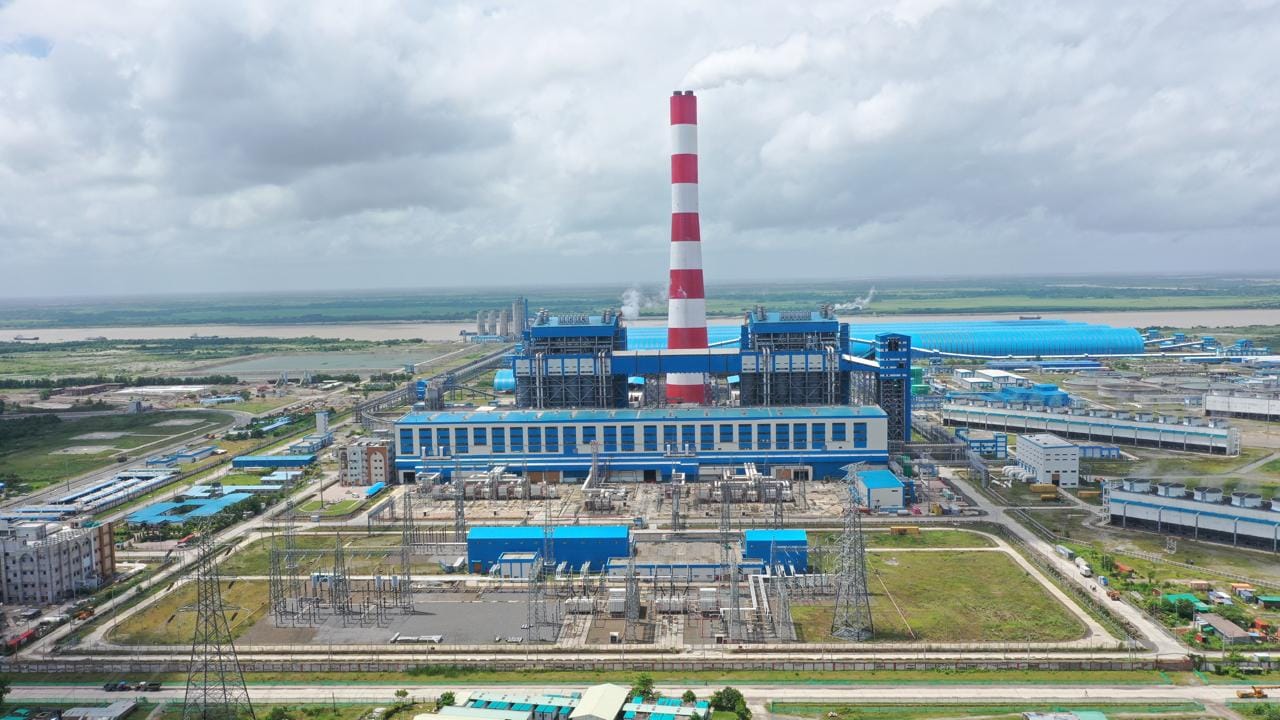
The government is planning to build a 442-megawatt solar power plant at Rampal in Bagerhat, next to the controversial coal-fired Maitree power plant, at an estimated cost of Tk 2,502.35 crore.
The proposed project, billed as one of the country’s largest solar power plants, will be built on 685 acres of land already owned by the Bangladesh Power Development Board (BPDB), meaning no fresh land acquisition will be required.
The project, titled “Construction of 442 MWp (DC) Solar Photovoltaic Grid-Connected Power Plant at Block-B, Rampal”, has already gone through a Project Evaluation Committee (PEC) meeting at the Planning Commission. Following necessary revisions, it is expected to be placed before the Executive Committee of the National Economic Council (ECNEC) for final approval.
The proposed implementation period is from July to December 2026.
Of the total project cost, Tk 375 crore will come from BPDB’s own funds, while Tk 2,127 crore will be provided from the Power Sector Development Fund as assistance at an interest rate of 2 percent.
The project puts the same Rampal area—long criticised by environmental groups over the risks posed by coal-fired power generation to the nearby Sundarbans—at the centre of a major renewable energy initiative.
The coal-fired Maitree Super Thermal Power Plant, a joint venture between Bangladesh and India, was built in Block-A of the Rampal site. Block-B, covering 918.50 acres, remains under BPDB.
Of the Block-B land, 76.63 acres are designated as a green belt, 23.87 acres as a flood protection embankment, 12 acres as a pond and 30 acres as a lake. After excluding these areas, 685 acres are available for the proposed solar plant.
BPDB acquired a total of 1,834 acres in Rampal in 2012 for power-generation projects.
A feasibility study completed in May 2025 recommended setting up a 442MW grid-connected solar power plant on the 685-acre site. The study, conducted by Infrastructure Investment Facilitation Company, found the project viable.
The estimated construction cost works out to about Tk 5.66 crore per megawatt of installed solar capacity.
“Development partners had objections to the construction of the coal-fired power plant, so the solar power project is being taken up with domestic financing,” a BPDB high official said, adding that the project had already received policy-level approval from the Planning Ministry and gone through the PEC process.
The government has set a target of generating 10 percent, or 10,000MW, of electricity from renewable sources by 2030, according to BPDB. The proposed Rampal solar plant is being presented as part of efforts to meet that target.
However, the PEC has recommended revisions to several proposed expenditure items before the project proceeds for final approval.
The project initially proposed spending Tk 66.60 lakh on electrical expenses, commissioning and related items, Tk 24.61 lakh on honorariums, Tk 16.65 lakh on entertainment, Tk 31 lakh on stationery, Tk 22 lakh on computer accessories, Tk 12 lakh on computers and Tk 21.74 lakh on furniture. The committee recommended rationalising and reducing these allocations.
Planning Commission officials said the project had been sent back to BPDB for necessary revisions.
Once BPDB makes the required revisions, preparations will be taken to place the project before ECNEC, they added.
The PEC has asked for detailed information on the proposed manpower structure, technical staff, annual budget and how the operating costs will be financed after completion.
It also recommended greater opportunities for local consultants since the project will be financed domestically.
Bangladesh is increasingly turning to solar power amid rising electricity demand and concerns over energy security.
According to the Integrated Energy and Power Master Plan 2023, peak electricity demand is projected to reach 29,257MW in 2030, 58,597MW in 2041 and 96,767MW in 2050.
The country’s highest-ever power generation stood at 16,794MW on July 23, 2025. Although electricity access has reached the entire population, expanding generation capacity and ensuring fuel security remain major challenges.
BPDB said increasing electricity demand and the need to strengthen energy security are driving the greater emphasis on solar power projects.