


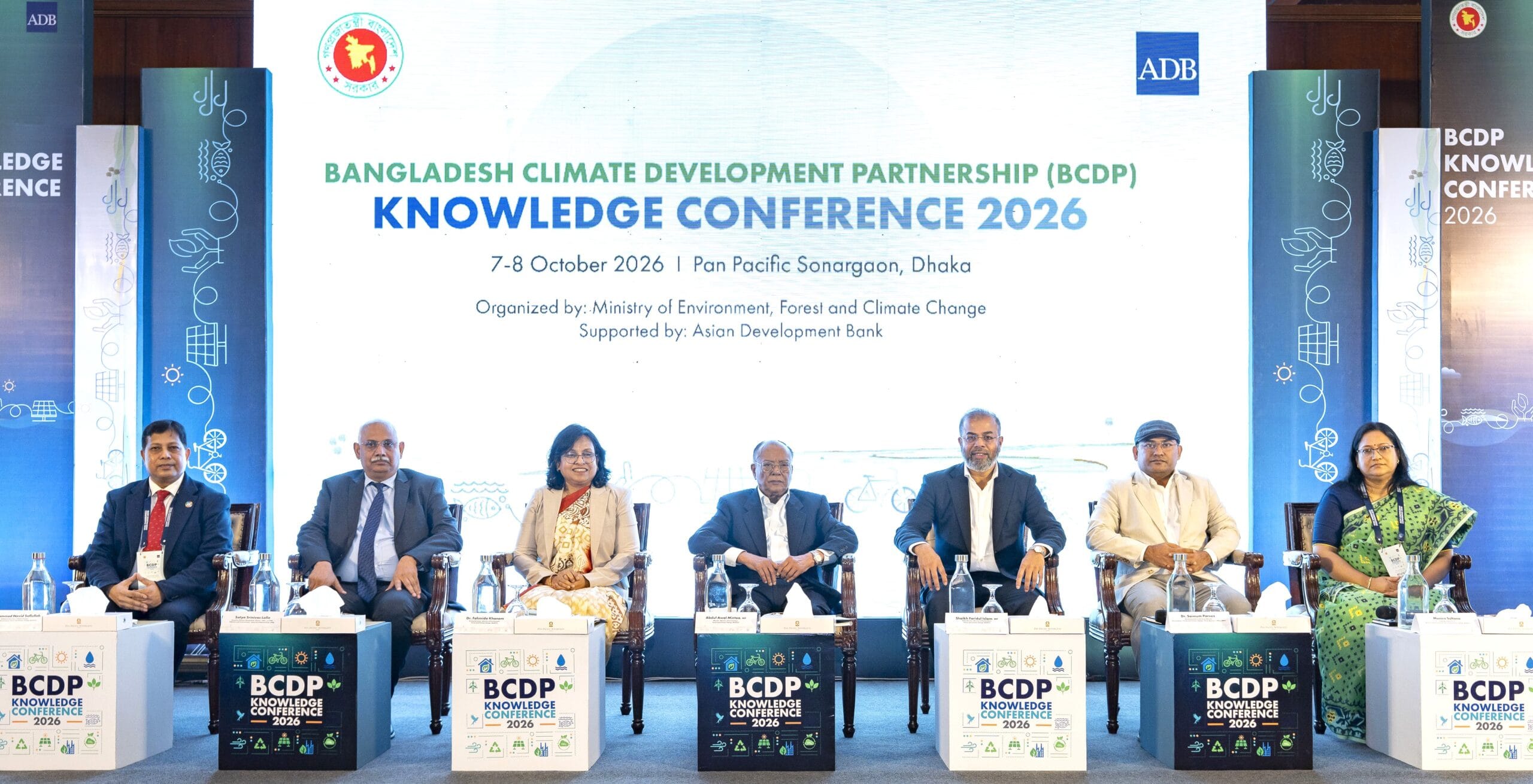
Bangladesh has launched a new digital platform to track climate projects and streamline investment as the government seeks to turn its climate ambitions into bankable programmes and measurable outcomes.
Environment, Forest and Climate Change Minister Abdul Awal Mintoo unveiled the Bangladesh Climate Development Partnership (BCDP) Web Portal at the opening of the two-day Bangladesh Climate Development Partnership Knowledge Conference 2026 in Dhaka on Wednesday.
The minister said decisions being made today on infrastructure and economic development would shape Bangladesh’s climate risks for decades, making it essential to translate national policies into coordinated programmes, quality projects, appropriate financing and measurable results.
He also called for climate-finance frameworks suited to Bangladesh’s fiscal realities, greater private-sector participation in clean energy and climate justice on Loss and Damage.
“Adaptation initiatives have unique financial characteristics,” Mintoo said, noting that many projects generate vital social and welfare benefits without offering conventional commercial returns.
He stressed the need to ensure the participation of women, young people, people with disabilities and marginalised communities in climate project design and governance.
The conference brought together more than 500 policymakers, development partners, climate experts, private-sector executives and civil society representatives from Bangladesh and abroad.
Delivering remarks on behalf of the Asian Development Bank, Satya Srinivas Lolla, ADB Executive Director representing Bangladesh, Bhutan, India, Lao PDR, Tajikistan and Turkmenistan, highlighted the challenge of balancing Bangladesh’s graduation from the Least Developed Country category with its continuing climate vulnerabilities.
He said the conference’s success would ultimately be measured by the actions and investments that follow, rather than by the discussions themselves.
“Turning ambition into reality will require substantial investment from both the public and private sectors,” Lolla said.
He said the partnership seeks to combine financing, technical expertise, institutional capacity and strategic partnerships to help Bangladesh move from climate ambition to implementation.
The BCDP Web Portal, one of the key highlights of the opening day, is designed to provide a central platform for real-time project tracking, investment-pipeline management, data integration and cross-sector coordination.
Officials said the platform is expected to help streamline domestic and international climate investment and improve coordination among government agencies, development partners and investors.
The conference also featured a Climate Solutions Exhibition and reaffirmed the BCDP, established in 2024, as a national institutional platform for climate-finance mobilisation, resource allocation and policy coordination.
The inaugural session was attended by State Minister for Environment, Forest and Climate Change Sheikh Faridul Islam, Special Assistant to the Prime Minister for Environment, Forest and Climate Change Dr Md Saimum Parvez, and Principal Secretary to the Prime Minister’s Office A B M Abdus Sattar.
Additional Secretary for Climate Change Mohammad Navid Shafullah delivered the welcome address, while Acting Secretary of the ministry Dr Fahmida Khanom chaired the session.
Three strategic plenary sessions were held on the first day.
The first examined pathways to climate resilience and low-carbon growth, focusing on how Bangladesh can sustain economic development amid rising climate risks.
The second discussed implementation of the National Adaptation Plan 2023–2050, including local-level implementation, sector-specific cost modelling and integration with national budgetary processes.
The third focused on multilateral development bank financing instruments and mechanisms for blending public and private capital to implement Bangladesh’s Nationally Determined Contributions 3.0.
The conference concludes on Thursday with working groups and technical sessions focusing on de-risking climate investments, developing investment-ready project pipelines and creating public-private financing structures in energy, transport and agriculture.