


Bangladesh plans to cut the time for key business approvals to 14 days by digitising government services, aiming to reduce business costs and attract more investment ahead of its graduation from the least developed country (LDC) category.
Commerce Minister Khandaker Abdul Muktadir sought World Bank support for simplifying business regulations, removing administrative delays and diversifying exports beyond the ready-made garment (RMG) sector.
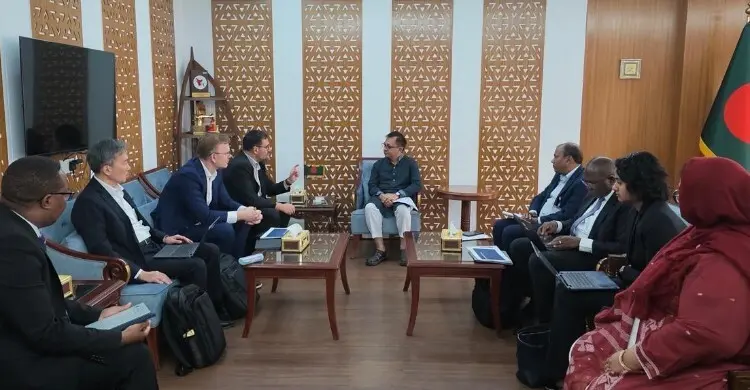
He outlined the plans at a meeting with an eight-member World Bank delegation led by Jean Pesme, division director for Bangladesh and Bhutan, at the Secretariat on Tuesday.
Under the plan, services from different ministries and government agencies will be brought under Invest Bangladesh’s one-stop service and the National Single Window platform.
Currently, businesses must approach multiple agencies for trade licences, environmental and fire safety clearances, and import registration certificates (IRCs). The government wants to complete these procedures within 14 days through an integrated digital system.
The minister said a three-year action plan was being prepared to address the challenges of LDC graduation, with trade facilitation, export diversification and policy reforms as key priorities.
New export sectors in focus
The government is targeting leather and leather goods, non-leather footwear, shipbuilding, ship recycling and light engineering to reduce dependence on garment exports.
It plans to establish a new central effluent treatment plant (CETP) at the Savar leather industrial estate to improve environmental compliance and help manufacturers obtain Leather Working Group (LWG) certification.
The government also wants to formalise the gold industry and develop jewellery manufacturing as an export-oriented sector.
Push for trade agreements
Bangladesh is pursuing economic partnership agreements with Japan and South Korea and free trade agreements with the UAE, Malaysia, Singapore and the European Union.
It has also received policy approval to pursue membership of the Regional Comprehensive Economic Partnership (RCEP), a major Asia-Pacific trade bloc.
World Bank support
Jean Pesme assured the government of technical assistance in trade facilitation, National Single Window implementation, skills development in leather and light engineering, and research on free trade agreements.
He said the World Bank Group and its private sector arm, the International Finance Corporation (IFC), were interested in supporting manufacturing competitiveness, agro-processing and higher-value industries.
Sebastian Eckardt, the bank’s regional practice director for prosperity, said the next three to four years would be critical for Bangladesh’s preparations for LDC graduation.
He stressed the need to remove tariff and non-tariff barriers, reform trade policies and improve integration into global value chains to attract foreign investment and create jobs.
The World Bank is also ready to train Bangladeshi officials to strengthen their negotiating capacity in trade agreements, he added.
World Bank Lead Economist Souleymane Coulibaly said reforming para-tariffs, including supplementary duties, could improve economic efficiency and export competitiveness.
He also highlighted the importance of better trade policies and logistics infrastructure in expanding exports and employment, citing Vietnam’s experience.
Senior officials from the World Bank and the Commerce Ministry attended the meeting.