


The Centre for Policy Dialogue (CPD) has proposed a monthly minimum wage of Tk18,578 to Tk24,204 for garment workers, setting a range for negotiations as the industry faces renewed pressure to raise wages amid a rising cost of living.
The proposed range is based on workers’ basic livelihood needs, inflation and employers’ capacity to pay, with the think-tank arguing that wages should gradually move towards a living wage.
Garment workers have been demanding Tk30,000 a month, against the existing minimum wage of Tk12,500 set in 2023.
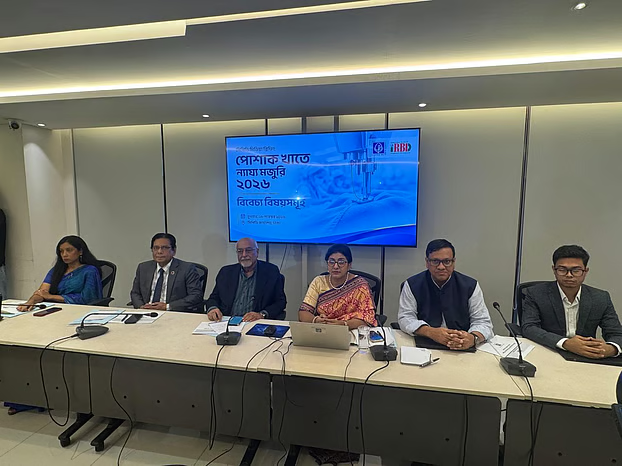
Presenting the proposal at a media briefing in Dhaka yesterday, CPD Executive Director Nazneen Ahmed said Tk18,578 would be needed to keep workers above the poverty line, while Tk24,204 would provide a minimum decent standard of living.
The calculations assume a four-member family with 1.58 earners, she said.
“Discussions should take place between these two figures. However, we need to move gradually towards a living wage,” Nazneen said at the briefing titled “Determining the Minimum Wage in the RMG Sector”.
The CPD said workers now need Tk16,351 to buy the same basket of goods and services that Tk12,500 could purchase when the minimum wage was fixed in 2023. The increase reflects inflationary pressure and does not represent any improvement in real purchasing power.
The proposal comes as the government-appointed Minimum Wage Board is working to revise wages following weeks of labour unrest, factory closures and clashes in garment-producing areas, including Mirpur, Savar, Ashulia and Gazipur.
The government formed a six-member wage board on November 1. At its second meeting on November 9, workers’ representatives proposed Tk32,000 as the monthly minimum wage, while the employers’ representative sought four working days to prepare a counterproposal.
The board’s third meeting, scheduled for November 16, was postponed due to the illness of its permanent workers’ representative. The meeting has been rescheduled for November 23, when employers are expected to submit their proposal.
Meanwhile, CPD Distinguished Fellow Debapriya Bhattacharya said the country’s economy was going through a difficult phase, but the government’s actions and parliamentary proceedings did not adequately reflect the mounting pressure.
He said economic hardship, business difficulties and labour issues were increasingly turning into law-and-order and political problems, partly because the government was failing to ensure adequate transparency and accountability in addressing the economic downturn.
Debapriya said the government was also falling short of its obligation to disclose the state of the economy to parliament every three months under the Public Money and Budget Management Act 2009.
Five months after the budget, the finance minister has yet to present such a statement, leaving questions about transparency in budget implementation, investment, trade and the broader economic situation, he said.
Had the government provided regular updates and made its reform commitments more transparent, including efforts to curb corruption, it could have managed the economic pressure more effectively and strengthened its position in negotiations with foreign buyers, he added.
Debapriya also stressed the need to diversify the country’s industrial base ahead of LDC graduation, saying Bangladesh could not continue relying overwhelmingly on the garment sector, which accounts for around 80 percent of export earnings.
He rejected arguments that workers should bear the burden of governance failures or corruption through lower wages, questioning the fairness of making labour absorb the cost of weaknesses in the economic system.
“Workers cannot be made to subsidise corruption,” he said, arguing that accountability should instead be demanded from those responsible for governance failures.