


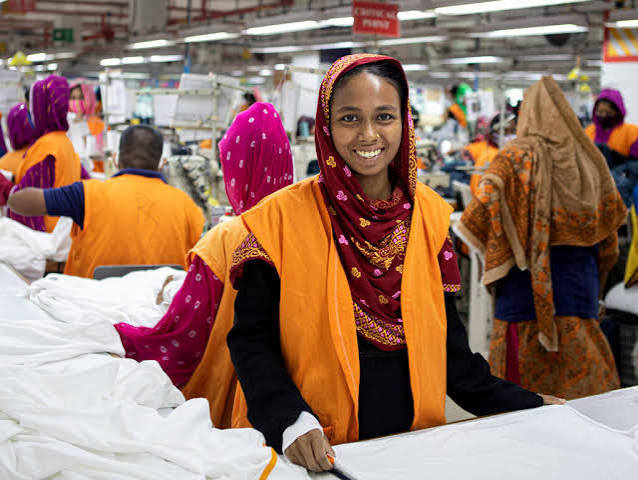
The minimum monthly wage for garment workers has been raised by 36 percent to Tk17,000 from the existing Tk12,500, ending weeks of negotiations between factory owners and workers’ representatives, but without a consensus at the wage board.
The Minimum Wage Board settled the new wage through a vote early Wednesday after the two sides failed to bridge their differences despite several rounds of negotiations on Tuesday.
Under the revised structure, the minimum wage for fourth-grade workers has been fixed at Tk17,000, while workers in grades three, two and one will receive Tk19,200, Tk20,000 and Tk21,500 respectively.
The new wage structure will take effect on December 1, according to members of the wage board.
The decision followed a prolonged bargaining process in which factory owners gradually raised their offer from Tk15,700 to Tk17,000, while workers’ representatives lowered their demand from Tk22,000 to Tk18,000.
At one stage, both sides submitted revised proposals of Tk17,000 and Tk18,000 respectively. When the differences persisted, the owners reduced their offer to Tk16,000, prompting board chairman Syed Azad Subhani to call a vote.
Four of the six board members voted in favour of Tk17,000, while the two workers’ representatives supported Tk18,000, effectively settling the minimum wage at Tk17,000.
The decision was confirmed around 2:15am on Wednesday by owners’ representative ABM Shamsuzzaman and workers’ representative Babul Akhter.
The board’s fourth meeting ended around 1:30am after an extended round of negotiations at its Segunbagicha office in Dhaka.
Owners and workers narrow differences
The negotiations began with sharply contrasting demands.
At the board’s second meeting on November 9, workers’ representatives proposed a minimum monthly wage of Tk32,000. The owners initially offered Tk15,000, later raising it to Tk15,700 at the third meeting on November 23.
On Tuesday, the workers’ side reduced its demand to Tk22,000, while the owners initially stood by their Tk15,700 offer.
During successive rounds of negotiations, the owners increased their proposal to Tk17,000. The workers’ side, meanwhile, lowered its demand to Tk19,000, then Tk18,500 and finally Tk18,000.
Despite the concessions, the two sides failed to reach an agreement, leaving the board to settle the matter through voting.
The board was formed on November 1, and its first meeting was held on November 4.
Labour unrest continues
The wage decision came amid continued protests and labour unrest in major garment manufacturing hubs, particularly Gazipur and Savar-Ashulia.
Workers took to the streets at several points along the Dhaka-Tangail and Dhaka-Mymensingh highways in Gazipur on Tuesday, disrupting traffic and clashing with law enforcement agencies.
Police fired tear gas and sound grenades to disperse protesters in some areas. A police box in Gazipura was also vandalised and set on fire during the demonstrations.
According to industrial police, authorities declared holidays at 70 factories in the Bhogra Bypass, Chowrasta and Konabari areas of Gazipur amid the unrest, while 32 factories remained closed indefinitely.
In Savar and Ashulia, 24 factories declared holidays and workers stopped work at seven others, according to industrial police. Another 20 factories were closed under Section 13(1) of the Bangladesh Labour Act.
Government seeks balance
Before the decision, Prime Minister’s Adviser on Labour and Employment Mahdi Amin said the government wanted a wage structure that would reflect workers’ legitimate expectations while protecting the garment industry’s competitiveness and employment.
He said inflation, workers’ living costs, the industry’s capacity, wages in other sectors and the wage structures of competing countries in the international market should all be considered in setting the minimum wage.
The government also wanted to maintain industrial stability and sound relations between workers and factory owners, he added.
The previous minimum wage of Tk12,500 was set in 2023, marking a 56 percent increase at the time. Before that, the minimum wage had remained at Tk8,000 since 2018.
The latest increase comes as the garment industry faces the challenge of meeting higher labour costs while maintaining its competitiveness in the global apparel market.