


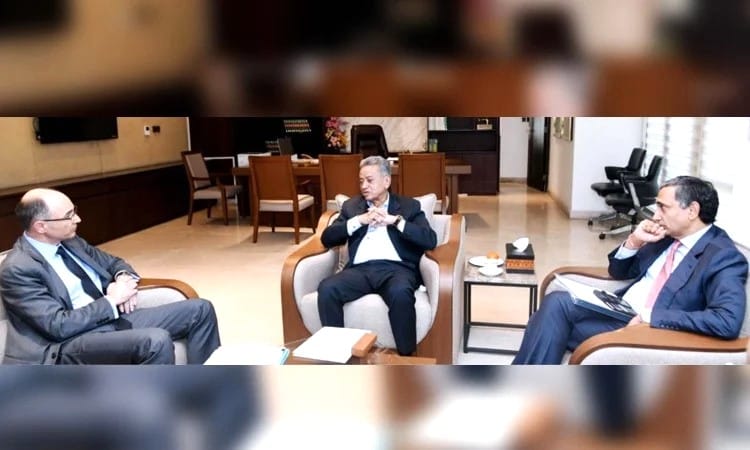
Finance Minister Amir Khosru Mahmud Chowdhury on Tuesday said Bangladesh’s ongoing programme with the International Monetary Fund (IMF) remains on track, as the government presses ahead with a series of economic reforms aimed at stabilising the financial sector and restoring growth.
Speaking to reporters after a meeting with Krishna Srinivasan at the Finance Ministry, Khosru said the programme would undergo its next review in July, with discussions continuing on conditions and implementation in line with current economic realities.
“We already have a programme with the IMF, and it is ongoing,” he said, expressing confidence that progress will continue in the coming months.
The minister acknowledged that Bangladesh is navigating a challenging economic environment, citing weaknesses in the banking sector, fragility in the capital market, and a persistently low tax-to-GDP ratio. He said the government is prioritising reforms outlined in its election manifesto, including deregulation, improving the ease of doing business, and reducing business costs.
He added that several social sector initiatives—such as family support programmes, farmer assistance schemes, and expanded agricultural credit—have already been rolled out to cushion vulnerable groups.
Khosru also said stalled development projects, delayed due to financial constraints during the previous interim period, would be revived as part of broader recovery efforts. “To revive these projects, we must undertake financial reforms and bring the economy to a stable position,” he said, noting that further measures would be reflected in the upcoming national budget.
On external financing, the minister said talks are ongoing regarding the next IMF disbursement, with around $1.3 billion expected by June, subject to the programme review.
He added that the issue would be discussed in more detail at the upcoming IMF-World Bank Spring Meetings in April.
Highlighting recent efforts to manage economic pressures amid global disruptions, Khosru said the government had ensured a stable fuel supply and contained inflationary risks during Ramadan and Eid.
Transport services remained operational without fare hikes, essential commodity prices were relatively stable, and there was no unrest in the garment sector, with workers receiving wages on time, he added.
Emphasising the need for collective action, the finance minister urged citizens to support government efforts. “The government alone cannot do everything. Public cooperation and restraint are essential. While global factors are beyond our control, we can overcome this crisis together,” he said.
Responding to questions, Srinivasan said IMF financing discussions are anchored in ongoing policy engagement with the government. He noted that global uncertainties, including geopolitical tensions, continue to pose risks for all economies, including Bangladesh.
“The war is an uncertainty for every country, and Bangladesh is in the same position,” he said, reaffirming the IMF’s continued engagement to support the country in addressing its economic challenges.