


On 16 April, 2026, the Bangladesh cabinet announced a major initiative to generate 10,000 megawatts (MW) of solar power by 2030, marking a significant milestone in the country’s energy transition journey. The decision reflects a growing recognition that Bangladesh can no longer rely excessively on imported fuels to ensure its energy security.
The importance of this initiative cannot be overstated. Bangladesh’s power sector has long depended on imported fossil fuels. The recent global energy crisis, driven by escalating tensions in the Middle East involving the US, Israel, and Iran, has demonstrated how vulnerable import-dependent countries can become. Rising fuel costs, pressure on foreign exchange reserves, and supply disruptions have underscored the urgency of diversifying the country’s energy mix.
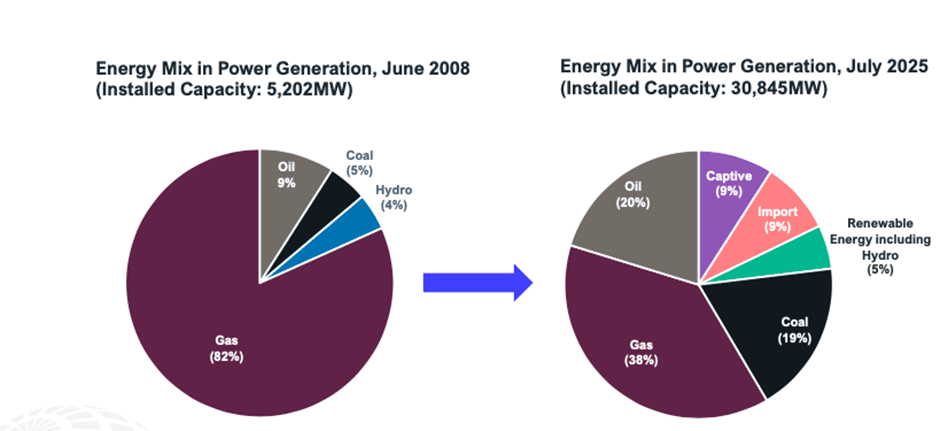
Fig. The Transformation of Bangladesh’s Power Sector (Source: IEEFA, 2025).
In this context, solar energy offers Bangladesh not merely an environmentally friendly solution, but also an economic and strategic necessity.
Located in a region with substantial solar irradiation, Bangladesh possesses considerable potential for utility-scale solar parks, rooftop solar systems, floating solar projects, and agrivoltaics. Yet despite years of discussion, the country’s renewable energy contribution to total electricity generation remains modest.
Therefore, the 10,000 MW target for 2030 should be viewed not simply as a political declaration, but as a national vision requiring immediate and coordinated implementation.
Ambitious targets alone do not guarantee success. Previously, the country failed to achieve the targets of 5% renewable energy by 2015 and 10% by 2020 set under the ‘Renewable Energy Policy 2008’. The previous interim government also failed to deploy 3,000 MW of rooftop solar power by December 2025, despite announcing the initiative on 3 July, 2025.
Previous renewable energy targets failed not because of a lack of ambition, but because of weak implementation, poor governance, land constraints, and policy inconsistency. Unless these structural barriers are addressed, the new target may face similar setbacks.
Solar power has become the cheapest and fastest-growing source of energy on earth. Its potential is nearly limitless – every hour, the sun delivers more energy than the world consumes in an entire year (Sivaram, 2018).
One of the foremost challenges, however, is land scarcity. Large-scale solar projects require vast areas, which are difficult to procure in a densely populated country like Bangladesh. This reality demands innovative policy and technological approaches. Floating solar projects on water bodies, the replacement of diesel-powered irrigation pumps with solar pumps, and rooftop solar installations in industries, commercial buildings, and government facilities must all be accelerated through supportive net-metering policies and financial incentives.
Solar power generation is inherently intermittent, and integrating large volumes of renewable electricity requires upgrades to the physical grid, including transmission lines, substations, reactive power compensators, energy storage systems, and smart load management infrastructure. Without substantial investment in transmission and grid flexibility, many renewable projects may face curtailment or operational inefficiencies.
Financing remains another critical issue. Renewable energy projects often involve high upfront costs, although their long-term operating expenses are relatively low. Bangladesh must therefore attract greater domestic and foreign investment through transparent procurement policies, reduced bureaucratic delays, sovereign guarantees where necessary, and stable regulatory frameworks. International climate finance and development partners can also play a constructive role in supporting this transition.
At the same time, bureaucratic fragmentation must be reduced. Renewable energy development involves multiple ministries and agencies, including the power division, land authorities, environmental regulators, local administrations, and financial institutions. Delays in approvals, land acquisition, and power purchase agreements have slowed many projects in the past. A centralised and empowered renewable energy coordination mechanism could help expedite implementation.
The private sector should also become a key partner in this transformation. Bangladesh’s export-oriented industries, particularly the ready-made garments sector, are increasingly under pressure from global buyers to adopt cleaner energy practices. Expanding rooftop solar and captive renewable systems can improve both energy sustainability and export competitiveness.
Beyond economics, expanding solar power also carries environmental and social benefits. Reduced dependence on fossil fuels would lower greenhouse gas emissions, improve air quality, and contribute to the government’s climate commitments. Moreover, renewable energy expansion could create new employment opportunities in manufacturing, installation, maintenance, and energy services.
However, achieving 10,000 MW by 2030 will require urgent and sustained action. The timeline is short, and the scale of the initiative is unprecedented for Bangladesh’s renewable energy sector. Delayed decisions, policy inconsistency, and institutional inertia could easily derail the target. The country therefore needs not only ambitious goals, but also measurable yearly implementation benchmarks, transparent monitoring systems, and strong political commitment.
Bangladesh now stands at a critical crossroads. The approved solar expansion plan presents an opportunity to transform the country’s energy future from one defined by import dependence and vulnerability into one driven by sustainability, resilience, and self-reliance. The challenge ahead is formidable, but with strategic planning and decisive action, the vision of 10,000 MW of solar power by 2030 can move from aspiration to reality.
(Mohammad Alauddin is a former Rector of the Bangladesh Power Management Institute. He writes articles for Just Energy News, and can be reached at [email protected])