


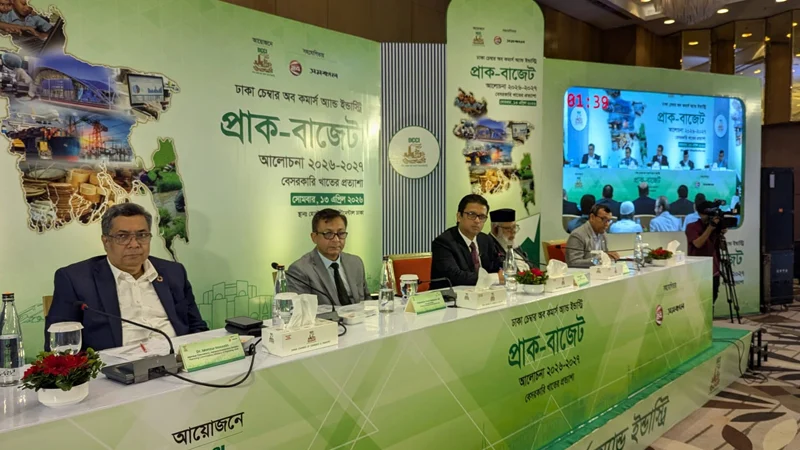
Commerce Minister Khandaker Abdul Muktadir has sought to reassure the business community that the forthcoming 2026–27 national budget will not place additional burdens on them, even as the government pushes to widen the country’s tax base.
Speaking at a pre-budget consultation in the capital on Monday, he said expanding the tax net — rather than increasing pressure on existing taxpayers — is essential for sustainable economic management.
The discussion, titled “Pre-Budget Discussion 2026–27: Expectations of the Private Sector”, was organised by the Dhaka Chamber of Commerce and Industry in collaboration with Samakal and Channel 24 at Hotel InterContinental Dhaka.
“Our focus is on bringing more people into the tax net, not raising the burden on those already paying,” the minister said. He added that the upcoming budget is expected to have a positive impact on the economy.
Muktadir expressed confidence in Finance Minister Amir Khosru Mahmud Chowdhury and the National Board of Revenue, describing them as capable of delivering a business-friendly fiscal framework.
He urged private sector stakeholders to maintain trust in the government’s economic management.
The minister acknowledged that the economy has faced challenges stemming from past weaknesses in accountability and transparency.
These shortcomings, he said, contributed to distortions that still affect economic stability today.
“Restoring normalcy is the first step towards stabilising the economy,” he noted, warning that a lack of coordination and transparency among stakeholders can lead to inefficiencies.
He also criticised earlier development projects that lacked proper feasibility, saying significant public funds had been spent without delivering the desired outcomes. Reviews by oversight bodies have pointed to inefficiency and, in some cases, corruption, he added.
Highlighting the limits of state-led growth, Muktadir said increasing government expenditure alone cannot ensure sustainable economic expansion. Instead, he stressed the need to stimulate private investment through a more enabling business environment.
Efforts are already under way to simplify business processes and reduce administrative bottlenecks. The government is expanding digital services so businesses can obtain licences and registrations online with greater ease.
In particular, the process for securing import and export certificates — IRC and ERC — is being streamlined. Applications, fee payments and certificate downloads will be handled online, cutting both time and compliance costs for businesses.
Turning to the energy sector, the minister said rising global prices have placed additional pressure on the government, but maintaining industrial output remains a priority. Steps are being taken to boost domestic gas exploration, increase LNG imports and build long-term storage capacity.
He also outlined plans to revive loss-making state-owned enterprises, especially sugar mills, through fresh investment and alternative management approaches aimed at improving efficiency and generating employment.
At the event, the DCCI proposed raising the tax-free income threshold to Tk 500,000 and lowering the top personal tax rate to 25 percent. It also called for aligning corporate tax rates for non-listed companies with listed firms and introducing a fully automated corporate tax return system.
In his closing remarks, Samakal Editor Shahed Muhammad Ali said the private sector remains the main driver of the economy and called for closer coordination between businesses and the government.
The session was moderated by DCCI President Taskin Ahmed, with participation from leading economists, business figures and policymakers, including Mahbubur Rahman and Sharif Zahir, among others.
Commerce Minister Khandaker Abdul Muktadir has sought to reassure the business community that the forthcoming 2026–27 national budget will not place additional burdens on them, even as the government pushes to widen the country’s tax base.
Speaking at a pre-budget consultation in the capital on Monday, he said expanding the tax net — rather than increasing pressure on existing taxpayers — is essential for sustainable economic management.
The discussion, titled “Pre-Budget Discussion 2026–27: Expectations of the Private Sector”, was organised by the Dhaka Chamber of Commerce and Industry in collaboration with Samakal and Channel 24 at Hotel InterContinental Dhaka.
“Our focus is on bringing more people into the tax net, not raising the burden on those already paying,” the minister said. He added that the upcoming budget is expected to have a positive impact on the economy.
Muktadir expressed confidence in Finance Minister Amir Khosru Mahmud Chowdhury and the National Board of Revenue, describing them as capable of delivering a business-friendly fiscal framework.
He urged private sector stakeholders to maintain trust in the government’s economic management.
The minister acknowledged that the economy has faced challenges stemming from past weaknesses in accountability and transparency.
These shortcomings, he said, contributed to distortions that still affect economic stability today.
“Restoring normalcy is the first step towards stabilising the economy,” he noted, warning that a lack of coordination and transparency among stakeholders can lead to inefficiencies.
He also criticised earlier development projects that lacked proper feasibility, saying significant public funds had been spent without delivering the desired outcomes. Reviews by oversight bodies have pointed to inefficiency and, in some cases, corruption, he added.
Highlighting the limits of state-led growth, Muktadir said increasing government expenditure alone cannot ensure sustainable economic expansion. Instead, he stressed the need to stimulate private investment through a more enabling business environment.
Efforts are already under way to simplify business processes and reduce administrative bottlenecks. The government is expanding digital services so businesses can obtain licences and registrations online with greater ease.
In particular, the process for securing import and export certificates — IRC and ERC — is being streamlined. Applications, fee payments and certificate downloads will be handled online, cutting both time and compliance costs for businesses.
Turning to the energy sector, the minister said rising global prices have placed additional pressure on the government, but maintaining industrial output remains a priority. Steps are being taken to boost domestic gas exploration, increase LNG imports and build long-term storage capacity.
He also outlined plans to revive loss-making state-owned enterprises, especially sugar mills, through fresh investment and alternative management approaches aimed at improving efficiency and generating employment.
At the event, the DCCI proposed raising the tax-free income threshold to Tk 500,000 and lowering the top personal tax rate to 25 percent. It also called for aligning corporate tax rates for non-listed companies with listed firms and introducing a fully automated corporate tax return system.
In his closing remarks, Samakal Editor Shahed Muhammad Ali said the private sector remains the main driver of the economy and called for closer coordination between businesses and the government.
The session was moderated by DCCI President Taskin Ahmed, with participation from leading economists, business figures and policymakers, including Mahbubur Rahman and Sharif Zahir, among others.