


Bangladesh remains heavily dependent on fossil fuels for electricity generation, with renewable energy accounting for just 2.3% of total output, even as imports of gas, coal and oil continue to rise, according to a new report by the Institute for Energy Economics and Financial Analysis.
The report, published on Wednesday, underscores mounting vulnerabilities in the country’s energy mix, driven by growing import dependence and exposure to volatile global fuel markets.
Over the past four years, Bangladesh’s reliance on primary energy imports has increased sharply from 47.7% to 62.5%. Fossil fuel imports rose by 14.8% over the same period, further cementing the dominance of conventional energy sources.
Analysing data from the 2020–21 to 2024–25 financial years, the study found that power generation costs have surged by as much as 83%, fuelled by high global energy prices, depreciation of the Bangladeshi taka against the US dollar, and weaker-than-expected growth in electricity demand.
While international fuel price volatility has played a role, the report points to structural inefficiencies within the power sector as a major driver of rising costs. These include high capacity payments to underutilised plants and an oversupply of generation capacity.
“Expensive peaking plants, excess capacity and fuel supply constraints are making electricity generation increasingly costly,” said Shafiqul Alam, the report’s author and lead energy analyst at IEEFA.
He noted that gas-fired plants operating at below a 25% load factor are producing electricity at costs as high as Tk16.85 per unit, compared with around Tk6 when operating at optimal levels.
Despite a global average of approximately 33.8% of electricity generation coming from renewable sources, Bangladesh lags far behind, leaving its power sector exposed to external shocks and price swings in international fuel markets.
Liquefied natural gas (LNG) imports remain a significant financial burden. The report estimates that Bangladesh may need to provide subsidies of around $1.07 billion between April and June 2026 alone to support LNG imports, based on current prices of roughly $20 per million British thermal units.
Declining domestic gas production has further intensified reliance on costly LNG imports, adding to fiscal pressures in the energy sector.
The report also highlights the impact of capacity payments, estimating that private oil- and coal-fired plants received average payments of Tk9.5 and Tk5.9 per kilowatt-hour respectively in the 2024–25 financial year, contributing to elevated generation costs even when fuel prices eased.
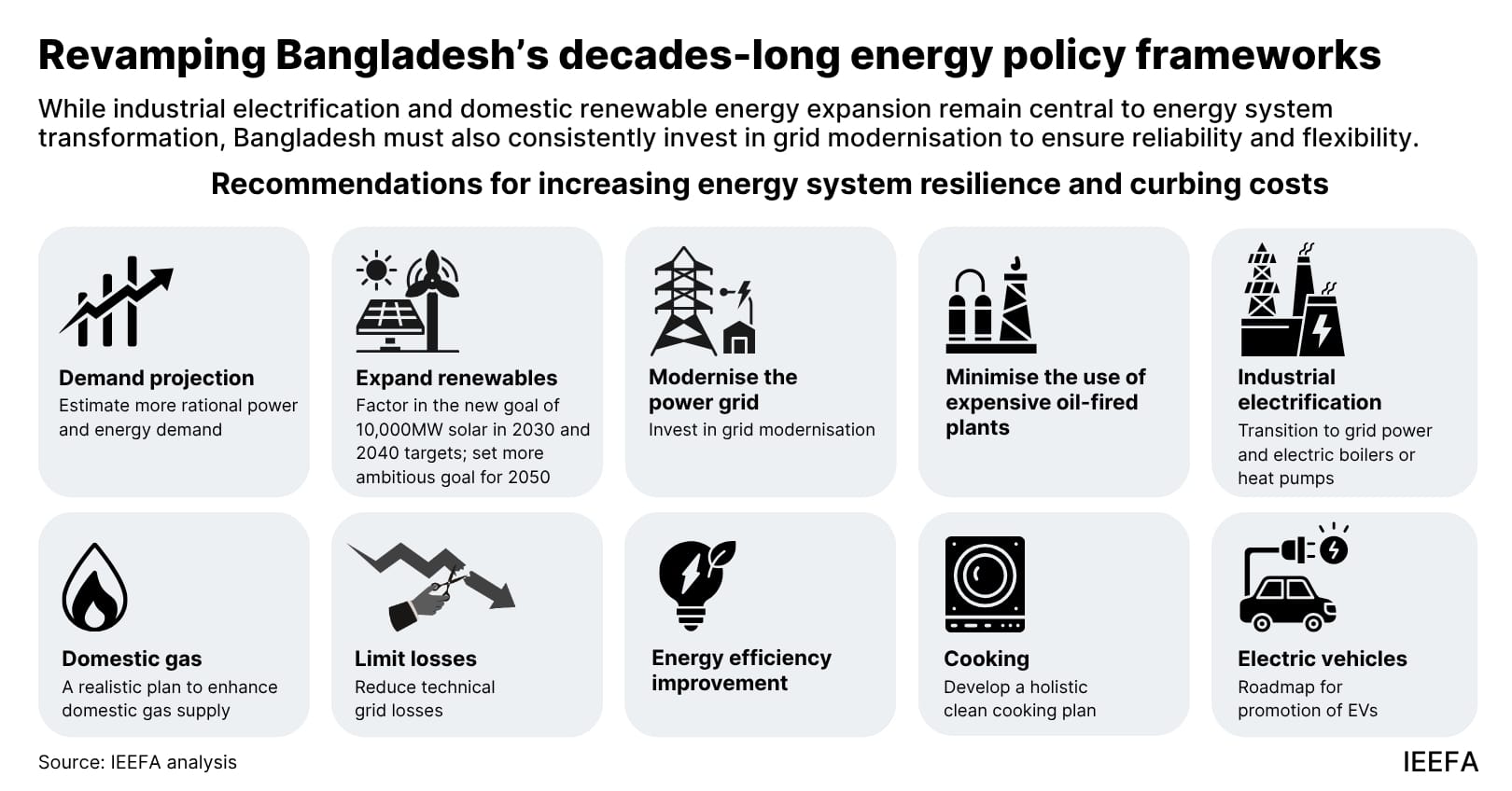
To address these challenges, IEEFA calls for a rapid expansion of renewable energy, improvements in energy efficiency and increased domestic gas supply. It also emphasises the importance of regional electricity trade under the BBIN initiative, linking Bangladesh with Bhutan, India and Nepal.
According to the analysis, importing up to 6,000MW of hydropower from Bhutan and Nepal during peak demand months could reduce Bangladesh’s annual gas consumption by as much as 257 billion cubic feet after 2030.
The report further recommends policy reforms, including reducing import duties on decentralised renewable energy systems. It notes that installing 100MW of rooftop solar capacity could generate savings up to 30 times greater than the one-off import duties currently imposed, primarily by cutting furnace oil imports over time.
Facilitating corporate renewable energy procurement through open access and competitive pricing is also seen as key, particularly for export-oriented industries seeking to meet environmental, social and governance (ESG) targets.
Financial pressures in the sector are mounting. The Bangladesh Power Development Board recorded a revenue shortfall of Tk55,660 crore (approximately $4.53 billion) in the 2024–25 financial year.
The report concludes that Bangladesh’s energy transition will depend on pragmatic policy decisions, including curbing overcapacity in fossil fuel-based generation and creating a more enabling environment for renewable investment to reduce long-term costs and subsidy burdens.