


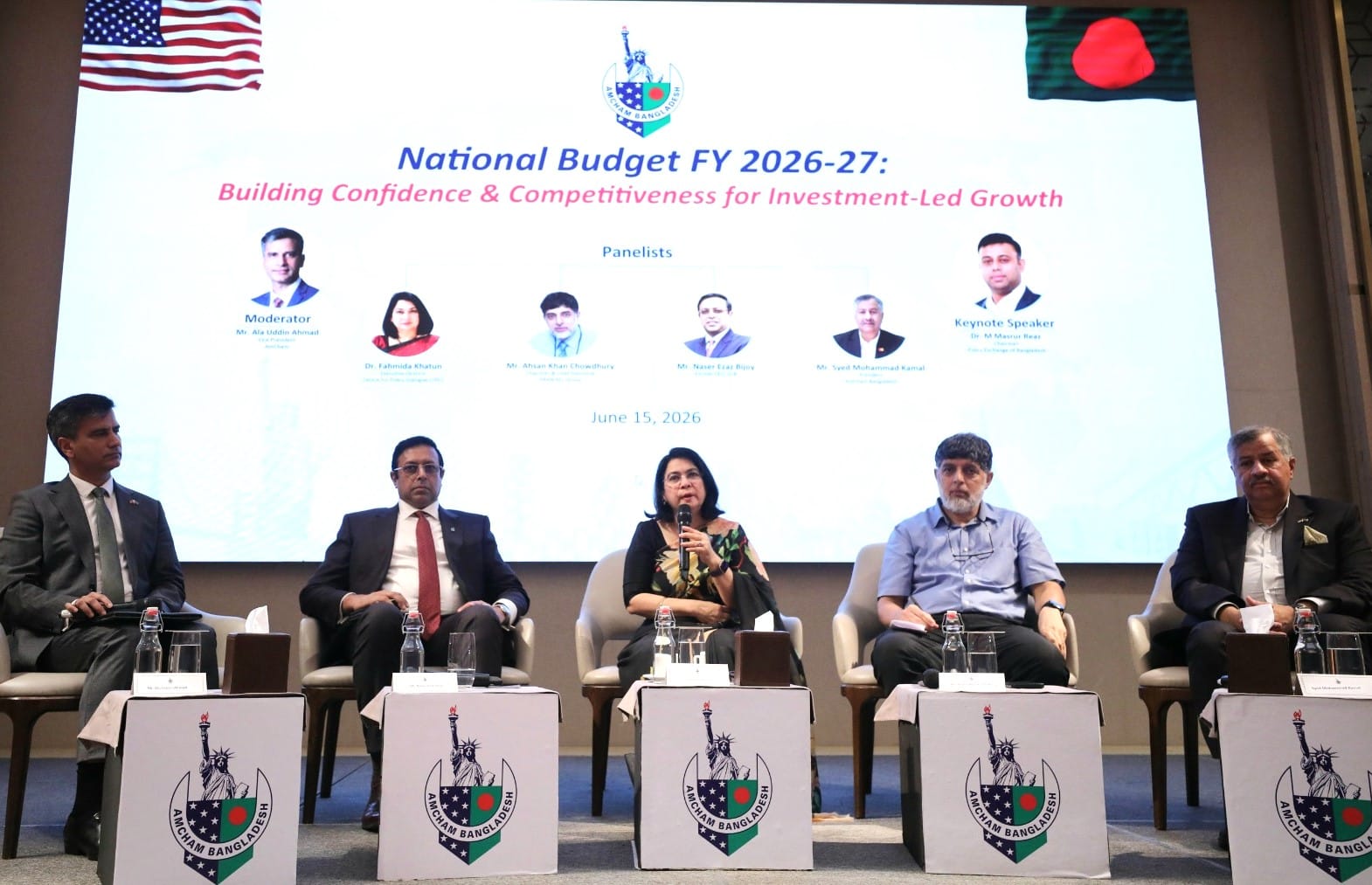
Business leaders and economists on Monday cautioned that the government may resort to aggressive tax and duty collection to meet an “overly ambitious” revenue target in the proposed FY2026–27 budget, amid the absence of a clear mobilisation strategy.
At a post-budget dialogue organised by the American Chamber of Commerce in Bangladesh (AmCham), speakers said the projected Tk 6 trillion revenue target lacks credible underpinning, raising concerns about its implementation and potential pressure on businesses.
The event, held at a hotel in Banani, was chaired by AmCham President Syed Mohammad Kamal and attended by chamber members, corporate leaders and policy analysts.
Presenting the keynote, Policy Exchange Bangladesh Chairman M Masrur Reaz termed the revenue goal “unrealistic” and warned of possible ad hoc measures to bridge the gap. “Without a clear roadmap, there is a risk of arbitrary steps in tax and duty collection,” he said.
He also pointed to structural rigidities in public spending, noting that about 41 percent of the budget would be absorbed by salaries, allowances, pensions, subsidies and interest payments. A sizeable share of development allocations remains in lump-sum form, which, he said, often lacks transparency and weakens accountability.
Centre for Policy Dialogue (CPD) Executive Director Fahmida Khatun described the budget as expansionary, reflecting the new government’s policy commitments, but flagged financing as a key challenge. “The size is not the issue — the question is how it will be financed sustainably,” she said.
Pran-RFL Group Chairman Ahsan Khan Chowdhury said the budget fell short of expectations in improving the ease of doing business. He stressed the need for stronger investment in skills development and noted that agriculture did not see a meaningful rise in allocation. However, he added that the current government has shown greater openness to private sector concerns than its predecessors.
Naser Ezaz Bijoy, former chief executive of Standard Chartered Bangladesh, warned that increased reliance on bank borrowing could crowd out private sector credit at a time when many banks are already under stress. “Liquidity constraints persist, and the budget does not clearly spell out how revenue will be realised,” he said.
The session was moderated by AmCham Vice-President and MetLife Bangladesh CEO Ala Uddin Ahmed.
In his closing remarks, AmCham Treasurer and Philip Morris International Bangladesh Managing Director Reza Ur Rahman Mahmud said eight of the chamber’s 18 budget proposals had been reflected in the draft budget.
The discussion highlighted mounting concerns over revenue realism, fiscal transparency and the overall feasibility of the proposed budget as the government prepares for its implementation.