


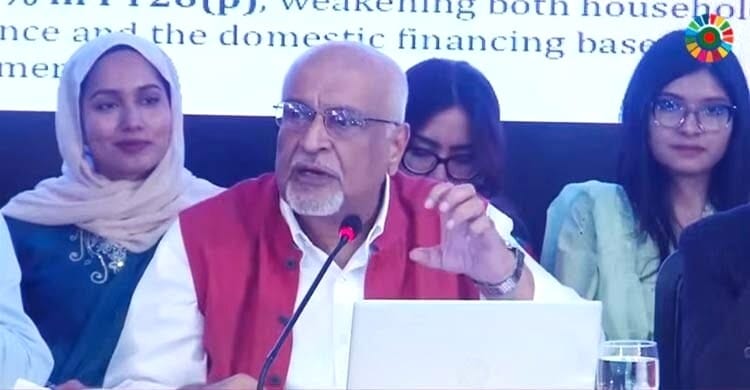
Economist Dr Debapriya Bhattacharya on Monday described the proposed FY2026–27 national budget as “thoughtful” in its policy intent but warned that it rests on a weak and, in some cases, “unprofessional” fiscal and macroeconomic foundation.
Speaking at a media briefing titled “National Budget 2026–27: What is in it for the Disadvantaged?”, the distinguished fellow of the Centre for Policy Dialogue (CPD) said the budget’s underlying framework raises serious concerns about credibility and implementation.
“The policy framework around the budget is, to some extent, thoughtful. But the problem begins with its foundation,” he said. “It has been built on a fragile—possibly ineffective—financial structure.”
The briefing was organised by the Citizen’s Platform for SDGs, Bangladesh, and moderated by CPD Distinguished Fellow Mustafizur Rahman.
Bhattacharya criticised the medium-term macroeconomic framework as weak, arguing that it undermines both fiscal stability and the logic of the growth model embedded in the budget. He also alleged gaps, inconsistencies and even “data manipulation” in the preparation of budget estimates.
“If data are presented with distortions, it is deeply concerning,” he said, adding that past governments had been criticised for overstating growth, understating inflation and failing to properly assess the impact of development projects. “It would be unfortunate if the current government follows the same path.”
He identified budget implementation as the single biggest challenge, stressing that responsibility does not end with its announcement. “Sustained public pressure and oversight are essential to ensure effective implementation,” he noted.
The economist pointed out that most projections in the proposed budget were not updated with data up to June 30, but instead relied on estimates prepared as early as September–October last year.
He urged the government to revise all targets and projections with latest data by July 30 to maintain fiscal discipline and provide accurate signals to the market.
Failure to update projections could lead to policy missteps and confusion within the government itself, he warned.
Bhattacharya also called for reinstating a provision under the 2009 law requiring the finance minister to present quarterly statements in parliament on economic conditions and budget implementation. He expressed hope that the first such statement would be delivered by September 30.
Raising questions about revenue targets, he said successive budgets tend to set “artificial” goals, placing undue pressure on the National Board of Revenue (NBR). “This year is no exception,” he added, cautioning that without institutional capacity, tax administration reforms and good governance, such targets are unrealistic.
He warned that in the event of a revenue shortfall, the government would have limited options. “It is not feasible to cut public sector salaries or external debt repayments. Ultimately, subsidy reductions may be the default choice, which would adversely affect ordinary people,” he said.
Emphasising subsidy reform, Bhattacharya argued that support should be better targeted. “Those who can afford to pay should not receive subsidies. Resources must be directed towards the poor,” he said.
He also criticised the government’s three-year economic plan centred on “recovery, restoration and reconstruction,” calling its first-year targets overly ambitious and potentially burdensome.
Without structural reforms and effective inflation control ahead of elections, the government risks undermining its own achievements, he cautioned.
Highlighting the plight of low- and middle-income groups, Bhattacharya said people are currently under “triple pressure” from inflation, stagnant wages and eroding savings. Many households are being forced to dip into savings to meet essential expenses.
While acknowledging increased allocations for social protection, education and health as positive steps, he expressed concern over large lump-sum allocations, warning that these could weaken fiscal discipline.
He also referred to the government’s plan to borrow around $9.5 billion from development partners including the IMF, World Bank and Asian Development Bank to finance the budget deficit. He stressed that any associated conditions must not undermine the interests of marginalised groups.
“External financing must serve the people, not work against them,” he said.
The briefing underscored deep concerns among policy analysts over data integrity, fiscal realism and the overall credibility of the proposed budget framework.