


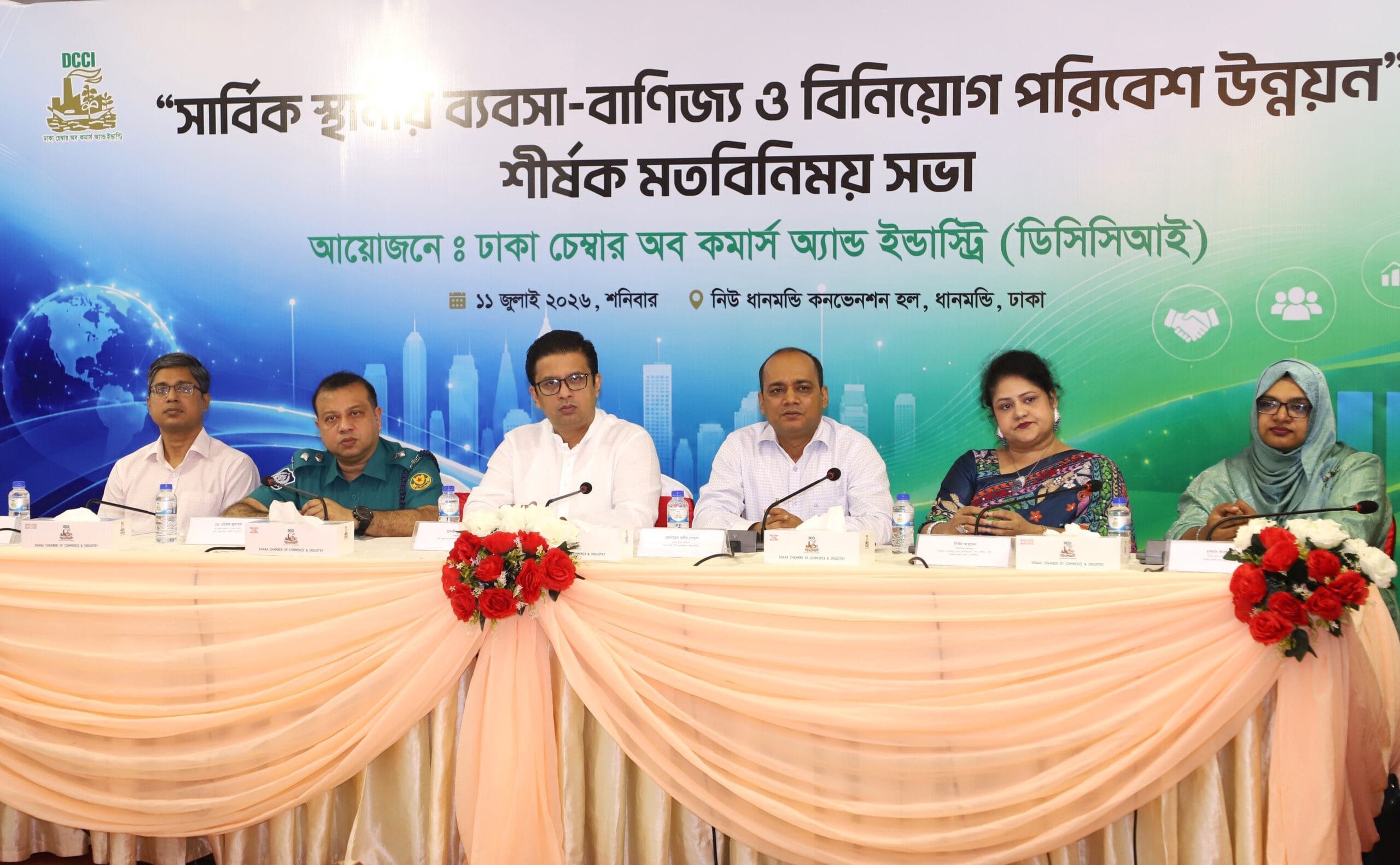
Business leaders on Saturday called for reducing the cost of doing business, simplifying regulatory procedures, improving access to finance and ensuring better law and order to sustain trade and investment amid global uncertainty and domestic economic challenges.
The demands came at an exchange of views on “Improving the Overall Local Business, Trade and Investment Environment”, organised by the Dhaka Chamber of Commerce and Industry (DCCI) at the New Dhanmondi Convention Hall.
Entrepreneurs from the Dhanmondi-Mohammadpur area said rising business costs, administrative complexities, difficulties in opening letters of credit (LCs), limited access to finance and energy shortages have made business operations increasingly challenging. They urged the authorities to automate trade licence and other government services to improve the ease of doing business.
In his welcome address, DCCI President Taskeen Ahmed said the business community continues to contribute significantly to the economy despite facing regulatory complexities, ambiguities in tax and VAT rules and law and order concerns.
He said electricity and energy shortages have increased transportation costs, while the mandatory closure of shopping malls and retail outlets by 7:00 pm has sharply reduced sales and business turnover.
Taskeen welcomed several measures in the national budget, including treating tax deducted at source as advance tax, reducing source tax on industrial raw material imports, allocating Tk 5,000 crore for the CMSME sector and introducing a stable five-year tax framework.
However, he expressed concern that the government’s ambitious revenue collection target and increased dependence on bank borrowing could crowd out private sector credit and discourage fresh investment.
Chief Revenue Officer of Dhaka South City Corporation Jonayed Kabir Sohag said the city corporation has adopted a zero-tolerance policy against harassment in trade licence issuance and other civic services. He said DSCC plans to organise a Trade Licence Renewal Week at DCCI to facilitate easier licence renewal for businesses.
Deputy Commissioner (Crime) of Dhaka Metropolitan Police Md. Tareq Zubair said police are maintaining zero tolerance against extortionists and continuing enforcement drives. He added that following the successful use of AI-based traffic management on several roads, police are considering expanding the technology across Dhaka under a proposed “Smart Policing, Smart City” initiative.
Additional Commissioner of Customs, Excise and VAT Commissionerate, Dhaka (West), Nirjhar Ahmed said global supply chain disruptions and capacity constraints have slowed business and investment activities. She said the new provision allowing VAT returns to be submitted every three months would improve businesses’ working capital and ease operations, while greater adoption of advanced technology would strengthen competitiveness.
NBR Second Secretary (Tax Policy) Nusrat Farzana said the government is working to balance revenue collection with tax incentives to improve the business climate. She said the Finance Act 2026 includes several measures to simplify business operations and noted that tax exemptions for the renewable power generation sector have been extended until 2035.
Mahmudun Nabi, Director of the Foreign Exchange Investment Department at Bangladesh Bank, said shortages of US dollars and foreign exchange reserves have delayed the opening and settlement of LCs, while high non-performing loans have kept lending rates elevated, increasing business costs. He also suggested joint public-private initiatives with international shipping companies to reduce import logistics expenses.
During the discussion, entrepreneurs called for easier import of machinery for the optical industry, lower taxes on signing money in the real estate sector, policy support for freelance promoters and digital marketing, faster container clearance, simplified LC procedures for new entrepreneurs, incentives for women entrepreneurs, streamlined trade licence issuance and extension of trade licence validity from one year to five years.
The programme concluded with DCCI awarding membership certificates to representatives of 39 newly enrolled business establishments. Around 100 business representatives attended the event alongside DCCI Senior Vice-President Razeev H Chowdhury, Vice-President Md. Salem Sulaiman and members of the chamber’s board of directors.